
The 2nd Furrow - Andrew Riddell Jr. (1808 - 1884) The Man in the Arena South Easthope
If John J.E. Linton was the observer, Andrew Riddell Jr. was the man in the arena. When Linton arrived at the Riddell farm in the late summer of 1842, he didn't find a gentleman farmer; he found a man whose hands were stained by the soil of the Huron Tract and whose story was measured in years of manual labor and calluses.
The date was September 19th, 1842, when John Linton made his way into the newly established South Easthope. The goal was to collect the statements of local settlers and Andrew Riddell Jr, age 34, was his first stop.
Riddell's testimony to Mr. Linton serves as a blueprint for the typical settler experience, though there was nothing typical about the hardships involved. Entering the bush of Huron Tract in the late 1830s, Riddell was part of the early wave of Scotch settlers who brought a specific brand of stubborn resilience to Perth County, a stubbornness that was so desperately needed.
His interview began with his background, creating a personal connection between the reader and the pioneer that John Linton mastered so well. As the words were transcribed, the air would have been thick with the smell of cut wheat. Andrew slowly starts to recount his tale as they find a shady spot to take reprieve from the sun.
Wiping the sweat from his brow, he looks off into the distance as if he sees the place he speaks of. “I came from Berwickshire, in Scotland, from near the town of Lauder. I settled in this township in the summer of 1832, when this and the adjoining township began to be settled”, referring to North and South Easthope townships.
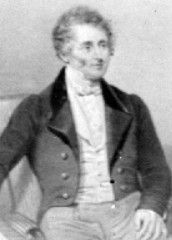
These two townships, named after Sir John Easthope, owner of the British newspaper The Chronicle and a director of the Canada Company. were settled by and still is made up of two prominent groups of settlers: the Highland Scots and the Hessen Darmstadt Deutsch.
1835 was a year of hive-like activity within the county as new settlers moved in and claimed their dreams. It was this year, that a well known , Reverend Proudfoot of the London District, travelled through the new settlement, newly named North Easthope and recorded what he was witness to: “Fifty Scotch families, most of them Highlanders”; he writes then goes on to describes the Dutch settlers around Helmer’s Tavern, on the east border of North and South Easthope as operating “noble farms” and as holding “no man a preacher who is not inspired by the Holy Spirit and if he get his preaching talent so easily he needs no pay.” When referring to the “Dutch”, Proudfoot means the Pennsylvania Germans of Wilmot Township, Mennonites, some of whom were settling in the area.
This statement, however minor, not only makes a note, but also reminds us that the Canada Company was not limiting their advertising of local land for sale in Scotland, but also in Germany. Ensuring a prompt development. During the year 1842, the Canada Company’s agent in Stratford would issue 60 claim tickets for North Easthope land, most of them to settlers with names such as:- Eidt, Erb, Faulhafer, Henkell, Herman, Hoffmeyer, Wettlaufer, Nafziger, Neeb, Paff, and more. Many of these names still present today as we drive past the modern farms now, far removed from the humble beginnings. The roots of the past remain, but now, most are within the gates of the cemetery, where the Scottish and Germany heritage is reflected in the names, images and words on the headstones.

The village of Shakespeare commemorates the Highland settlers of North Easthope. Families like the Stewarts, McTavishs, Crerars, Scotts, Frasers, and Fishers among others, with a cairn along the highway they were responsible for clearing. This cairn is located by another history site the Fryfogel Inn, another integral part in the foundation of this community.
Andrew continues, reflecting of the early days “There were but few indeed had emigrated to this quarter previous to this year, and if I recollect well, the main road to Goderich between these townships was only begun to be cut out, two years before this.” This road would become Highway 7/8 from Stratford to New Hamburg and then onto Kitchener.
“At any rate,” he continued, “it was not altogether finished in 1832, for I was employed that year on it. A sleigh or bush road had been tracked out, but the main road I refer to is sixty-six feet wide, the trees on which breadth were all cut down, and burned or hauled off the road, and crossways made with logs, where there were wet spots. This road is the length from the east end of the Huron Tract to Goderich about fifty-eight miles.”
Immensely proud of his accomplishments and all that the settlers had achieved, Andrew refrained from beaming, but you could tell from the deepening of his tone that it had moved him. Linton scribbled feverishly as to not miss a word. They had made so many improvements and in such a short time, a true testament to the will, strength and determination of the settling families.

Yes, some were families, as many as 3 to maybe 8 or more adults, working together, but others were forging their way alone, Andrew recalls “I had no family then, except my wife, I have now six children, and some years we lived in what is called a shanty, being a small house built of logs, and notched down at the corners, and having a shed-roof, or a roof sloping one way only. I settled on Lots 16 and 17, in the 1st Concession of this township, fronting the road above mentioned, containing 100 acres each, and having a good creek (or “burn,” as we call it in Scotland) running through part of the lots.”

Mr. Riddell’s property is a beautiful section along the side of Highway 7/8, just outside of Shakespeare. To this day, the property still has a stream flowing freely, and possibly some of the original trees that ones stood 180 years ago.
Although, the inflation has run rampant, and money is sometimes and tough conversation, Andrew openly discloses “The price of this land was 1 1/2 dollar, per acre. I began to chop and clear the ground for spring crops. My means were but scant, for the money I had being 60 dollars, I paid on the lots to the Canada Company; and what we required for provisions, until I had my own crops, I obtained by my labour.” Quickly proving his ability, Andrew did not take long to become self sustaining, however, the Canada Company still required payments and cash was king. Fortunately, many needed developments required labour and there were only so many here and able, Andrew being one of the eager.
“When the above main road was turnpiked in 1835, I wrought on it and saved money, as did many others of my neighbours. There is, therefore, now since that year a good road all the way to Goderich.” Unknown to Andrew, the 1850s would bring the railway directly though the center of his property, continuing the chain of forward progress, keeping Andrew on the forefront of advancement and change.
The interview continues and Linton urges Andrew to report on the health of his crops and the state of his livestock, but he also speaks to the economic reality of the time. “I have now about forty-five acres of cleared land, which produces good crops, and I am clearing for acres more this year.” The words casually fall from his lips, but this is no easy task. In the days before power tools, tractors, engines, the work was done by hand. Every century old tree chopped down, with an axe, every trunk then logged, with a hand saw, carried, by the yoke and oxen, stacked or assembled, by the pioneers, all by hand, all by Andrew and each settler on this land.

This progress was exactly what the Canada Company was expecting, and what they needed to prove that this new world was everything you dreamed. Andrew was the proof, and his statement was every settlers dream. He continued, “I have built a log-house, the logs of which are all hewed or “flatted”, and the roof is covered with shingles. I built also a long-barn, but this year I have got raised, and expect to have completed before winter, a large frame barn, 62 by 40 feet. It is now so far finished that my crops, as far as yet saved, are in it. It is an advantage to have a long barn, and, if possible, a frame one, to hold all the crops. They are generally constructed to include in the building a place for horses and cattle, and if raised on a slope, (as mine is,) and where part of the ground can be excavated, so much the better, as the divisions for cattle, can be all under where the grain is, and also under the thrashing floor.”
By 1842, Riddell’s farm was a testament to improvement, a technical term the Canada Company used to describe turning wild forest into productive land. This year marked a turning point for the Riddell family. They were moving past the subsistence phase, where they harvested just enough to keep their family from starving. Entering the surplus phase, where profitability became possible. This was the dream the Canada Company sold, but Riddell’s words remind us that this transition was paid for in sweat.
Linton flips to a fresh page, dips in the ink and continues to record, “This barn when finished I can safely value at 500 dollars, but to me, and to others who are farmers, who perform part of the work, it will not cost this in cash, as the excavations, and many things connected with the building, I have done myself, but the value above stated is correct.” Andrew looks to his callused hands and sees the other ways he has paid for this land, the long hours of back breaking work, nights of prayers, to wake up and do it again, day after day.
Almost self correcting he pulls himself back from the seriousness of the labour and lightens his expression to the reveal the rewards of his efforts, “My crops this year consist of fall and spring wheat, oats, peas, barley, potatoes and turnips. My crops are good, and the field of oats I am now saving is a fair sample. At a moderate estimate the value of my crops may be 240 dollars, and in this I have not included the hay grown on eighteen acres. My land I would not sell for less thank 2500 dollars and it is worth it, for the situation is good, and it is well watered.”
Clearly impressed with the lots that he selected and acquired, Andrew discloses the balances paid to the Canada Company and then lists his livestock amassed, but then subtly discloses that he has had to sell cows or equipment to keep afloat from time to time. “I have paid to account of the price of the land to the Canada Company, since the first payment, about 160 dollars, which makes 220 in all. My stock of cattle at present consists exactly of the following: 5 milch cows (milk), 1 yoke working oxen, 1 odd ox, 1 yoke of three-year old steers, 1 bull, 2 heifers (rising three years,) 2 ditto (rising two years,) 15 sheep, 1 year old steer, and 4 calves of this year, besides hogs. I have occasionally sold off some cattle. I have a wagon, fanning-mill, and other articles required to carry on operations of a farm.”

And carry on farm operations he did, even if by any means necessary. The above image is cut from the public Tax Canada, Ontario, Tax Assessment Rolls, 1847-1847, showing Andrew and his 200 acres, still being maintained in 1847, with 120 uncultivated acres with an impressive 80 cleared and being farmed. Continuing with improvements, at least 5 years after Mr. Linton's visit, most likely until he was called home.
Riddell had clearly become fond of this land and the country he now called home and he had no reason to hide it, “I have been asked, would I advise Emigrants to come to this country, or to this tract, and my reply is, most certainly I would. It may be said or thought that my success is not to be generally seen in others. I reply, “visit my neighbours,” and the extent of their clearances, and stocks of cattle, will plainly show that my case is a very common one.”
He continued, to encourage more to take the chance, come to Canada and experience it for yourself, but not without realizing most can not, no matter how dire the situation, “In many cases Emigrants with families, defer leaving the place of their birth, where, it may be true, many and tender associations endear it, but where there is no prospect of providing safely, and to some extent, for their families; this country is before them.”
Through words like these and his encouragement, starting with his father, Andrew began to promote his land, relaying the realities of hard work vs. reward, “I have advised my father, Andrew Sr., (who lived a year or two before he left, near Melrose and Galashiels) to come here, and he came with his family; and when he arrived at my then humble abode he had not, I know, (and which he often says to others,) “a shilling;” but his success is far beyond mine.”
Andrew then convinced another, “My father-in-law, Robert Patterson, (also from near Lauder,) came, acting on my advice, and his success is beyond either my father’s or mine. Many others followed. In advising many to emigrate, I allude to the industrious, sober, and preserving." (signed) Andrew Riddell Jun.
Andrew Jr. wasn't alone. His father, Andrew Riddell Sr., was also part of these statements taken by Linton. In the world of the 1840s, a son wasn't just an heir; he was essential labour. The presence of both Andrews in Linton’s notes highlights the intergenerational struggle of the Huron Tract and the importance of family. They were building a clearance that they hoped would last for a century, unaware that their names would still be spoken 180 years later. We will cover Andrew Riddell Sr. in a later tale.
Linton used the Riddell testimony to prove success was possible, but it wasn't immediate. Riddell’s account detailed, the many backbreaking efforts needed to reach improvement. Andrew rose to his feet and bid Mr. Linton a good day, with and deep breath of determination returned to his field, the wheat was not going to harvest itself.
John collected his things, shook Riddell’s hand, then made his way back to the road, where his horse and carriage stood. Satisfied with the first interview and a little more confident in the task that lay before him. If each pioneer were half as successful as Andrew, the Canada Company would surely be impressed.

When I next found Andrew was on the census of 1881. At that time, Andrew remained on the farm, 73 years of age along side him, Isabella at the age of 70. Both shown on the image provided. It also appears that their daughter Margaret (43) and grandson John (27) reside within the household. Living a full and prosperous life, achieving the dream they envisioned as they embarked for the new land.
Andrew Riddell, Jr. may not have changed the world for everyone, but he certainly changed the lives of his family, including his father and father-in-law. Andrew Jr. is buried at St. Andrew’s Cemetery North Easthope. There along side his wife Isabella Patterson (1812 – 1884) in the shadow of the church they attended. The ground he worked so hard to clear, he is now one with, interred in the consecrated Perth County earth not far from his parents and sister Janet.
It is here we lift the plow on another furrow and look to the next unturned row. Next week we will return to the fields of Perth county and see what we can unearth with The 3rd Furrow - Timothy Wallace’s Scythe and the Soil of North Easthope. I hope you will join me.
Angie Moore
Eternal Care Stone Services

Comments