
Buried in the Furrows: The 9th Furrow – John Stewart (1782-1869) The Momentum of the Settler

The morning was still young when John J.E. Linton turned his horse onto the narrow track leading eastward, the wheels of his carriage dipping gently through ruts carved not by years, but by weeks. The forest pressed close on both sides, tall and restless in the breeze, as though whispering of the stories still hidden beneath the pine canopy. John L. had spent the better part of the week walking fields, leaning on rails, and listening to the breath of pioneers who carved their lives from the Huron Tract, but something in this journey felt different. Eight Glen Quaich families had come together, the history books would one day say, but today he was seeking one man who had left the Glen with the kind of resolve that moved whole communities.
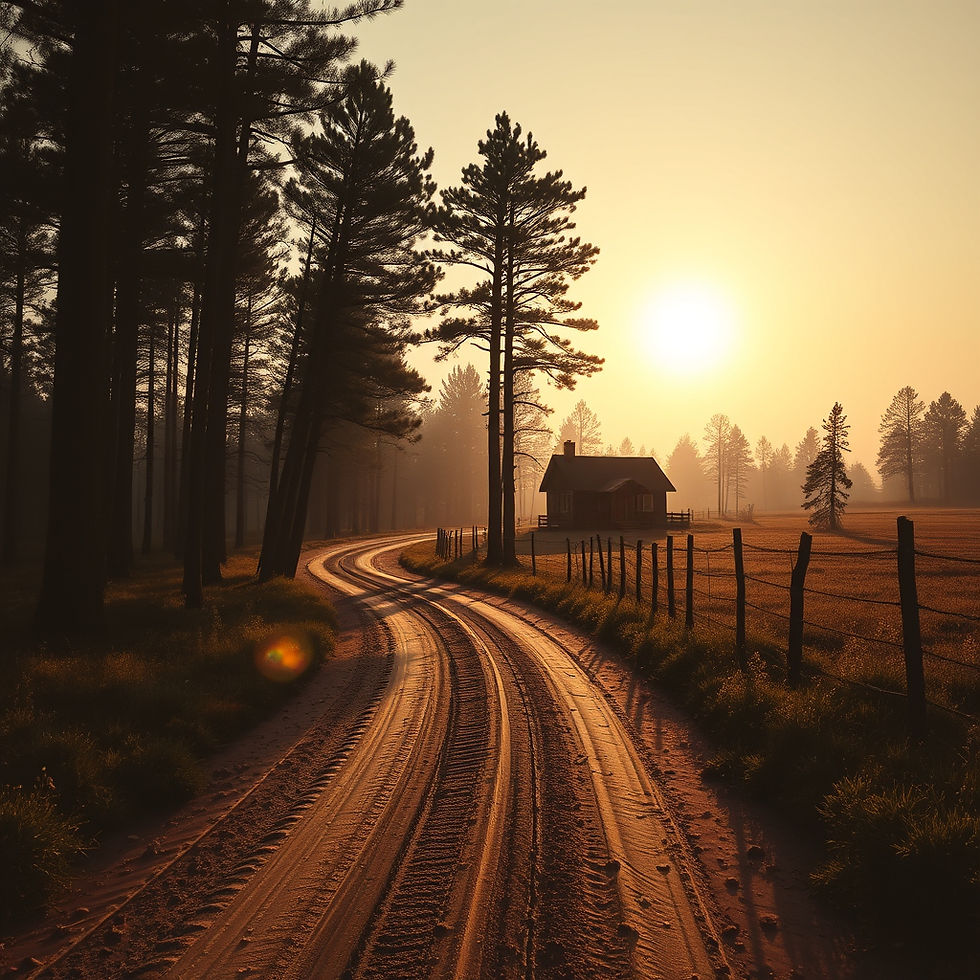
Ahead, sunlight spilled across a clearing, laying a soft gold across a broad sweep of farmland. A tall, two‑story log house stood at its center, smoke curling lazily from its brick chimney. A dog barked once, not in warning but announcing, and soon a man emerged from behind the barn, brushing straw from his sleeves. His steps were purposeful but unhurried, the gait of someone who had walked this land long enough to trust it, and long enough to know it would not yield without effort.
John Stewart raised a hand in greeting as John Linton approached. They shook hands at the edge of the clearing, and John S. nodded toward a pair of stumps arranged beneath the shelter of a giant beech. With an inviting gesture they made their way towards the stumps, where they took a seat.

With the beech leaves shivering overhead, a breeze carried the scent of hay, the faint sweetness of ripening grain, and something else; something unmistakably Highland. Something that only those who had grown up in Glen Quaich could recognize in each other. John S. settled opposite him, and without preamble, without fanfare, his story opened like a gate swinging slowly on worn hinges. Linton began to write…
“He came from Turrerich, in Glen Quaich, in 1832, having left the Glen that year about the middle of June, and arrived at North Easthope on the 1st of September; eight families from the same place emigrated and travelled together and settled in the township and in the adjoining one, South Easthope.”
John imagined them as John S. spoke; eight families striding away from hearth and hill, their footsteps stitched together like tartan threads, forever woven, not scattered. They had carried more than belongings; they had carried each other.
John’s voice softened as his memories moved forward, falling from his lips. “This settlement was only then beginning, for in the distance of twelve miles and a half between Stratford, (called the Little Thames,) and the most easternmost part of the tract bordering on Wilmont, there were only three houses or ‘shanties’ occupied by Mr. Helmore, Mr. Fryfogel and Mr. Sargint; one other settler, Mr. D. Bell, had just arrived, but had no houses up. These settlers were on the road side, for it was 1833 and 1834 when settlers moved to lots on the land off the main road.”

John S. referred to Mr. Fryfogel, owner of what would be known as the Fryfogel Inn. Long before the Huron Tract was threaded with concession roads and framed barns, before the steady hum of settlers’ axes rose from every clearing, there stood a single beacon at the edge of the wilderness: Fryfogel’s Inn. To weary emigrants stumbling northward from the Little Thames, the inn was more than a stopping place; it was the first warm glow of civilization after days spent threading dense bush and corduroy tracks.
Mr. Fryfogel himself, with a temperament as sturdy as the timbers he built with, offered not only lodging and a hot meal, but direction, news, and the reassuring sense that the hardships of the road were shared by many. In a land still learning to call itself home, his inn became a quiet cornerstone of the Huron Tract’s growth; a gathering place where newcomers compared notes on soil and settlement, where friendships sparked over the clatter of tin cups, and where caravans paused just long enough to breathe before pushing deeper into the unbroken forest. It was, in every sense, the first doorway into Perth County’s future.
As John S. spoke, John glanced toward the faint trail behind him. It was hard to picture a place so empty, so raw, where shanties stood like lone sentinels along the road. Yet here they were now; barns rising, fences stretching toward the horizon, families rooted where once only forest reigned.
John’s hands folded loosely, as though cradling the past, happy to have let it go, but reminiscent of how it served him. “The farm which he leased in Glen Quaich was a small one, a few acres, with the privilege of a pasture on an adjoining hill. His neighbours were similarly placed, possessing only what maybe called ‘small holdings’ from five or fifteen acres each.”
“His family then were six in number, but not of age to assist in chopping and clearing but very little. There are three of them now well able to help, and they perform most of the work.”
A faint smile crossed John’s face at that last line. The pride was undeniable, but it shone quietly; as a pioneers’ pride always did. Children, once too small to swing an axe, now stood beside him as partners in the great work of shaping a homestead. Their sweat mingled with his in the earth beneath their feet.
John and his wife Catherine Crerar, married in Scotland prior to arriving in Upper Canada. On their journey they had four small children in tow. Katherine, James, Peter and John Jr.. Once established on their lot they added to their energetic brood, welcoming Margaret, Elizabeth, Alexander and Duncan. Eight children in total, a very healthy and industrious group, all that a pioneer could wish for.

Then John S. leaned back slightly and continued. “He applied to the Canada company for three lots of land 100 acres each, situated on the road side, and the following year he also applied for three lots and in the rear, in all 600 acres of land. He commenced at once to chop and clear the land and built a small house. There were so few settlers at the time that the house though small took no little trouble to put up, but the same difficulty was not experienced next year, as a settlement increased rapidly. When he came, he paid and got a deed for one of the lots, and paid part on the other two, an installment; since that time, he has paid money on the five lots.”

John wrote quickly, but he couldn’t help pausing at the image; Stewart alone in the forest, gathering timbers, lifting walls, building not merely a house but a foothold. Alone, yet not alone, knowing others from the Glen walked the same hard road, and that his family depended on him.
John S. continued, voice level and steady, the way men speak when their stories have become part of the soil. “When the spring came, or rather towards the commencement of summer, his money was exhausted, but the provisions bought were sufficient to the crops were ready. From the crops of oats and potatoes this season he made some money, and particularly as they were scarce, and a brisk demand increased emigration and traffic by the main road. The land since that time has yielded sufficient, not only for support but for sale. His family have been industrious, and he has managed to be an economical in everything.”
The Stewart homestead stretched quietly before them as proof of the words. Acre by acre, season by season, the land had answered their effort. A dog trotted past, then a young boy with an armful of kindling. John S. nodded approvingly, then returned to his account.
“He has now a good stock of cattle; they have a first winter they had the first winter, one cow, which gave milk till spring, when he bought another, and at the same time a yoke of working oxen. He has now one span of horses, one colt two years old, and another, one year old, two yoke of working oxen, one yoke of five-year old steers, two yoke of two-year olds, three steers, seven cows, six calves, forty-six sheep, five year old heifers. He sold two cows the other day, and during these some years past sold a good many cattle.”
John followed his gaze to the pasture. A line of cattle grazed contentedly beneath the sun. It was one thing to list animals on a page; another to see the living herd scattered along the fields, each one earned through years of clearing, planting, harvesting, and saving.

John S. went on. “He has about 102 acres of cleared land. He had this year forty acres of hay, twenty in pasture, seventeen acres in wheat, fourteen acres in crops of oats, barley and ten acres in fallow. He has nearly 10 acres of new land cleared this season for wheat. His homemade clothing or cloth last year was 106 yards being woollen, cotton, and wool, and flax, and expects this year to have a hundred yards. He has a wagon and a cart horse sleigh and harness, fanning mill and other farming implements. His barn is a log one at 74x26, stable 40x23, and other small buildings. His house is a two-story log building with a brick chimney.”
Here, emotion crept into John’s voice, not pride, exactly, but a kind of contentment. The house, the barn, the fields; they were not just improvements. They were proof that the wilderness had answered back. That the family’s labour had been met with abundance.
He drew a slow breath before continuing. “He states that his neighbors have succeeded well. Many have emigrated this season from Glen Quaich, and experts that next year nearly all of his old friends in the Glen will be in Canada, and in this tract. A brother-in-law who has been settled for some years in the township of Beckwith, has taken up 900 acres of land in the adjoining township of South Easthope, to which he intends removing in the winter or spring.”
John’s eyes softened at the mention of the friends he expected soon. For all the hardship, for all the miles from the Highlands, there was comfort in knowing that Glen Quaich was slowly re‑gathering on Canadian soil.
Finally, he concluded; “He would not accept a $4,000 of his land, buildings, and improvements. (not including cattle or crops,) and justly believes that he forms no exaggeration on the value of his property.” The last words hung between them, not boastful but firm, rooted, like everything else John Stewart had built.
As the sun rose high in the sky, as Johns wife called to him for lunch, Linton closed his notebook with quiet reverence. He rose, thanked John S. for his time, and felt the weight of the moment settle into him. These were not merely statistics for shareholders, these were the foundations of a township, a county, a nation. Although he had been invited to stay, Linton knew he had to move on, there were still more statements to record and time was passing quickly.
John S. walked him back to the road. Behind them, the house stood tall, the fields wide and golden, the voices of children rising softly through the evening air. Momentum, that was the word that stayed with John as he led his horse away. John Stewart had carried it across an ocean, through the wilderness, and into a future not yet written. The land, now shaped by his hands, seemed to carry it forward still, momentum.

John Stewart and his wife Catherine Crerar (1794-1877) are buried in St. Andrews Cemetery, just outside of Shakespeare. The remained on their farm until into their 80s, where they raised many children and were loved by many grandchildren. Today, they lay next to their
friends, neighbours and family that made the journey, worked the land and laid roots that grew our family trees. Resting peacefully, but never forgotten.
The stories will continue next Wednesday, I look forward to sharing the next pioneer and reviving their tales.


Comments