
The 7th Furrow – John Crerar (1786 - 1862) The Man and the Mystery
Some men arrive in the historical record like a steady footstep on a dirt road; clear, predictable, easy to follow. Others appear like a shadow at the edge of the field, their outlines shifting depending on who is telling the story. John Crerar is one of those shadows. His life in North Easthope is well documented, thanks to the careful hand of John J.E. Linton, but the life he left behind in Scotland carries a whisper of mystery, the kind that drifts across generations and settles into family lore.
Linton found him in 1842, a man of fifty‑five, weathered by years of chopping, clearing, and coaxing a farm out of the wilderness. But before the forest, before the oxen and the acres of wheat, there was Glen Quaich; a narrow, rugged valley in Perthshire, Scotland, where John began his life.

“He emigrated from Glen Quaich, in Perthshire, Scotland, in 1833, leaving the Glen in June, and arriving in North Easthope in the month of August following. He was a farmer, on a lease, of a small farm of eight acres, with the right of pasture on the hill for cattle. The ‘holdings’ of all his neighbors might average from six to fifteen acres.”
Eight acres in Glen Quaich was not much, but it was enough to raise a family and enough to feel the tightening grip of the times. The Highlands were changing. Land was scarce, rents were rising, and opportunities were shrinking. For some, the decision to leave was practical. For others, it was survival. And for a few; if the old stories are to be believed…it was escape.

Mary MacLennan’s History of the North Easthope Pioneers preserves a tale passed down by grandchildren, a tale that paints John in a different light. According to them, he had been “a whisky smuggler all his life in the old country,” a man who knew the back trails and the hidden glens, always one step ahead of the Excisemen. They say his real name was McIntosh, and that he took the name Crerar to disguise himself when he fled to Canada.
Is it true? Perhaps. Perhaps not. But the fact that the story survived at all tells us something about the man: he carried an air of quiet calculation, a resourcefulness that served him well on both sides of the Atlantic. Whether he left Scotland as a fugitive or simply as a father seeking a better life, the result was the same, he arrived in North Easthope with determination, two strong sons, and very little else.
“He took up 300 acres of land. three lots, one of which he paid when he came, and he had as much money left as bought the yolk of oxen for $70 two cows for $20 each, and as bought was Provisions were needed by the family till the crops came off the ground in 1834. He had no other money.”
Three hundred acres. For a man who had worked only eight in Scotland, the sheer scale must have felt overwhelming. But John did what so many of the Perthshire settlers did; he started with a shanty, a clearing, and the steady rhythm of the axe.

“He commenced first by clearing a small spot, where he raised his house for shanty and afterwards continued chopping during the winter. Having the help of his two boys who are now 21 and 18 years of age, he has two girls besides. When the spring came, he cleared the chopped land and put his crops in. He increased his clearance every year, working hard and each year, his boys were more able to help and assist him, he is 55 years of age.”
You can almost picture them, John and his sons, swinging their axes in the deep snow, the forest echoing with each strike. The girls tending the fire, the animals, the small comforts of home. The land slowly giving way beneath their hands.
By 1842, the transformation was remarkable.
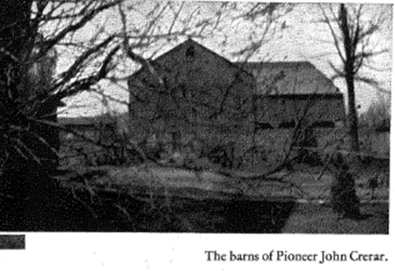
“His clear land now extends to 80 acres and besides he is harrowing in his fall wheat on the new piece of 12 acres his crops this year 10 acres of fall wheat four of spring wheat 10 of oats and seven in other crops with 25 acres of hay and his Pastor is also 25 acres his stock of cattle is one span of horses one yoke of oxen three stairs six milk cows four heifers six yearling steers five calves 29 sheep and 18 Hogs he sold in the spring of last year two yolks of oxen.”
This was not the work of a man hiding from his past. This was the work of a man building a future. I am reminded that many settlers to this area came from Perthshire and many would have be acquainted with one another. If John was trying to re-invent himself, this may not be the best location to get an anonymous start.
In addition, he had paid off another lot and part of the third. His neighbours were thriving. A sawmill had risen to the north, and the side road; once only a rough track, was now lined with settlers. The community was taking shape around him, each farm a testament to perseverance.

“The settlers generally after the first few years they are settled, endeavor to provide their own clothing by rearing sheep. This year he expects to have eighty yards of homemade cloth, and last year he had about the same quantity. It is mixed in most instances with cotton, yarn, and also with flax, although wholly with woollen yarn is preferred, and which, as it is made, after being ‘fulled’ is a good cloth.”
Eighty yards of cloth. Enough to clothe a family through the winter. Enough to prove that the Riddells, the Wallaces, the Crerars, and all the others were no longer merely surviving, they were establishing themselves.
And John? He had no intention of leaving. As he clearly put in writing, with his final words.
“He has no inclinations to dispose of the land and improvements, which he considers worth $4,000. Indeed, he says he would not accept of that some of money if offered of him.
For a man who may have once lived by his wits in the hills of Perthshire, this land, this hard‑won, sweat‑earned land, was more than property. It was redemption. It was identity. It was home.

John remained on his farm until his passing in 1862, at the age of 75. He was laid to rest in St. Andrew’s Cemetery in North Easthope beside his wife, Grace (1795–1861), who had gone ahead just a year before. Their stone, weathered by nearly two centuries of seasons, stands pale and worn now; its carving softened by time. Yet speaking their names, recalling their lives, and bringing their story into the present grants their memory a fresh breath, as though the act itself restores what the stone can no longer hold.
In moments like this, I can’t help but think of the surviving spouse choosing that final marker, the quiet, intimate decision of selecting the tribute that would stand for generations. The weight of it: the colour, the shape, the size. Was it dignified enough? Was it too imposing? Did it reflect the life lived, the love shared, the years intertwined?
John chose a beautiful white marble stone for Grace, detailed with careful carving and a verse etched into its base. He must have known that soon his own name would rest there too, completing the story they
had built side by side.
Another furrow has been turned, lifting his story into the light, we honour not only the man he became, but the land that held him, and the whispers that followed him across the sea.
Whether his name was Crerar or McIntosh, whether he fled the Excisemen or simply the limitations of an eight‑acre lease, the truth is this: John carved a life in North Easthope that could not be taken from him. His story, like so many in this series, is one of reinvention, resilience, and the quiet determination that shaped Perth County.

Comments