
Chapter 10: The Fourth Row - The Long Line of Remembrance (Part II)
Returning to Section A, we pick up exactly where we left off; standing in the damp grass at the midpoint of Row Four beside the Masonic marker of Wilhelm Pimper. In our last journey, we uncovered the stories of the first thirteen residents who anchored this long line. Today, we step past that halfway mark to clean and document the remaining thirteen stones of this large twenty-six-stone row.
As we push further down the line, the timeline continues to weave through the late 1860s to the 1880’s. The landscape outside the churchyard gates was rapidly modernizing; the railway was reshaping local commerce, and the old log cabins were systematically being replaced by grand brick and stone homesteads. Yet, inside these sacred boundaries, the markers remind us that prosperity never bought immunity from grief. Written predominantly in the comforting, familiar German script of the old country, these remaining thirteen stones represent the mothers, fathers, and children whose quiet presence solidified the foundation of this community.
Let us clear the moss from the fourteenth stone and bring their names back into the light.
Catharina (Krantz) Diehl (1841–1872)

The fourteenth stone in our line presents a somber milestone in our walk down Row Four. Written in cleanly preserved German script, the monument commemorates a young life cut short at the beginning of a bitter Ontario winter:
"Zum Andenken an Catharina Ehefrau von Heinrich Diehl eine geb. Kranz gest. 18 Feb.1872 Alt. 31 Jah. 1. Mo. und 9 Tagen"
Translated directly into English, her epitaph reads: "In Memory of Catharina, wife of Heinrich Diehl, née Kranz, died Feb. 18, 1872, Aged 31 Years, 1 Month, and 9 Days."
Catharina’s story begins like many others within this sacred ground, beginning her life an ocean away. Born January 9th, 1841, in Lodz (Lodzkie), Poland, immigrating to Upper Canada with her parents and splitting her youth between the Polish countryside and the Canadian bush.
In 1861, the census places her in the care of her parents. Adam Grant Krantz (1816-1903) and Anna Maria (Schwetzel) Krantz (1819-1903). Listing the parents’ birthplace as Germany, but the birthplace of their children in Russia. In fact, all but one of the Krantz children were born in Russia, with Maria, their youngest, a full Canadian, being the only one that never experience life in the homeland.
We use the census to narrow down the year of immigration, since we are unable to locate an actual record. This is how we do it, the year is 1861 on this census, Maria is 4, the next closest in age is John at 11, John was not born in Upper Canada, this closes the gap on the possible year of immigration. With some simple math we can estimate that their arrival was between 1850 to 1857. Catharina is 20 years old, on this record, which means she was between 9 to 16, when immigrating.


As the second oldest un-wed daughter, her role in the household would have been absorbed with daily chores and learning the skills need to manage her future family. Lessons that would prove vital, as it was not long before the parents’ roof was no longer over her bed.
By December 1862, she married Heinrich "Henry" Diehl, a fellow European settler whose family had carved out a homestead on Concession 5, Lot 28 of South Easthope Township. The 1871 census catches a snapshot of her life just one year before her death, a busy mother managing a household with five young children under her feet.

1871 census lists Catharina along with her husband Heinrich ‘Henry’, who she married in Sebastopol on the 23rd of December 1862. Here the family lists 5 children in 1871, Mary (1863-1952) Heinrich (1864-1887), Christian (1866-1934), Augustina (1868-1960) and Adam (1870-1947). Their last child was born in 1872, a daughter Anna Maragaret (1872-1937). Catharina unfortunately passed away just nine days after the birth of Anna Maragaret.
Catharina was only thirty-one years old when she passed away on February 18, 1872. While the community was modernizing, the reality of pioneer life meant that winter illnesses and childbirth carried an unforgiving cost. Her husband Heinrich was left to tend the farm and care for their young children, eventually marrying Margaretha Döerr later that December to help keep the homestead together.
Anna Katharina (Wilker) Wettlaufer (1841–1872)

Stepping directly to position fifteen, we find a marker that reveals a profound, shared tragedy in the Sebastopol community. The stone stands as a twin in sorrow to the one we just left, its German inscription reading:
"Hier ruhet in Gott Anna Katharina Wettlaufer geb. Wilker zu South Easthope im Jahr. 1841 Januar 28 gest. 18 Feb 1872 Alter 31 Jahre 20 Tag."
In English, this heartbreaking monument reads: "Here rests in God, Anna Katharina Wettlaufer, née Wilker, born in South Easthope on January 28, 1841, died Feb. 18, 1872, Aged 31 Years, 20 Days."
Anna Katharina’s stone provides a rare and remarkable distinction: she was a first-generation daughter of Canada itself, born in nearby Wilmont Township in the winter of 1841, back when the region was primarily a dense wilderness of old-growth timber. She married Conrad Wettlaufer (1835-1901), a well-respected pioneer family, October 25, 1859, connecting two of the area's foundational German-speaking lineages.
Anna Katharina and Conrad went on to welcome at least five children to their household, Frederick (1860-?), Christine (1863-1887), John Conrad (1866-1915), Elizabeth (-1869-1905) and finally Katharina (1872-1873). Born the year her mother passes, taking her name, sadly only surviving months.
The mother’s death attributed to inflammation after confinement post childbirth. A normal response to childbirth, driven by hormonal shifts, the healing process and the release of excess fluid retained during pregnancy. However, bacterial infections tended to set in, due to unsanitary environment, and infections caused fevers, and fevers sometimes lead to sepsis. Misunderstood at the time most treatments included methods like bloodletting, leeches and prescribing mercury, which was to be taken internally. As you can well assume these methods had no benefit and survival was based on the individual’s ability to fight infection, mostly a losing battle.

We are drawn to reflect on the previous stone of Catherina Diehl, another mother, who passed just days after childbirth. The most gripping piece of archival evidence on this stone is Anna Katharina’s death date: February 18, 1872. She died on the exact same day, at the exact same age of thirty-one, as her neighbor Catharina Diehl. Perhaps of the same cause. Too lose two young mothers on the very same winter day suggests a shared, devastating event swept through the concession lines; where days which should have been filled with joy, now wipe the tears of children that have lost their mother.
Young vibrant women, victims to an aggressive fever that the rudimentary medicine of the 1870s simply could not stop. Her burial alongside Catharina would have turned the churchyard into a space of immense collective mourning for the congregation that week. With all the founding families represented, leaning on the strength of community to get through these dark hours.
Conrad, now a widower with small children went on to marry Christina Hornmann, August 31, 1873. Young Katharina had passed, harvest was fast approaching and the children needed a mother’s care. These days were not about waiting an appropriate amount of time, or moving on to soon, survival had to take priority, and nothing prepares you for the unthinkable, the loss of a wife or mother.
Johannes Kalbfleisch (1788–1872)
With the sixteenth stone our focus shifts, from our journey of the tragic losses of the young to the revered passing of an old-world patriarch. Carved with precise detail, the monumental inscription bridges the ocean between the German states and Perth County:

"Johannes Kalbfleisch geboren den 24 Aug. 1788 Birben Gross Herzogthum Hessen Darmstadt gestorben den 15 Ag. beerdigt den 18 Aug 1872 Alter 84 Jahre 11 Monate u. 22 Tage"
Translated directly into English, it reads: "Johannes Kalbfleisch, born August 24, 1788, in Biber [phonetically carved as Birben], Grand Duchy of Hesse-Darmstadt, died August 15, buried August 18, 1872, Aged 84 Years, 11 Months, and 22 Days."
Johannes’s stone is a historical treasure, mapping out a massive life that spanned continents and generations. Born in 1788, in the Hessian village of Biber, he was a child during the French Revolution and a young man when Napoleon's armies marched across the German states. He spent the vast majority of his life in Europe, raised a family, and witnessed the political and economic upheavals that eventually drove his children to look across the Atlantic for a better future.
Details taken from his marriage record, provides us with the names of his parents, Johannes Kalbfleisch Sr. and Anna Maria Becker. On October 4th, 1810, Johannes married Anna Elisabetha Noll, under the cross of a Lutheran church in Grebenau, and began their family in Germany.
Before immigrating to Canada, at least five children were born and the following were listed as immigrating with their parents, Adam (1816-?) future husband of Anna Barbara Becker, Mary (1819-1878), Henry (1823-1889) future husband of Anna Katharina Jungblut, George (1825-1917) husband of Elisabeth Daum, Catherine (1830-?).

The family arrived in New York, August 17, 1837, on the Earl Durham. Johannes was a late-life immigrant, arriving in Canada as an elder patriarch. Rather than clearing the heavy timber himself, his role in Perth County was that of the respected grandfather, anchoring the multi-generational Kalbfleisch households recorded in the local censuses.
1861, finds them living with their son, Henry, in South Easthope. Ten years later, 1871, they had a residence next to their son Adam, a widower by this time. Johannes would only reside there one more year, at that time his permanent residence at Trinity was established.
His monument is unique because it preserves the exact chronology of his final days in the late summer heat of 1872, noting his death on August 15th and his burial just three days later August 18th. He passed away at the grand age of eighty-four, a life linked to the 18th century, laid to rest in the soil of the new world.
Anna Elisabetha (Noll) Kalbfleisch (1790–1875)

Moving to the seventeenth position, we find ourselves standing before the matriarch who anchored the very family story we just uncovered. Resting right beside her husband Johannes, her weathered stone reads:
"Elisabetha Kalbfleisch Ehefrau von Johannes Kalbfleisch geboren am 11 Aug. 1790 Hessen Darmstadt gestorben am 26 April 1875 Alter 84 Jahre"
Translated directly into English, this touching marker reads: "Elisabetha Kalbfleisch, wife of Johannes Kalbfleisch, born August 11, 1790, in Hesse-Darmstadt, died April 26, 1875, Aged 84 Years."
Elisabetha was the silent backbone of the Kalbfleisch migration. Early church registers fill in the gaps of her long journey, noting she was born in Schwartz, in the district of Alsfeld, Hesse-Darmstadt. Her parents Johann Heinrich Noll and Anna Margaretha Becker.
With much of their life being documented previously under Johannes, we do not have much of a story to tell. By the time, her husband Johannes passed, she was already an eighty-two-year-old widow when we left her in the late summer of 1872.

The local censuses capture her final years living quietly on the family homestead, surrounded by the grandchildren who were growing up as true Canadians. She survived three more long Ontario winters after losing Johannes, finally passing away in the spring of 1875 at the advanced age of eighty-four. Her presence in this row firmly cements the multi-generational sacrifice required to transplant an entire lineage from the old country into the soil of Perth County.
As you can see her stone has fallen and the effort to restore is underway. As part of the restoration project this is one of the stones selected to repair as close to original as possible. At the time this blog was written the restoration process was still ongoing and pictures will be provided and update once the stone is corrected.
Anna Catharina (Jungblut) Kalbfleisch (1831–1889)

Here we continue with the fourth row, facing the eighteenth stone keeps us within the branches of the same prominent pioneer family tree, but shifts our timeline forward into the final weeks of the 1880s. Written in deeply cut German, the marker reads:
"Hier ruhet Katharina eine geb. Jungblut Ehefrau von Heinrich Kalbfleisch geb. d. 12 Oct, 1831 gest. d. 30 Dec. 1889 Alter 58 Jahre 2 M. 18 T."
In English, this beautiful monument reads: "Here rests Katharina, née Jungblut, wife of Heinrich Kalbfleisch, born October 12, 1831, died December 30, 1889, Aged 58 Years, 2 Months, and 18 Days."
Katharina’s life represents the mid-century generation of settlers who watched the raw wilderness transform into a landscape of established brick homes and prosperous farms. Born in the autumn of 1831, to Johann Werner Jungblut (1796-1873) and Anna Catharina Kalbfleisch (1801-1882). Baptized October 26th, 1831, in Gerbenau.
She married Heinrich Kalbfleisch, son of Johannes and Elizabeth Kalbfleisch in Ontario after immigrating with her family. Once married, she managed a bustling rural household. The 1871 and 1881 censuses document their life on the homestead, tracking the heavy daily labor of spinning wool, churning butter, and raising a large family to help tend the livestock and seasonal crops.

On a death certificate from 1889, the diagnosis of "congestive and inflammation of the bowel" lasting one week describes an acute, life-threatening abdominal crisis; known in modern medicine as severe enterocolitis, acute peritonitis, or a strangulated bowel obstruction that has progressed to tissue necrosis (death) and systemic infection. In the late nineteenth century, "congestion" referred to a massive, stagnant pooling of blood in an organ's vessels, while "inflammation" signaled the rapid, destructive immune response to severe injury or infection. When striking the bowel, this combination meant that the intestinal lining was intensely swollen, ulcerated, and losing its blood supply, causing the gut to shut down entirely and leak toxic bacteria directly into the sterile abdominal cavity.
For Anna Kalbfleisch, the final week of her life would have been a grueling, agonizing struggle against a body rapidly poisoning itself from within. The affliction began with a sudden, localized abdominal pain that quickly spiraled into unremitting, cramping spasms as her inflamed intestines fought fruitlessly to move contents past the congested blockages.
As the days wore on and the inflammation ruptured the delicate intestinal wall, a raging fever would have taken hold, accompanied by persistent, exhausting vomiting and a abdomen that grew hard, swollen, and fiercely painful to the slightest touch. In the drafty quiet of a late-century farmhouse, without the modern lifelines of intravenous fluids, antibiotics, or emergency exploratory surgery, Anna’s battle was fought with nothing more than ineffective warm compresses, drops of laudanum to dull the sharpest edges of the pain, and the helpless vigils of her family.
Over those seven long days, as dehydration sucked the moisture from her skin and sepsis slowly overwhelmed her circulatory system, Anna’s struggle became a quiet, deteriorating surrender to exhaustion, closing her eyes on an era where a common abdominal emergency was an absolute and agonizing death sentence.
Katharina passed away on December 30, 1889, from congestive and inflammation of the bowels, after one week of suffering, ending her struggle just one single day before the arrival of the new decade. Her death at fifty-eight years old closed out a lifetime of immense physical devotion to her family and congregation, leaving behind a legacy of hard-won agricultural prosperity.
Heinrich Gischler (1831–1873)

At position nineteen, the German script momentarily gives way to an English inscription, marking a sudden and tragic loss that shook a young family just as the mid-summer harvest was beginning:
"Heinrich Gischler born Sept 1, 1831, dies Aug. 2, 1873, aged 41 yrs. 11 mos. 1 dy. husband of Anna M. Gerhardt"
Heinrich’s story is a poignant reminder of how fragile a pioneer family's security could be. Born in September 1831, Heinrich immigrated to Ontario and married Anna Maria Gerhardt, establishing their homestead on Lot 26, Concession 4 of South Easthope Township. The following marriage record details what we know about this new family at that time.

When the person no longer exists to tell their story, it is the records, the census and the community recollection that fills in the gaps of who these pioneers are and how they lived. It is in the Marriage Records from 1861, that we find the names of the parents of both Heinrich and Anna, their place of birth and the witnesses that attended their April 23rd wedding.

The 1871 census reveals a snapshot of a highly productive, thriving farm: Heinrich was managing 60 acres of improved land, harvesting over a hundred bushels of wheat, tending orchard fruit, and looking after a growing family of five young children. Little did he know the fate he faced within the next twenty-four months.

On a death certificate the cause is reported as a combination of edema and jaundice. This paints a clear clinical picture of advanced liver failure progressing to systemic organ shutdown; a condition known in modern medicine as end-stage liver failure. Edema, historically referred to as "dropsy," describes a massive, unnatural accumulation of fluid in the body's tissues and abdominal cavity, which occurs when a failing liver can no longer produce vital proteins like albumin to keep fluid inside the bloodstream. Jaundice, noted by doctors of the era by its striking yellow pigmentation, is the direct result of a diseased liver losing its ability to filter blood impurities out of the body, causing the toxin to back up and yellow the skin, tissues, and the whites of the eyes.
For Heinrich Gischler, his final weeks were a heavy, deteriorating battle against a body that was slowly losing its battle. The illness would have begun insidiously, with profound fatigue and a deep, systemic weakness as his liver failed to process nutrients and clear everyday waste from his bloodstream. As the condition advanced, Heinrich would have watched his body physically transform; his ankles and legs would swell heavily with fluid, making every step an exhausting effort, while his abdomen distended with trapped fluid, putting a suffocating pressure on his lungs and heart.
At the same time, the yellow cast of jaundice would have deepened across his skin, accompanied by a relentless, maddening itch caused by bile salts depositing directly under his flesh. In an era long before liver transplants, specialized diuretics, or blood-clearing therapies, local physicians could do little more than offer comfort measures to ease his labored breathing and apply soothing topicals to his skin. As the unfiltered toxins finally crossed into his central nervous system, Heinrich would have drifted into a deep, merciful hepatic coma, peacefully bringing an end to a grueling physical struggle against a silent and overwhelming internal failure.
Heinrich Gischler was just one month shy of his forty-second birthday when he died on August 2, 1873. Suffering from an advanced physical decline marked by edema and severe jaundice, his passing at the beginning of August took the primary labourer from the farm. The facts, Heinrich released his last breath and was buried the next day. Native of Kieba, Hessen, at the age of 41 years, 11 months and 17 days, Heinrich was a tremendous loss.
Heinrich's death left his widow, Anna Maria, to manage the immediate future of the household and the care of their young children: Margaret (born c. 1864), Henry V. (born 1869), and Barbara (born 1872). Navigating the sudden loss of a husband in a rural 19th-century concession required a heavy reliance on family networks and sheer endurance. Anna Maria maintained the family's footing through this transition, later entering a second chapter of life when she married Andrew Hahn and welcomed their daughter, Elizabeth Hahn, in 1874.
Catharina (Bauer) Kalbfleisch (1847–1873)
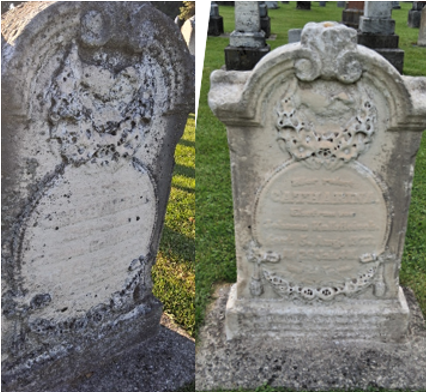
Stepping to the twentieth stone, we encounter a heartbreaking postscript to the summer of 1873. Returning to the traditional German script, this monument stands just steps away from Heinrich Gischler, reading:
"Hier ruhet Catharina Ehefrau von Johann Kalbfleisch gest. 5 Aug. 1873 Alt. 26 Jah. 4 M. und 23 Tagen"
Translated directly into English, it reads: "Here rests Catharina, wife of Johann Kalbfleisch, died August 5, 1873, Aged 26 Years, 4 Months, and 23 Days."
Catharina's stone revealing an incredibly intense window of grief for the Sebastopol community. She passed away on August 5, 1873, a mere three days after her neighbor Heinrich Gischler died down the concession line. At just twenty-six years old, Catharina was a young bride and mother whose life was cut short at its very beginning.
Catharina was born in Wilmot Township, Waterloo Region of Ontario. Her parents Felix “Conrad” Bauer and Maria (Berg) (1821-1876), a German immigrant. Conrad a blacksmith by trade, secured work in the Petersburg area of Wilmot Township. The two were married May 1st, 1846, in Preston Ontario and the following year welcomed their first of nine children, Catharina.
Catharina was followed by Margaret Grettel (1848-1928), Mary Bruckner (1851-1883), Johanna ‘Hannah’ Kalbfleisch (1854-1935), Elizabeth (?-1854), Henry (1855-1946), Conrad (?-1858), William (1860-1926), and John (1862-1937). Raising in the developing Petersburg area, this family like so many others faced the reality of settler life, love, loss and mid summer burials.
While the men of the township were in the fields desperately trying to secure the summer crops, the Kalbfleisch home was burning brimstone, fumbling around in the dimly lit red light and isolating a failing family member. Catharine had contracted Smallpox. In the 1870’s smallpox was one of the most feared ways to die, whispered under the breaths of mothers, referred to by the name the “Speckled Monster”. Smallpox was no joke.

For Catharina her diagnosis in 1873 was terrifying, with a predictable timeline only set to last two to three weeks. With a 10-to-14-day incubation period, she would have gone about her daily tasks unaffected and unaware of what lies ahead. Then she would have entered the next phase days 1-4, an immediate onset of violent flu-like symptoms, soaring fever, chills, headache, and an agonizing backache leaving her bedridden. Days 5 thru 9 offer a small reprieve, providing a small sense of false hope as the fever dips, then the small red dots begin to appear. First, in her mouth and on her tongue, bursting and releasing millions of viral particles, transitioning to the well-known rash that breaks out on her arms, face, hands and quickly spreading over her entire body. Death would usually find its place between 11 and 16 days. Immune systems were overwhelmed; organ failure was common and secondary bacterial infections did not make recovery easily attained. Although the smallpox vaccine did exist, it was poorly distributed amongst rural areas and many like Catharine lost their battle to the speckled monster, because of this.
At 26 years old, 4 months and 4 days, Catharina also lost her fight and was interred the next day. Th highly contagious nature of smallpox made this a mandated requirement imposed by the health boards. There would be no public viewing, no traditional church wake, and no large funeral procession. Catharina would have been placed in a charcoal or pitch (a tar like substance) lined coffin, sealed and removed to the cemetery, typically at night, with only a minister and a small group of asymptomatic family members.
It was not uncommon for the surviving family to not only face the grief of the loss but also the public stigma of being infected, at least for the upcoming weeks. Their house fumigated by burning sulphur (aka brimstone) and washing every single surface with carbolic acid or lime. This air would burn their eyes and lungs for weeks reminding them of the loss everyday, yet the community could not be supportive in this time of need, for fear this hand would touch their house next.
David Trachsell (1838–1873) & Sarah (Fryfogel) Trachsell (1846–1870)

The next marker we find in position twenty-one, it is here we encounter a more modern stone in comparison to the ones we’ve recently cleaned. No longer does the traditional German script mark the face of this stone, giving way entirely to English on a monument that unites two of Perth County's most prominent pioneer surnames in a story of early loss. The stone reads:
"Trachsell David Trachsell born 1838 - died 1873 Sarah Fryfogel his wife born 1846 - died 1870 Gone but not forgetten"
This completely English inscription marks a shifting cultural tide in the concession lines. Sarah was born in 1846 into the famous Fryfogel family; the very lineage of Sebastian Fryfogel, who built the iconic Fryfogel Tavern, the famous 1844 brick inn down the road. Providing him with the designation as the first settler of Perth County.
Sarah was the daughter of Sebestian Sr. and Mary nee Eby. She married David Trachsell, and the couple set to work building their life in the township. They were blessed with a single daughter Mary Adeline Trachsell (1866-1918), who would later go on to marry Siebert Wilhelm. But sadly, neither parent would be there to view it.
Tragedy struck the young family at the turn of the decade. Sarah was only twenty-four years old when she passed away in 1870, likely leaving David to manage both a grieving household and the heavy daily labor of a nineteenth-century farm. Due to the other records providing the details of Sarahs’ existence, I believe the date listed here for her birth is incorrect. Guessing that David’s birth date was entered in the confusion of grief.


David survived his young wife by only three years, passing away in 1873 at the age of thirty-five. Again no cause of death is provided, but at this time the simplest of infections and the smallest of bacteria could end the strongest settler. The stone stands as a poignant double monument to a young couple whose lives ended just as the wilderness they were born into was becoming fully civilized. The dreams their parents envisioned dies with them and the future generation was left to navigate the path alone.
Elizabeth (Wilker) Wagner-Klein (1837–1919)

The twenty-second represents a remarkable matriarch whose life spanned the entire evolution of the township. Written with unique shorthand details, her monument reads:
"Wilker Elizabeth Wilker wife of Jacob Wagner Re. John Klein 1837-1919". No translation needed.
Elizabeth’s stone provides a condensed map of a long, resilient pioneer life. Born in 1837, in Petersburg, Waterloo County, October 1st, 1837. A daughter of the foundational Wilker family, she grew up enduring the raw hardships of early South Easthope. Her father John Peter Wilker (1809-1889) and mother (Margaretha Anna (Kalbfleisch) Wilker (1813-1882).
Raised in the area she knew as home, her first marriage was May 23rd, 1854, to Jacob Wagner, with whom she shared the grueling work of establishing a homestead, a big business in Tavistock as a flax manufacturer, in addition to raising a family.
They raise a family of ten children, equally divided, five sons and five daughters. Unfortunately, only four sons and two daughters would survive until their mothers’ death. Leaving George, Henry, Peter, and Katharine all of Chicago, Jacob of Shakespeare, and Augusta Alles of Stratford. It was smallpox that took Jacob and two children, (Jacob jr. (17) and Anna Louisa, ‘Annie’ (14)) in 1873-74, the same year as Catharina Kalbfleisch had fallen to the same illness. It was a frightening year for the community as they struggled to fight an unseen killer, smallpox.
When Jacob passed away, I was less than a month to the day, she lost Annie, then 5 days later Jacob jr., Elizabeth had to navigate the immense practical realities of a widow in a rural economy where operating a farm required a partner. All this while also dealing with the grief of losing 3 family members in 6 weeks, never knowing if more would follow. She eventually remarried (Re.) John Klein, another local German settler, September 1st, 1877. One more child between Elizabeth and John secured the union. It was then that Annie, who would become Mrs. Charles Loth, joined their family, lovingly named after the first daughter lost.

Living until 1919, Elizabeth was at her daughter Katharine nee Wagner's in Chicago when death took her at 81 years 11 months and 4 days. Elizabeth reached her 82nd year, nut not her 82nd birthday. She survived two husbands and lived long enough to see handfuls of grandchildren. She bid farewell to the old horse-and-buggy pioneer days and watched them give way to the arrival of the automobile, anchoring this row as a true symbol of endurance.
Jacob Wagner (1830 - 1873)

At position twenty-three, we step directly beside Elizabeth to find the weathered fallen stone of her first husband. Marked by the distinct tool work of a fraternal brotherhood, the newly uncovered text on this damaged monument fills in a deeply poignant blank in our journey:
"Wagner, Jacob Wagner died Dec. 6, 1873, aged 43 y'rs & 10 m's” (Mason sign; fallen stone)
With the date and age clear, Jacob’s story snaps into heartbreaking focus against the broader timeline of Row Four. Born in early 1830, in Germany, he immigrated to the Tavistock area and built the first major flax mills, assisting in making flax textiles a leading industry in the area. Flax and linseed oil products were a booming industry in Oxford and nearby counties. Buy focusing on local turnip and flax industries he supported the rural economy, employed many struggling people, and grew a large business prior to his death.
He was just forty-three years old when he closed his eyes on December 6, 1873. He passed away a mere four months after his neighbors Heinrich Gischler and Catharina Kalbfleisch were laid to rest just a few steps down the line during that devastating summer. Now with December winds shutting up the homes, Smallpox was sweeping through the community, and the winter was to become more deadly with each week that passed. For Elizabeth, the coming winter of 1873 brought the ultimate test of pioneer resilience; left to anchor the homestead in the biting December frost with the heavy grief of a partner cut down in the prime of his life. Along side the fact that small children at home were also ill from smallpox did not ease her burden.

Not much in the history books tells of how he died, the focus is on the business, his family and community support. At the crown of the marker sits a sharply etched Masonic square and compass, identical to the symbol we uncovered on Wilhelm Pimper's stone at the midpoint of this very row. Jacob was a brother of the local lodge, indicating he was a deeply respected, civically minded figure among the regional tradesmen and farmers who valued brotherhood and community building in a raw, developing county. As a fallen stone, it sits level with the earth, quietly holding the boundary of the Wagner plot beside the woman who spent her youth helping him tame the surrounding soil, building a legacy and a family.
Catherine Reid (1859–1863) & Margaret Reid (1861–1863)

The twenty-fourth position presents what is arguably the most heartbreaking collective tragedy in the entire fourth row., which says a lot as we have already discovered so much. Written in elegant English script, the monument commemorates the young children of Robert and Louisa Reid:
"Reid Catherine died Jan. 11, 1863, aged 3 years da's Margaret died Jan. 12, 1863, aged 2 years & 7 days. Children of Robert & Louisa Reid These lovely buds so young and fair, called hence by early doom: Just came to show the sweetest flowers, In paradise could bloom"
Before we explore the short lives of these two young girls we must first look to what lead to their existence. Parents, Robert Reid (1835-1892) and Louisa nee Hardham (1838-1921), a father from Scotland and mother from Germany, forming a true Canadian family, a combination of homeland traditions with a mix of new world essentials.

By 1862, they were a family of 5, Robert, Louisa, Catherine (3), Margaret (1), and John H. (newborn). Seemingly, a happy family. Catherine old enough to talk, Margaret crawling, if not walking around the home, and Louisa nursing young John. Robert beaming, a beautiful wife, family and life, while quietly in the background death was watching.
As the calendar turned so did the mood in the household, Margaret’s 2nd birthday, January 5th, was celebrated not with cake or presents, but with compresses and prayers. Candle lit rooms filled with the sounds of suffering, Catherine and Margaret were ill. Louisa exhausted with their care and the requirements of caring for newborn John, the devastating reality of the winter of 1863 steps out of the shadows.
The terrifying truth of this stone is found in the consecutive dates: Catherine died on January 11th, and her little sister Margaret died the very next day, January 12th, just 7 days after her birthday. To lose a three-year-old and a two-year-old within twenty-four hours is the textbook, ruthless signature of a nineteenth-century winter epidemic sweeping through the concession lines.

*note: the miscalculation in Margaretha’s age adding 7 months, perhaps the dates were recorded incorrectly, maybe the transcriber confused the line above while recording the line below, whatever the reason I will go with the dates on the stone and record, ignoring the 7 months.
Without modern antibiotics or extensively tested vaccines, these bacterial infections lead as the leading causes of death among children. Highly contagious, they struck multiple family members simultaneously, forcing exhausted parents to care for several sick children at once. A particularly horrifying situation as diphtheria, attacked the airway, cause by a toxin producing bacterium. Beginning as a sore throat it escalated quickly, forming a thick membrane of grey matter across the throat and tonsils. Creating the feeling of being slowly strangled from the inside. Their neck would swell dramatically, referred to as ‘bull neck’ making it hard to talk, swallow or even breathe. Death would be at the hands of literal suffocation or the toxins attacking the hear muscle, resulting in a heart attack.
Scarlet fever, also a bacteria infection, begins similarly to strep throat, but accompanied with a sever headache, high fever, agonizing sore throat, then within 2 days a bright red rash spreading quickly across the body. To touch the skin would feel like course sandpaper, their tongue, bright red, like a strawberry. Hallucinations were common, caused by high fevers, dehydration, body aches and throats so raw even water was impossible to swallow. The infection would eventually enter the bloodstream, causing sepsis, or cause kidney failure, making the end painful, but quick.
In January 1863, South Easthope was still a landscape gripped by deep snow and bitter cold, forcing families to isolate indoors where woodstoves pulled drafty air through the homestead. Whether it was diphtheria, scarlet fever, or a severe respiratory virus passing invisibly from child to child, Robert and Louisa Reid were left utterly powerless as the illness claimed both of their daughters in a single weekend. The nightmare was real, and every family was in fear, would their household be next. When they finally made it through the dark days of diphtheria, and scarlet fever they believe the worst was behind them.
Overcoming the grief of loss and ensuring the family name continued took priority. The Reid family added three more children, according to the 1881 census, William, born in 1867, Ann 1869, and Robert jr. 1873. Their last son joining the living the same year smallpox would come to devastate the community. By then the Reid family had experienced enough loss to last a lifetime, alas, it was not the end.
A little more research connects Robert and Louisa to Hermine Reid, a stone placed in the memorial cairn. This stone is the last of the Reid children born May 27, 1879 and passing just 17 days later. If not for the stone and the church records no records would exist, as she did not make it onto the 1881 census, she only lived 17 days but she was still another profound loss on this family that had already suffered enough, but we are not done yet.
John H. would find his end in San Fransico Bay, in 1887, aged 24. Buried only a few rows away, the youngest of the family rests, with an epitaph that explains it all. “In memory of John H. son of Rob’t & Louisa Reid accidentally drowned while boating in San Fransico Bay Cal. April 10, aged 24, 7 m’s & 15 d’ys. In the midst of life, we are in death. Remains brought home by deceased’s friend W.H.F. Briggs, San Fransico”.
Most of the Reid family finds rest here at Trinity. Father, Robert found his final sleep in 1892 at 57, carved upon the same stone as John and Louisa made it to 83, passing in 1921, in Detroit Michigan, but finding her way to Section B under the pines, and of course Catherine and Margaret. The two names that lead the family into grief and introduced a mother to heartbreak.
The carver beautifully captured the family's crushing grief through the bittersweet epitaph, comparing the short lives of the little sisters to tender flower buds that were called away by an "early doom" before they ever had the chance to fully blossom in the harsh pioneer world.
Catharina (Alles) Mogk (1847–1874)

The twenty-fifth stone bring us near the very end of our long line, standing before a weathered monument written in the comforting German script of the old country. It reads:
"
Mogk Catharina Mogk Ehefrau von Johannes Mogk geboren den 8 Sept. 1847, gestorben den 1 Maerz 1874 26 J. 5 Monates & 23 Tage"
Translated directly into English, this stone reads: "Catharina Mogk, wife of Johannes Mogk, born Sept. 8, 1847, died March 1, 1874, Aged 26 Years, 5 Months, and 23 Days."
Born in the autumn of 1847, to Johann ‘Valentine’ Alles (1806-1877) and Anna Maria Reiber (1815-1859), she was a true daughter of the developing township, marrying into a prominent branch of the local Mogk family who were instrumental in clearing the early lots of South Easthope.
In all the Mogk’s would have eight children, beginning with Andrew (1839-1911), Christian (1843-1908), Annie Margaret (Alles) Schenk (1843-1896) then Catharina in 1847. She was followed by the Margaretha born in 1849, lil Anna Maria in 1851, Wilhelmina in 1852. This was the year, at the age of 5, Catharina would have spent her days playing with her sibling, chasing three-year-old Margaretha, giggling with 1 year old Anna Maria and looking forward to the winter. Her mother, either pregnant with Wilhelmina, or had just given birth was preparing as the shape of the family was preparing to change forever, but in ways not expected.
In the fall of 1852. Margaretha and lil Anna Maria both fell ill, unknown for sure the cause, but most likely the common bacterial viruses that had caused so much damage to the family trees before them. Similarly to other tragedies of the community, within days of each other, both girls were lost to their illness, leaving the family with 2 empty seats at the table and a hole in a mother’s heart, no one could repair. Margaretha lost her fight Oct 19, 1852, and Anna Maria, her mother’s namesake, Oct 24, 1852, just 5 days later. Sadly, no stones stand for these two toddlers can be located, but they do appear on the record of death, confirming they are here, but their modest marker no longer stands.
Having experienced the loss of her sisters, Catharina’s mother would have held her closer, praying nothing happened to her or infant Wilhelmina. It took 4 years before Anna Maria (mother), would have another child, welcoming Henry in 1856. Unfortunately, 1859 brought a new loss, at the age of 12, Catharina lost her mother, Anna Maria nee Reiber had passed. Leaving a handful of young in the care of her and the older sister, until Valentine remarried Elizabeth Sippel and had another son, Valentine Alles (1867-1927).
Catharina went on to marry John Mogk, giving birth to her daughter, Wilhelmina (1873-1930), possible complications with the birth or a completely unrelated issue, may have led to her death as all that is recorded is hemorrhage. She was only twenty-six years old when she closed her eyes on March 1, 1874, meaning she belonged to the exact same generation of young mothers as her neighbors Catharina Diehl and Anna Katharina Wettlaufer, who were taken just two winters prior.

Passing away on the first day of March, Catharina survived the worst of the brutal Ontario winter only to slip away just as it began its slow transition into spring. For a young wife in the 1870s, winter was a season of endless, grueling domestic labor; keeping the hearth fire burning continuously, spinning wool by oil lamps, and meticulously rationing out the remaining root cellar provisions harvested from the previous autumn. Her sudden passing left a quiet, heartbreaking void on the Mogk homestead just as the grueling work of the spring thaw and maple syrup tapping was about to begin down the concession lines.
Her daughter left motherless, would be comforted by a heartbroken husband, and the pioneer life never stopped. John remarried, Catherina Nau (1853-1922) a year or two later, giving Wilhelmina a mother and adding many more children she would grow up to call family.
Catharina (Gonder) Keutsch (1835–1874) & Anna Elisabeth (Wagner) Keutsch (1840–1884)

At position twenty-six, we reach the final anchor of this monumental row. This double monument stands as a profound testament to family bond, preserving two German inscriptions that span a decade of shared family history:
"(a) Hier ruhet in Gott Catharina Keutsch geboren den 22 December 1835 gestorben den 21 Mar. 1874"
"(b) Hier ruhet in Gott Anna Elisabeth Keutsch geboren den 15 Juni 1840 gestorben den 30 Juli 1884"
In English, this beautiful, sorrowful stone reads:
"(a) Here rests in God, Catharina Keutsch, born December 22, 1835, died March 21, 1874."
"(b) Here rests in God, Anna Elisabeth Keutsch, born June 15, 1840, died July 30, 1884."
The timeline on this final stone captures two very different tales, two sides of one stone, two wives of one man, and the evolving of a township. To begin the story, we will look to the man they married and the connection they had. It was Conrad Keutsch, the man that would erect this stone and place both of their names on the tablet. Born around 1829, in Germany, Conrad immigrated to Upper Canada, Waterloo County, a single man, working as a shoemaker and had established a respectable trade for himself. It was at that time he met, fell in love and married Catharina Gonder.
Catharina (Gonder) Keutsch, born in the winter of 1835, a daughter of Valentin and Elisabetha Gonder. Was literally swept off her feet by this shoemaker, Catharina and Conrad Keutsch, were married March 9, 1858, taking up residence in South Easthope Township. Together they had four children, beginning with Catherine or Mrs. William Lau (1860-1948), Henry (1862-1944), Margaret or Mrs. Walter Atkinson (1865-1899), and Leonard (1867-1899). Fortunate enough to have all children reach adulthood, yet unfortunately unable to live to see it.
She passed away on March 21, 1874, at thirty-eight years old, a mere three weeks after her neighbor Catharina Mogk died just steps away. Her youngest Leonard just seven years old, and the oldest Catharina at 14, inheriting the daily chores along with abandoning the hopes of any further education.
We had to dig deeper for Catharina as the record of death for her provides few details other than her married name, the name of her husband, Conrad Keutsch, but in addition to that no information, in fact it states exactly that, (no information).


Anna Elisabeth, Conrad’s second wife, was born five years later in 1840. Her maiden name listed as Wagner, yet no quick reference to parents, not on her stone or on her record of death but what it does say is the means in which she passed, ‘Died giving Birth’. Another time that should have been filled with joy became overshadowed by the reality of the times.
Anna Elisabeth, married Conrad, September 14, 1875, a year and a half after Catharina’s death. Only to survive Catharina by a decade, passing away in the mid-summer heat of July 1884 at age forty-four. By the time Anna Elisabeth was laid to rest beside Conrad’s 1st wife, the old log cabins of Catharina’s day had largely given way to grand brick homesteads and the rumbling of local steam railways. Yet, despite the changing world outside the gates, the family returned to this exact spot to reunite the women that raised them, loved them and gave them life.

Stepping back from the twenty-sixth stone, we look back down the full, sweeping length of Row Four. What began as a simple line of stones has revealed itself to be a massive, multi-generational tapestry of endurance, sacrifice, and community grief.
In this single row, the factual records have forced us to confront the heavy reality of nineteenth-century life. We stood beside young mothers like Catharina Diehl, Anna Katharina Wettlaufer, and Catharina Mogk, whose lives ended abruptly in the prime of their youth during those unforgiving winter months. We felt the sudden panic of the Gischler, Wagner, and Reid families, who watched their loved ones snatched away in the blink of an eye during the critical August harvest or the dead of January. And we found anchor points in the long-lived resilience of old-world patriarchs like Johannes Kalbfleisch and enduring matriarchs like Elizabeth Wilker.
As we pack up our brushes, scrapers, and water buckets, the damp grass of Section A holds a deep, reverent silence. These twenty-six stones do not just mark where bodies were laid; they map out the very human cost of the landscape we enjoy today. Written in bold English or hand-carved German script, their stories are now safely out of the moss and back in the light; reminding us that every single name in this soil earned their place in the long, unbroken line of remembrance.


Comments