
Chapter 8: The Third Row - Shadows in the Soil
Updated: Jun 27
With one foot in the churchyard and the other in the records, we return to Section A, we pull our boots onto the damp grass of Row Three. To walk these physical rows is to realize that the cemetery layout is a living mirror of the community's slow, agonizing progress. As we stand at the head of this new line, the year is 1863, over two decades since the first axes bit into the East Zorra bush. The settlement was no longer a scattering of isolated shanties; it was an established, hardworking fabric of stone houses, split-rail fences, and expanding fields. Yet, even as the landscape changed and the wilderness retreated, the language of the people remained fiercely rooted in the old country.
The markers in this row are still carved in the traditional German script, a defiant statement of identity and faith in a rapidly changing Upper Canada. These stones tell us that while these families were building a new life in Ontario, they still thought, prayed, and mourned in the language of their ancestors. For the stone carvers of Perth and Oxford counties, working with local limestone or early marble, the old script was an art form, a way to anchor a family’s deepest grief in a familiar, comforting heritage.
A Daughter of Georg Kalbfleisch (1863–1863)

The very first stone anchoring Row Three brings us face-to-face with a story that lasted only a single day, recorded in the soft, weathering pores of the historic marker. Written in the traditional German of the early congregation, the inscription reads:
"Hier ruhet in Gott ein Tochterlein von Georg Kalbfleisch und Elisabeth Kathrina einer geborene Daum geboren und gestorben den 9ten Mai 1863"
Translated into English, this tender epitaph tells a story of immediate, shattering loss: "Here rests in God a little daughter of Georg Kalbfleisch and Elisabeth Kathrina nee Daum, born and died the 9th of May, 1863."

To look at the historical context of the Kalbfleisch family is to see a household heavily woven into the early survival of the township. Georg and Elisabeth Kathrina (née Daum) were part of that resilient German-Electorate wave that brought deep agricultural traditions to the area. The census records from this era capture a bustling, productive homestead, where every hand was needed to manage the livestock and clear the remaining hardwood lines. But on that spring day in May 1863, all the progress in the world couldn't alter the tragic reality unfolding inside the timber walls of their home.
In the 1860s, childbirth remained the single most dangerous event in a pioneer woman’s life. When labor began on the Kalbfleisch farm, the arrival of this baby girl brought an immediate transition from anticipation to grief. She never had the chance to receive a given name, to be brought before the altar for baptism, or to see the spring crops breaking through the dark soil of her family's concession. Her entire earthly existence was bounded by a few short hours on the 9th of May.
This baby’s name was never printed in the record of deaths, her father had to step away from the planting to purchase or carve this marker, ensuring that even though his little girl left no trace in the civil census or church ledgers, her presence would be permanently recorded in stone. Today, the letters are softening under decades of Ontario frost, but this first stone of Row Three stands as a monument to a family's enduring love, a quiet, German-script reminder that the foundation of this community was built on the memory of children who slipped away before their lives could even begin.
The Children of Robert and Elisabeth Beyer (Theodor, 1861–1865 & Mary, 1864–1865)
Moving just a few steps down Row Three, we find ourselves before a single, weathered stone that bears a double burden of grief. Carved into the marble is an inscription that tells of a household hit by two devastating losses in the span of less than a month. We turn to the record of deaths and read the words that changed a family forever.


97. Ernst Theodore Beyer, son of C.R. Beyer and Elizabeth nee Gabel, born November 9, 1861. Died March 31, 1865 buried April 2, 1865 at the age of 3 years, 4 months 21 days. Directly following this entry 98. Maria Elizabeth Beyer, daughter of C.R. Beyer and Elizabeth nee Gabel, born September 8, 1864, buried April 3rd, 1865. Age 6 months, 24 days. Burying their children only 1 day apart. On the stone it reads…
"Heir ruhen in dem Herrn Zwei Kinder von Robert und Elisabeth Beyer Theodor geb. am 9 Nov. 1861 gest. am Marz 1865 in alter von 3 jahr. und 21 tagen Mary geb. am 8 Sept. 1864, gest. am 2 April 1865 im Alter von 6 monaten und 24 tagen"

Translated directly from the original German script, the stone reads: "Here rest in the Lord two children of Robert and Elisabeth Beyer: Theodor, born on the 9th of November 1861, died on March 1865 at the age of 3 years and 21 days; Mary, born on the 8th of September 1864, died on the 2nd of April 1865 at the age of 6 months and 24 days."
To understand the tragedy etched into this stone, we have to look at the historical timeline of early 1865. The Beyer family, like their neighbors along these concessions, were working hard to establish their agricultural roots in the township. But the closing weeks of a nineteenth-century winter often brought waves of contagious respiratory illnesses; such as scarlet fever, diphtheria, or croup, that spread rapidly through isolated households.
For Robert and Elisabeth, March of 1865 became a nightmare. First, their three-year-old son Theodor, old enough to be running around the cabin floor, succumbed to illness. Before the mud could even dry on his fresh grave, the sickness claimed their infant daughter, six-month-old Mary, just a few days into April. Losing a child was a heavy blow, but having a cradle completely emptied in a matter of weeks was a crushing reality. This double headstone stands as a stark monument to a family that had to find the strength to keep farming the land while carrying a double share of sorrow to the churchyard.
Hannah Elisabetha Behrenwald (1855–1865)
The next stone in the row takes us from the loss of infants to a child who had lived

long enough to become a deeply integrated, helpful part of her family’s daily life. The German inscription reads:
"Heir ruhet in Gott Hannah Elisabetha Tochter von Karl u. Johanne Sophia Behrenwald gest. den 1 Aug. 1865 Alter 9 Jahre 8 mon. u 13 Tage"
In English, the stone translates to: "Here rests in God Hannah Elisabetha, daughter of Karl and Johanne Sophia Behrenwald, died the 1st of August 1865, aged 9 years, 8 months, and 13 days."
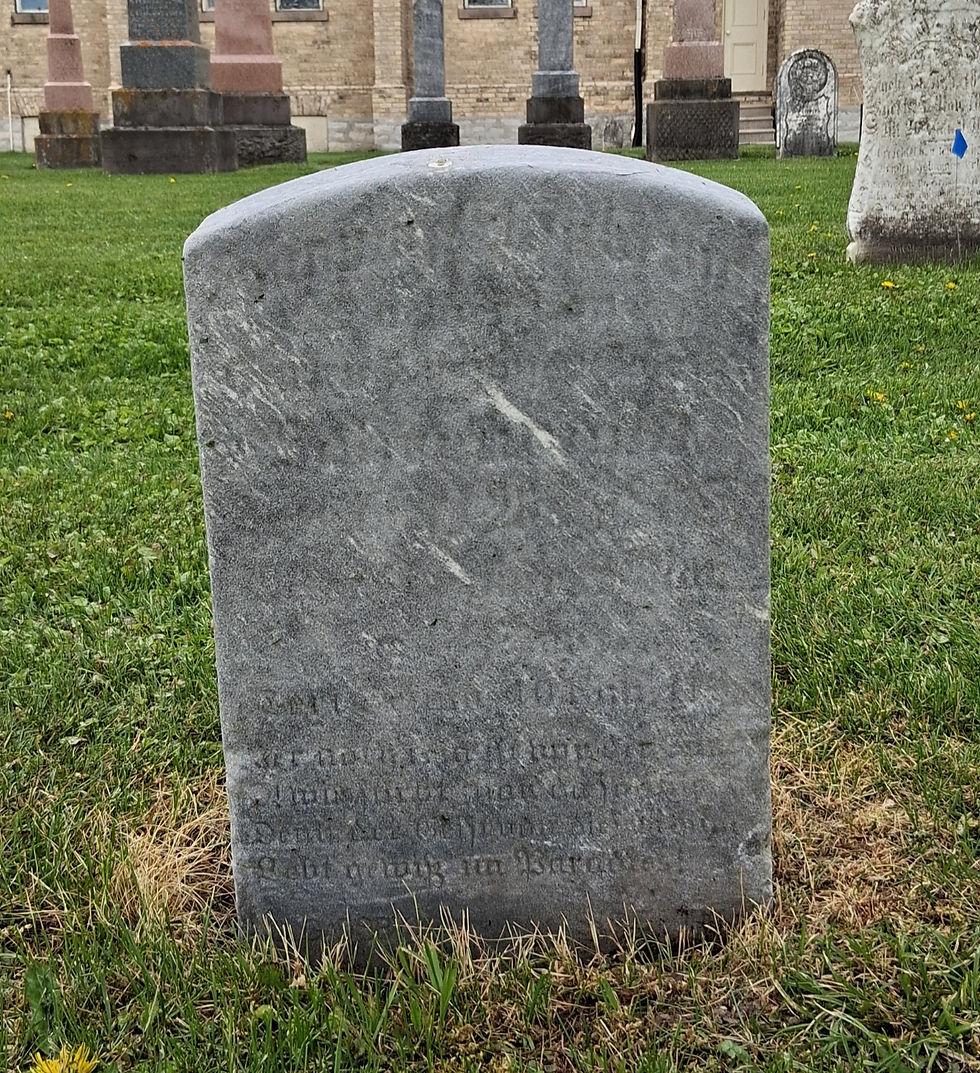
Hannah Elisabetha was nine years old when her story abruptly stopped at the height of the summer of 1865. In the mid-1860s, a nine-year-old child on an East Zorra farm was no longer just a dependent; she was an essential link in the household engine. She would have been old enough to help her mother, mentioned as Johanne Sophia, in this record as Dorothea Sophia nee Fisher, on findagrave. She would have helped her mother with the churning of butter, the tending of the garden, and the care of younger siblings, while her father, Karl, worked the fields.

Losing a child of this age was a profound shock to a frontier home. It meant the sudden silence of a voice that had filled the cabin for nearly a decade, and the loss of a future the family had watched grow. Her death on the first of August came right during the frantic rush of the summer harvest, forcing the Behrenwalds to stop their labor in the fields to dig a grave in the heat of late summer. Hannah’s stone stands as a reminder of the fragile thread that held these pioneer families together, where even a decade of strength could be swept away in a single season.
Hannah was not found on the record of deaths at Trinity, and is also listed on her parents stone located at Grace United in Tavistock. We can presume that Hannah was laid to rest at Trinity, and simply mentioned on the stone with her parents to keep the family connected. It is unlikely that Hannah, was reinterred at Grace United and this mention is merely a cenotaph in her honour.
Anna Gela Schaefer (1867–1867)
Continuing along the line of Row Three, we step forward two years in time to the spring of 1867, where another brief life is recorded in the softening limestone. The Record of Deaths place her at 113,


The fourth stone is hers, and it reads:
"Hier ruhet Anna Gela Tochter von Heinrich und Eva Schaefer geb. den Apr 7, 1867 gest. den 19 Apr. 1867 Alter 12 Tagen"
Translated into English, the inscription states: "Here rests Anna Gela, daughter of Heinrich and Eva Schaefer, born the 7th of April 1867, died the 19th of April 1867, age 12 days."
Little Anna Gela’s life was measured in just twelve short days. She arrived in April of 1867, a historic year for Canada as the provinces moved toward Confederation, but within the timber walls of Heinrich and Eva Schaefer's home, the only world that mattered was the survival of their newborn daughter.

In this era, neonatally fragile infants had very few defenses against the elements or early infections. For twelve days, her parents would have kept watch by the hearth, balancing the frantic chores of the spring planting with the desperate hope that their baby girl would take root. It was not to be. Her father had to leave the newly thawed fields to bury his daughter in the early spring soil, ensuring that her twelve days on earth were given a permanent place in the sacred rows of the congregation.
Johann Leonhard Wettlaufer (1867–1867)
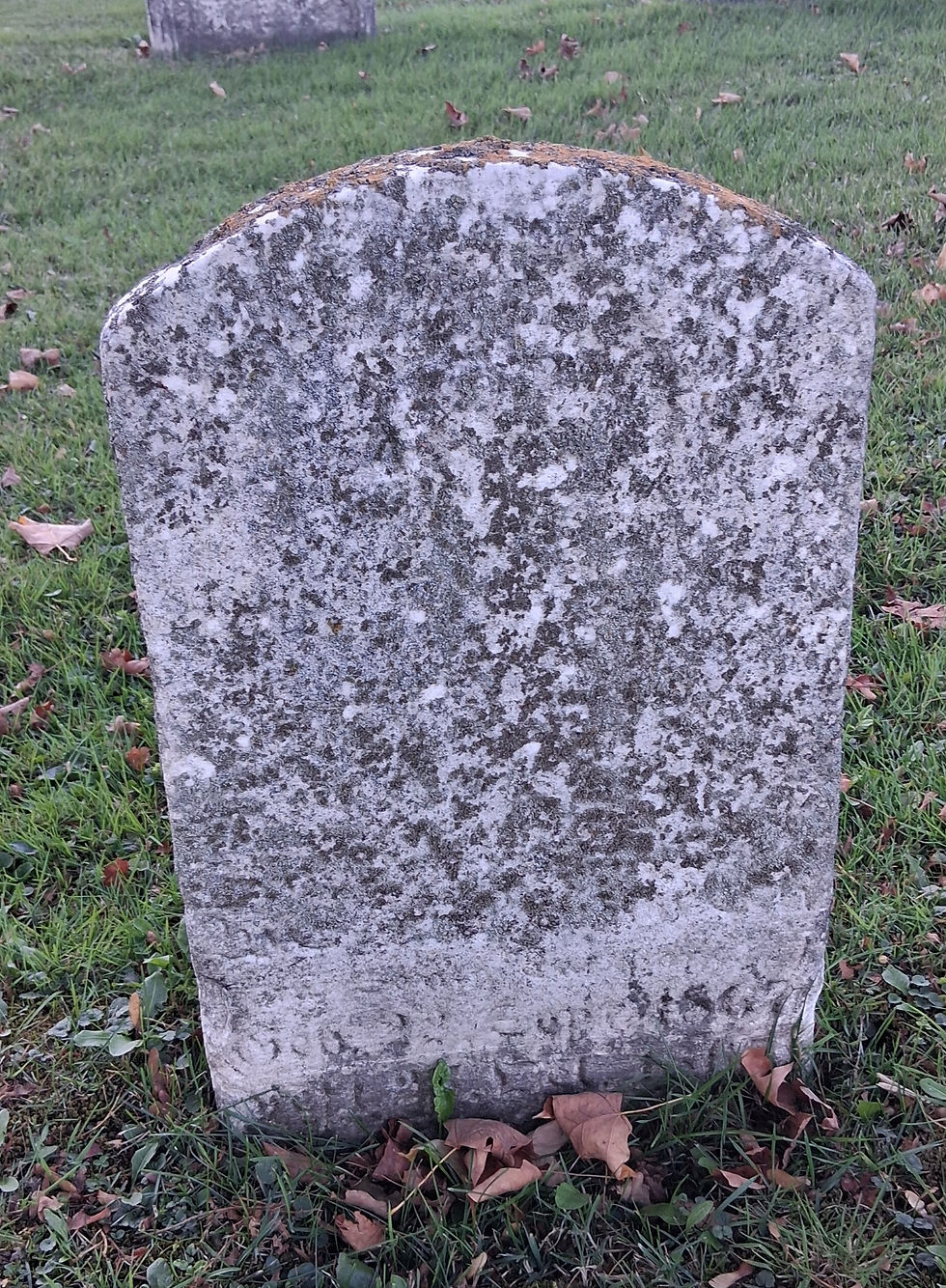
Bending low before the final marker of Row Three, we find the line anchored by a name deeply rooted in the pioneering history of the region. Found on the Record of Deaths as 118, the last entry of 1867. It is here I will draw attention to the fact that not all names appear on the record of deaths, and not all names are on the stones that remain. There will always be names lost, life gets in the way, the time between pastors visits may be long, records may have been kept at various churches as the pastor travelled, the need to inter a loved one had a need for speed and when this happened so rapidly not all names were entered to the records and not all wooden crossed remained through the years. Johann finds himself on the record of death, and his stone remains.

The German text, carved with the familiar care of the era, reads:
"Hier ruhet in Gott Joh. Leonh. Sohn von Heinrich u. Catharina Wettlaufer aus South Easthope geb. 22 Sept. 1867 gest. 25 OCt. 1867"
While the limestone abbreviates his name, the old church registers fill in the gaps, recording him fully as Johann Leonhard. Translated into English, his epitaph states: "Here rests in God Johann Leonhard, son of Heinrich and Catharina Wettlaufer from South Easthope, born the 22nd of September 1867, died the 25th of October 1867."

The inclusion of the words aus South Easthope (from South Easthope) tells an important story about the reach of Holy Trinity's early community. Heinrich and Catharina Wettlaufer were not clearing land in the immediate shadow of the churchyard; they were farming in the neighboring township. To bring a child here meant preparing a wagon and making a deliberate, somber trek across township lines, navigating the rutted dirt roads of late autumn to ensure their son was laid to rest in sacred ground alongside their kin and countrymen.
Little Johann Leonhard’s life spanned just over a month. He arrived as the summer harvest was winding down and left just as the first sharp frosts of late October began to lock up the Ontario soil. For thirty-three days, the Wettlaufer cabin was filled with the fragile hope of a new generation, only for that hope to be cut short as the autumn leaves fell. By burying him at the terminus of Row Three, Heinrich and Catharina left a permanent physical anchor of their South Easthope household in the East Zorra earth; a testament to a faith that knew no township boundaries.
With the stone of little Johann Leonhard, the physical boundary of Row Three comes to an end. To look down this line of markers is to look at a generation of devastating losses, where the slow, steady progress of the 1860s agricultural boom was constantly shadowed by the fragility of human life. Five stones. Six children. Not a single one of them lived to see adulthood. Yet, the fact that these markers stand here today, carved in the proud, enduring script of the old country; proves that these lives were never truly small to the people who loved them. They were the very heart of these pioneer homesteads. As we step away from this third row, leaving the German inscriptions to face the elements, we carry their names forward, knowing that the fields we pass today were paid for in the quiet currency of these early churchyard rows.


Comments