
Chapter 11: Gathering the Fragments - The Memorial Cairn (Part II)
To truly understand how a community remembers its dead, one must sometimes look at what happens when time, weather, and the plow threaten to erase them completely. In our earlier journey to the sacred center of the churchyard, we stood before the massive stone memorial cairn; a monument built not for one individual, but to safeguard the broken and displaced pieces of our collective history that still remained at that time. Today, we return to that stone sentinel to document and honor the remaining names sunken into its face.

But to appreciate the names preserved on the cairn today, we look back to a pivotal moment in the summer of 1884; exactly a century before the cairn itself was built. It was during that time that families were laying residents like Anna Elisabeth Keutsch to rest, and the new church has stood for a year. As the decades rolled on, unmaintained plots sank, wooden markers rotted away, and pioneer marble fractured under the weight of severe Ontario winters. Scattered fragments of the foundational families risked being lost to the earth forever.
That trajectory changed profoundly in 1984. Recognizing the number lost already and realizing that these early settlers deserved a permanent anchor, the community rallied to construct the memorial cairn. Rather than letting the broken pieces of historic markers face destruction, local hands meticulously gathered the surviving fragments of pioneer marble and limestone, permanently embedding them into a bedrock of mortar and concrete. It was an act of profound historical rescue.
As we stand before the cairn once more, let us brush away the dust from the next set of names, stepping back into the archival records to reconstruct the lives of the pioneers whose very headstones form the walls of this monument.
Infant Daughter of Robert & Louisa Reid (1879-1879) Hermine Reid

Position eleven on the cairn brings us face-to-face with a familiar family name, pulling us back into the profound domestic sorrow of the Reid household of Row Four. Written in English, the inscription reads:
"Daughter Robert & Louisa Reid who died June 13,1879 aged 15 days (G. & S. Stratford)"
For Robert and Louisa Reid, this tiny fragment represents a reopening of old wounds. Sixteen years after they buried their little daughters Catherine and Margaret in consecutive days during the winter epidemic of 1863, the couple welcomed another baby girl into their home in the late spring of 1879. She survived for only fifteen days before passing away on June 13th.

In the below record of death; we see Mrs. Reid’s maiden name referred to as Heidkamm, in other locations we have seen it as Hardham, stating her fathers name as Willam. It is times like this I wonder how far into the rabbit hole I go; do I dig deeper or leave it for the family to discover the treasures hidden in the records? My main goal is hoping to increase the interest and leave enough for others too experience ah-ha moments.

With that, I look to other areas of interest, the stone maker and the markings. The small notation at the bottom of the stone (G. & S. Stratford), reveals a significant detail about the community's modernization. This marker was carved by Gadsby & Sharman, a prominent monument firm operating out of the nearby booming railway hub of Stratford. Operating under the name The Stratford Marble Works of Gladsby & Sharman.
By 1879, local stonecutters were highly skilled and able to offer high-quality, professionally carved marble to mark the resting places of each and every loved one. Here is a business directory listing from 1881 for Stratford Marble Works of Gladsby & Sharman. In business eight years at the time of Hermine’s death.

The Forgotten Remnant
The twelfth position on the cairn presents a quiet, anonymous tragedy:

"Illegible"

This fragment is the ultimate reason the 1984 community project was so critical. Choked by decades of hail and rain, fractured by heavy frost, or worn smooth by the relentless Ontario elements before being rescued, the stone has completely given up its identity.
Though we can no longer read the name, the birth date, or the words of comfort left by their family, this nameless piece of marble stands as a collective monument to all the undocumented memories sealed within the churchyard soil.
The Unknown Youth

At position thirteen, we encounter a broken sliver of old-world marble that leaves us with a compelling, heartbreaking genealogical puzzle. All that survives at the base of the stone is a fragment of the age calculation:
"Alter 19 Jahre u. 8 M."
Translated from the German script, it simply tells us this soul died at "Age 19 Years and 8 Months." To die at nineteen in the nineteenth century meant a family lost a young adult who was right on the cusp of independence; a son who was fully capable of swinging an axe in the timber bush, or a daughter who was a vital pillar of the domestic farm economy.

Because local church death registers and regional civil records preserve the exact ages of the deceased, this nineteen-year, eight-month calculation gives us a precise blueprint. By cross-referencing this specific age with local Lutheran burial records from the 1860s and 1870s, we hope to eventually match this fragment back to the exact name it once carried, rescuing this young pioneer from anonymity.
Unfortunately, this is not the case here, after looking through the records no man or woman listed matched the age of this individual, leaving this a mystery as well. Sadly, another name lost.
Heinrich Krantz (1873–1874)
Stepping to the fourteenth fragment, the German script brings us back to a devastating summer season of infant mortality in the township. The stone reads:
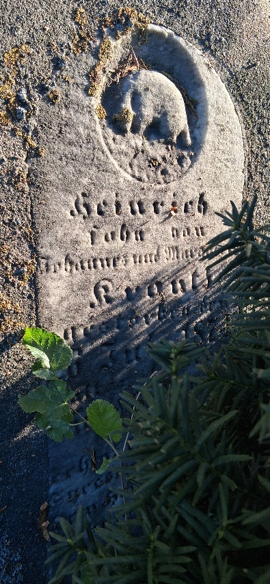
"Heinrich Sohn von Johannes und Margaretha Krantz gestorben den 26 Juli 1874 Alter 1 Jahr und 6 Monate Verse (Gadsby & Sharman, Stratford)"
In English, little Heinrich's epitaph reads: "Heinrich, son of Johannes and Margaretha Krantz, died July 26, 1874, Aged 1 Year and 6 Months. Verse."
Little Heinrich was born in January 1873 and passed away on July 26, 1874. His death occurred a mere four months after his aunt, Catharina Mogk (née Krantz), was laid to rest in Row Four. Heinrich’s father Johannes ‘John’ Krantz (1850-1933), was the brother of Catherina from the previous chapter, little Heinrich’s mother was Anna ‘Margaret’ Wettleaufer (1851-1933).

Heinrich was the first-born child of John and Margaret, saying goodbye to this sweet baby only three months prior to the birth of their next child, Anna Mary (Krantz) Sippel (1874-1930). Knowing that Margaret was with child while caring for a sick child must have been terrifying, the uncertainty and fragile nature of young life was enough to cause a mother, weeks if not years of anguish over the loved and lost.
Late summer was a notoriously dangerous time for pioneer infants. Before the advent of refrigeration, high summer heat often caused milk and well water to spoil rapidly, leading to deadly outbreaks of summer cholera or dysentery that could overwhelm a one-year-old's system in a matter of days. This was possibly the case for Heinrich, however, no specific cause was listed on this entry.

The Krantz’s would continue to have many more children, I believe 10 in total. With all surviving into the 20th century. Prior to their passing, both in 1933, John and Margaret would lose two more children, Anna Mary, mentioned above and Christina (1882-1909), age 26, cause of death pneumonia. On April 5th, two days after his death, the remaining children and Margaret, would lay to rest John, who broke his leg at 82 and then contracted pneumonia, the fatal blow. Margaret was not long behind, only four entries away, following in August, old age was listed on her record of death at the church, but the actual death certificate lists chronic myocarditis as the cause, an understandable, gradual weaking of the heart, of a life that tested every ounce of your being.

Like the Reid stone, this monument for Heinrich, was also crafted by Gadsby & Sharman of Stratford, featuring a German inscription beautifully carved by English-speaking hands, a testament to how local businesses adapted to serve the deeply rooted German traditions of Perth County's rural concessions. In fact, adaptation was the core of pioneer life, it was a time where what you were given is what you got, no more and no less. Time was not a concept in which you tried to fill, but a finite resource you had barely enough of, and every day there seemed to be less.
Margretha Schaefer Heinbuch (1872–1881)

The fifteenth position on the cairn presents a beautifully detailed German inscription that marks a profound loss during the early summer of 1881:
"Hier ruhet Margretha Schaefer An____ Tochter von Johannes u. Margaretha Heinbuch geb. den 5 Nov. 1872 gest. den 16 Juni 1881 Alter 8 Jahre 7 Monate u. 11 Tage"
Translated directly into English, this poignant stone reads: "Here rests Margretha Schaefer [An____], daughter of Johannes and Margaretha (Heinbuch), born Nov. 5, 1872, died June 16, 1881, Aged 8 Years, 7 Months, and 11 Days. [Followed by a Verse]"
The Verse reads, “Seine Laufbahn war geschwind, Ohne Sünd' und Schuld [und Pein]; [Ruht/Schläft] nun das holde Kind An des Vaters Herzen.”

Which translated to, “Its life's journey was swift, Without sin, guilt, [or pain]; Now the sweet child rests At the Father's heart."
The blank space left on this transcript bothered me, as the word is there, it is just hard to read. What we do know the word is long, German and starts with ‘An’, with that I get to clicking the buttons and asking more questions. What could this word be? Is there a common German word that would go on a headstone? What words are written to describe a daughter with that similar combination of letters?
After cleaning the stone, zooming in and out and in again, photographing from various angles, searching German text and gazing at combinations or letters that over time became more like an eye exam than an actual word with meaning, I found it! The missing word is “Angenommene”, which translates to classic Fraktur German script is – Adopted or Accepted, but in this text, more than likely Adopted daughter of Johannes and Margaretha Heinbuch. A wonderful find, however, this causes even more questions.
Margretha was born in the autumn of 1872, growing up during an era when the raw log shanties of South Easthope were quickly disappearing, replaced by prosperous brick homesteads. But as her stone reminds us, modernization never bought safety from childhood illnesses. Passing away at eight years old in June 1881, Margretha was old enough to have been walking the dirt concession lines to the local schoolhouse, helping her mother tend the summer kitchen gardens, and learning the traditional German prayers of her congregation.

But who in fact were her parents, listed as H. & F.L. Schaefer on the record of deaths. Clearly more research was needed. Unfortunately, after digging deeper, I came up empty handed. No records could be found in Ontario of her parents, leaving the question, perhaps another will uncover.
Her death in mid-June cut her down just as the strawberry fields were ripening and the heavy summer farm work was shifting into high gear. Her family of the heart buried her with a traditional verse of scriptural comfort, sealing her memory into the very bedrock of the community she left behind far too soon. The Heinbuchs' forever making a declaration to the world, that she was loved, chosen, adopted, and accepted.
Elizabeth (Weitzel) Roth (1840–1876)

The sixteenth fragment on the cairn preserves a beautifully cut but deeply weathered German inscription that requires the aid of early church registers to be fully made whole:
"Elizabeth Roth eine geborene Weitzel Ehefrau von Johannes N. Roth geboren den 7 Maerz 1840 gestorben den 13? Maerz 1876 Alter ______"
Translating to “Elizabeth Roth, a born Weitzel, wife of Johannes N. Roth, born the 7 March 1840, died the 13? March 1876, Age____”
While time and the elements ruthlessly eroded the final lines of her age calculation from the stone's face, the local church death records step into the gap to complete Elizabeth's story with precise accuracy: she died on March 13, 1876, at the exact age of 36 years and 6 days.

Born Elizabeth Weitzel in the spring of 1840, she grew up alongside the very first generation of children born into the cleared concessions of the township. She married Johannes N. Roth, navigating the immense physical and domestic expectations placed upon a pioneer wife. Her death in mid-March of 1876 occurred just six days after her thirty-sixth birthday.
March in Perth County was a notoriously difficult month; a time of freezing mud, fluctuating temperatures, and the tail-end of winter respiratory illnesses that easily preyed on exhausted bodies. Elizabeth’s passing left her husband to face the looming spring planting season with a quiet house and a heavy heart,
her broken marble slab now securely held within the protective mortar of the cairn.

Eckard Wilker (1849–1864)

Moving to position seventeen, we encounter a moving fragment that shifts our gaze to the immense grief of a prominent pioneer family losing a son on the cusp of manhood. Written in traditional German, the stone reads:
"Hier ruhet Eckard, Sohn von Andreas und Anna Maria Wilker geb. am 15 Sept. 1849 gest. am 13 Marz 1864 im Alter von 14 Jahr. und. 6 Monat."
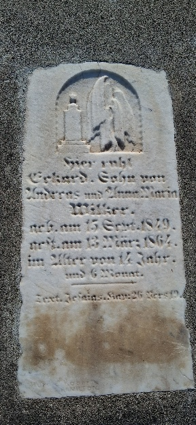
In English, this sorrowful monument reads: "Here rests Eckard, son of Andreas and Anna Maria Wilker, born Sept. 15, 1849, died March 13, 1864, at the Age of 14 Years and 6 Months." A closing text verse follows his age.
In traditional 19th-century German-Canadian churchyards, it was very common to include the specific Bible passage that the pastor preached on during the funeral service. Isaiah 26:19 is a deeply comforting resurrection verse, reading: "Your dead shall live; their bodies shall rise. You who dwell in the dust, awake and sing for joy!"
(Note: If you look at the very bottom edge below this line, you can also see the maker's mark for the stone carver, W. Opper out of New Hamburg, Ontario)

Eckard was born in the autumn of 1849 into the foundational Wilker family line. Father Andreas “Andrew” Wilker (1811-?) and mother, Anna Maria nee Wettlaufer (1814-1883). Residing on Lot 21 Concession 4, they were at the heart of Sebastopol. The exact spot where the church proudly stands today.
To lose a fourteen-year-old son in the spring of 1864 was an incredibly severe blow to a pioneer farming household. At fourteen, a boy was no longer just a child underfoot; he was actively working the fields, handling the teams of horses, and providing vital muscle to help his father clear timber and maintain the family's acreage. Eckard passed away on March 13th, coincidentally the exact same calendar day that Elizabeth Roth would slip away twelve years later. There was no receord of the original verse on Eckard's stone, now his final blessing verse is recovered by the cleaning, newly available to the eyes of history, his placement on the cairn ensures that the sacrifice of this young pioneer is never entirely erased from the township's memory.

Curiously, the next entry caught my attention as the name was identical, but the dates and age were not the same. In addition, the parents listed also did not match.


Again, more research is needed as, Andreas and Anna Maria, are not listed as the parents, yet they did have a son Jacob, born in 1836. Was this Jacob’s son named after his father, this seems probable. Yet, find a grave does not have the name of Jacobs wife as Kunigunde nee Rausch, it lists Catherine nee Heinbuch. So does this Eckhardt belong to another?
I was able to find a marriage record for John the son of Jacob, Listing the parents of the groom as Jacob and Kundigunde, or Kinsgorade. But weirdly enough someone on family search linked her to the family tree of Catherine Heinbuch. I do not believe these are the same woman, but at this point I am unable to provide proof as the records are incomplete, and they merely may have been linked by frustration in the search. We know that maiden last names Rausch and Heinbuch are not interchangeable, with the fluidity of first and middle names. So, this is not likely the same person, however, the marriage record located was from 1883, Jacob passed in 1890, so it is also unlikely this is from a second marriage and most likely the records have been crossed or confused due to name similarity. I guess this is another mystery for the family to resolve.
Jacob Jungblut (1860–1879)
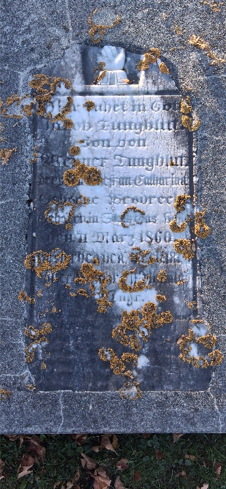
The eighteenth fragment embedded in the cairn wall features a beautifully descriptive German inscription that meticulously charts a short life cut down just weeks shy of a major milestone:
"Hier ruhet in Gott Jacob Jungblut Sohn von Werner Jungblut dessen Ehefrau Catharina geborne Broderecht geboren in South Easthope den 11 Marz 1860 gestorben den 3 Feb 1879 Alter 18 Jahre 11 Monate u. 2 tage"
Translated directly into English, his epitaph reads: "Here rests in God, Jacob Jungblut, son of Werner Jungblut and his wife Catharina, née Broderecht, born in South Easthope March 11, 1860, died Feb. 3, 1879, Aged 18 Years, 11 Months, and 2 Days." The script unfortunately lost to time.

Jacob was a first-generation son of the township, born into the deep woods of South Easthope on March 11, 1860. His parents Werner Yungblut (1829-1914) and Catherine nee Broderich (1836-1910).
By the late 1870s, he had grown into a young man on the verge of nineteen-years of earned life experience, providing critical muscle on his father Werner's farm during the winter logging and clearing seasons. He passed away on February 3, 1879; tragic. To lose a strong, grown son right on the cusp of his birthday was a catastrophic emotional and economic blow to a pioneer family, leaving Werner and Catharina to face the biting February cold with a devastating silence on the family homestead.

Jacob unfortunately left his family at the age to 18, from consumption. A once energetic, vibrant young man, cut down in the spring of his life. One unique aspect to this record is the missing name of the father. I assume this is not because the father was unknown, more likely due to the inability of the transcribers to read the previous handwritten text, and as opposed to guessing, they left it blank. Census records, Find a Grave and other sources confirm Werner was his father.
Johannes Wettlaufer (1808–1878)

At position nineteen, we move from the tragic losses of youth to the passing of an old-world patriarch whose roots stretch back to the German fatherland. Written in bold German script, the monument reads:
"Hier ruhet in Gott Johannes Wettlaufer von Grebenau gestorben 1 Feb. 1878 Alter 69 Jahre 2 Monate u. 17 Tage"

In English, this solemn monument reads: "Here rests in God, Johannes Wettlaufer, from Grebenau, died Feb. 1, 1878, Aged 69 Years, 2 Months, and 17 Days."
Johannes’s stone is an incredible historical map, explicitly naming his birthplace as Grebenau, a historic town in the Grand Duchy of Hesse. He belonged to the brave vanguard of Hessian immigrants who packed up their lives, boarded cramped timber ships, and crossed the Atlantic to carve out a brand-new destiny in Perth County.
Arriving as an adult, Johannes spent decades swinging the felling axe; unlike axes meant for splitting firewood or carving, a felling axe is engineered to cut across the wood grain, slicing deeply into the trunk with each swing. He also was skilled at pulling stubborn pine stumps and helping to solidify the Wettlaufer name as a cornerstone of the regional agricultural community. He passed away in the dead of winter 1878, a revered elder who lived to see the raw wilderness he conquered transform into a landscape of prosperous, interconnected farming concessions.

Further records uncover the believed cause of death to be old age. To think, old age at just sixty-nine, how hard must he have worked to earn those miles on that body? Either way it is an honourable age and a well dedicated life, building a community, with every year productive and deserved. Thankfully the recorder was better at documentation than math, as a miscalculation places a 67 on this record where a 69 should be. We know based on his birth year of 1808, Johannes had earned the distinction of living until his 70th year.
Katharina Maria (Kaufmann) Schaefer (1779–1871)

The twentieth fragment brings us before the oldest resident preserved on the memorial cairn, holding a breathtaking historical record that links the Sebastopol churchyard directly to the 18th century. The stone reads:
"Hier ruhet in Gott Katharina Schaefer geb. Kaufmann zu Kraussenberg K. Hessen im Jahr. 1779, 23 July gest. 1871 6 Mai Alter 92 J. 2 M 14 tage."

Translated into English, it reads: "Here rests in God, Katharina Schaefer, née Kaufmann, born in Kraussenberg, Electorate of Hesse [K. Hessen], on July 23, 1779, died May 6, 1871, Aged 92 Years, 2 Months, and 14 Days." Since cleaning the text at the bottom has become more visible, and reads…
Nun Gottlob, es ist vollbracht Gottlob! die Pilgerschaft Auf dieser Erd, die lang gewähret. Weinet Ihr lieben, thut Euch nicht betrüben Es kommt die Zeit Christus hat Bereit Wiedersehn, O Wiedersehn. Amen, Halleluja, Amen.”
The line-by-line translation…
Nun Gottlob, es ist vollbracht = Now, thank God, it is completed
Gottlob! die Pilgerschaft = Thank God! The pilgrimage
Auf dieser Erd, die lang gewähret. = Upon this earth, which lasted so long.
Weinet Ihr lieben, thut Euch nicht betrüben = Weep, my loved ones, but do not grieve
Es kommt die Zeit Christus hat Bereit = The time is coming, Christ has prepared
Wiedersehn, O Wiedersehn. = A reunion, Oh a reunion. (Literally: "To see each other again")
Amen, Halleluja, Amen. = Amen, Hallelujah, Amen.
Katharina was the wife of Johann Kasper Schafer, from the town of Eudorf, Germany, where they raised their children and watched their lives change every decade. Katharina’s life was nothing short of extraordinary. Born in 1779, to the Kaufmann family, in the Hessian village in Germany, she was already a ten-year-old girl when the French Revolution began, and a grown woman when Napoleon Bonaparte’s armies marched across Central Europe. She lived through the collapse of the Holy Roman Empire, raised her family in Germany, and made the grueling journey to Canada as an elderly matriarch alongside her adult children.
One of those children was Anna ‘Annie’ Elizabeth nee Schaefer Heinbuch, one of the first settlers to the area, arriving here in 1835 with her husband John Heinbuch. Married in Shakespeare, the same year they arrived, celebrating the event at the Fryfogel Traven, the most happening place at the time, or the only place. Records report that once married the couple returned to the bush, finding their homestead property at lot 25, concession 4. Annie and her husband lived there for almost 60 years until John’s death.
Currently unsure if Katharina had made the original journey with her daughter in 1835 or if she arrived later, perhaps after the passing of her husband, as I was unable to locate any record of him landing on Canadian soil. Either way, prior to the 1861 census and after 1835, she joined her daughter on the property that was once nothing but bush and was able to enjoy a life in Canada with her grandchildren.

Census records place her living with her daughter Annie in 1861 and 1871, just prior to her passing away in May 1871 at the spectacular age of ninety-one. In her 92nd year, she was a living, breathing link to the days before Canada or the United States were even fully formed nations, laid to rest peacefully in the soil of the new world, the day she was buried a life of historic events and global change went with her.


The record of deaths, however, records her under her maiden name, not overly common, but it sometimes happens. It also, only mentions her middle name, but does provide the important dates and the confirmation of her husband’s name, confirming this is the same person. This is a past that I feel has so much more to tell, I just couldn’t strike the right keys, uncover the secret or pull the right thread. Perhaps the family has the answers already.
Johannes Weber (1836–1866)

Stepping to position twenty-one, the German script pulls our timeline back to the mid-1860s, documenting a sudden loss that claimed a young man in the very prime of his life. The stone reads:
"Hier ruhet in Gott Johannes Weber Sohn von Johannes und Katharina Weber geb. den 14ten August 1836 gest. den 19ten April 1866 Alter 29 Jahre 8 Mo. u, 5 T."
In English, his monument reads: "Here rests in God, Johannes Weber, son of Johannes and Katharina Weber, born August 14, 1836, died April 19, 1866, Aged 29 Years, 8 Months, and 5 Days." A traditional German verse sits worn below.

Johannes was born in August 1836, making him part of the very earliest wave of pioneer children raised in the newly opened concessions. His parents Johann (1804-1883) and mother Katharina nee Niebot (1808-1884), married March 9th, 1837… Oh-uh, is this a family scandal or have the dates been recorded incorrectly. Either way the records state Johannes was born eight months prior to the marriage of his parents. They would go on to have more children, giving Johannes siblings/co-workers as the family farm needed all the hands they could provided.
By 1861 we find him, just five years before his death on the census. Twenty-five years old, married to wife, Magdalena, and his occupation: Yeoman, A proud title signifying an independent pioneer who owned and worked his own land, establishing true economic independence on the township frontier.
Little is known of Magdalena, she is most likely not the unknown lamb marker that sits at the head of the memorial cairn. Possibly one of the remarried Magdalena’s within the cemetery, but no mention of a last name, no baptism record, no marriage record or headstone, that I can find.

Johannes was just twenty-nine years old when he passed away on April 19, 1866. Mid-April was a chaotic, high-stakes time for local farmers. The frost was leaving the ground, the mud roads were nearly impassable, and families were working long, grueling hours from dawn until dusk to prepare the soil for spring planting. To lose a strong, twenty-nine-year-old partner right as the agricultural season was launching left the Weber household to shoulder the immense weight of the spring harvest with broken hearts.
Farming has and always will be a family affair, building strength from adversity, fields from of forests and memories out of moments. Sometimes these moments collide and history is made, reminding us that not every life is grand, but every life is noticed. These memories are remembered simply by a name, carved into a stone, which is just a name to some, but to others it's a hug not longer felt or a seat at the table that is no longer filled.
Joh. R. Friedrich Wettlaufer (1869–1870)

At position twenty-two, we encounter a heartbreakingly tiny fragment that reminds us how thin the line between life and death truly was for pioneer infants. The stone reads:
"Heir runhet Joh. R. Friedrich Sohn of Heinrich u. Catharina Wettlaufer geb. 19 Juni 1869 gest 17 mai 1870 Alt. 10 Mo. 28 tage"

Translated directly into English, this tiny epitaph reads: "Here rests Joh. R. Friedrich, son of Heinrich and Catharina Wettlaufer, born June 19, 1869, died May 17, 1870, Aged 10 Months, 28 Days."
Born into a well-known family, Friedrich’s parents were Heinrich Wettlaufer (1824-1898) and Catharina (Schneider) (1826-1884). Back then, big families were a necessity, and Catharina had dreams of a big family of her own. After they were married, they set to the task. Records indicate they had at least eleven children. Losing two infants, Leonhard in 1867 and Friedrich in 1870.

Here the 1871 census, shows a bustling household of seven, with John listed as the oldest child in the home. You will notice Friedrich does not appear as we had been born and passed all before this census was collected. There also appears to be grown children out of the house, but an 1861 census was not located.
Catharina dream of motherhood was answered but ended with a familiar sting, both of the sons she had carried and laboured for, the ones that should have been the last 2 sons to hold a mothers hand, passed while infants.

Little Friedrich lived for just under eleven months. His death on May 17, 1870, occurred right as spring was turning to summer. A season when fluctuating temperatures and waterborne seasonal illnesses frequently proved fatal to infants whose immune systems were fragile. For Heinrich and Catharina Wettlaufer, the loss of another baby boy meant carrying a tiny bundle into the churchyard just as the fields were greening, leaving a permanent gap in their family circle that would eventually be immortalized in stone.
Anna Louisa Wagner (1859–1874)

The twenty-third position brings us back to a family we just left in Row Four, revealing a devastating second chapter of grief for the Wagner household. Written in elegant English script, the stone reads:

"Anna Louisa daughter of jacob & Elizabeth Wagner dies Jan. 6 1874 aged 14 years 2 m's and 4 d's Sister thou art gone to rest Thins is an early lamb But Jesus summon'd thee away Thy Saviour called thee home"
The verse “Schwester, du bist zur Ruh' gegangen, Deines ist ein frühes Grab; Doch Jesus rief dich fort von hier, Dein Heiland rief dich heim.”
Translated “Sister, thou art gone to rest, Thine is an early tomb; But Jesus summon'd thee away, Thy Saviour called thee home.”
The factual timeline of this stone carries an incredibly intense, tragic weight. Exactly nine days before her father, Jacob Wagner, passed away on January 15, 1874, fourteen-year-old Anna Louisa died on January 6, 1874. In less than 2 weeks, Elizabeth Wilker Wagner was completely brought to her knees; losing her teenage daughter to smallpox with no time to celebrate the New year, and her husband to the same speckled monster just a week and two days later. This would be unimaginable today, but then it was more common than we believed.

This heartbreaking story places young Anna as patient zero in her home, most likely bringing the illness home with her from school or a friend’s home. Jacob’s sacrifice shows the unwavering affection that a parent has for their child as he most likely contracted the same illness while trying to care for his daughter, knowing his wife must stay healthy for their other children. If they could only make it through the unrelenting winter, alas, they did not.
When smallpox breached the Wagner family homestead, it shattered not only their health but the very fabric of pioneer mourning. The diagnosis transformed the home into a strictly quarantined "pox house," completely isolating the family from the community they relied on. Neighbors could only show comfort from a desperate distance, leaving essential supplies at the edge of the farm lane before retreating. Inside, the air was thick with the scent of vinegar and burning sulfur as the family kept a grueling, round-the-clock vigil over young Anna, knowing with every feverish touch that they were inviting the devastating virus onto themselves.
When the virus took its toll, there were no elaborate Victorian viewings, no crowded church services, and no communal comfort. By strict public health law, victims of the "speckled monster" had to be interred with clinical, panicked haste, often within twenty-four hours. Sealed in plain pine coffins, both Anna and Jacob were carried straight to the churchyard in devastating silence. If a minister was present, he stood far upwind at the edge of the plot to hurriedly read the commitment service, leaving the surviving family to bury their dead isolated, un-shaken, and alone on the township frontier.
The stone notes it was crafted by Gadsby & Sharman, Stratford, who engraved a beautiful English poem providing a heartfelt comfort for a family that lost a teenage girl, the reference of sister, showing that not only a mother carried the burden of grief, provides a small measure of poetic comfort to the siblings who had just lost the two primary pillars of their world.
Christina Wilker (1835–1868)

Moving to position twenty-four, we uncover a beautifully preserved monument that links the Wilker family to an early trade route beyond Perth County. Written in traditional German, it reads:
"Christina Tochter von Heinrich und Margarethe Wilker geb.

2 April 1835 gest. 21 Juli 1868 Alter 33 Jahren 3 Mo. 19 ta."
In English, it reads: "Christina, daughter of Heinrich and Margarethe Wilker, born April 2, 1835, died July 21, 1868, Aged 33 Years, 3 Months, and 19 Days."
Christina was born in the spring of 1835, growing up as one of the true eldest daughters of the earliest South Easthope settlers. Her parents, Heinrich and Margaretha (Gerhard) Wilker. Clearly listing their names, therefore this search should be simple, unfortunately that is not how this turns out. After searching for the parents in the records, I come up empty, I search the census for Christina and empty again. I assume she may have been married, at 33 there is a good chance, but nothing is recorded. I start looking for her mother, a less common name in the area Gerhard, and I find her.
Margaretha is listed on a marriage record in 1860, listed along with her husband Heinrich on a marriage record for another daughter, Margareth nee Wilker Reibeling (1837-1905), but here is the issue, the family name is recorded as Wilcker, a variation. But then the trail ends, I search more on this family and the trail is cold, which I find peculiar as this is typically a well documented family. I must be missing something.
As I collect all the information I have, I am disappointed to say the least, not in the facts, but in the documenting. From all accounts, all I can find is that Christina had a sister and that Christina passed away at thirty-three years old on July 21, 1868; the absolute height of the exhausting mid-summer harvest. Even with the lack of information, we know she was loved.

The small maker's mark at the bottom, Scott, Galt - reveals a fascinating historical fact. Before the railway hubs in Stratford and Tavistock were fully established in the 1870s, families looking for high-quality marble carvers frequently looked eastward to the older, bustling manufacturing town of Galt (now part of Cambridge). The Wilker family went to great lengths to cart this heavy marble monument back along the early stagecoach roads to ensure Christina’s memory was marked with the utmost dignity.
The Silent Cross

The twenty-fifth position on the cairn presents a solemn, completely anonymous visual anchor:
"Illegible" as recorded in the OGS, Ontario Genealogical Society.

Carved uniquely in the distinct shape of a Christian cross, this deeply weathered piece of pioneer stone had once thought to have completely surrendered its words to the passage of time. Believing that the names and dates have dissolved under decades of rain and Ontario frost, its physical silhouette remains a powerful, as we wonder at the statement of faith. It stands as a fitting final guard to this section of the cairn; a silent witness to the forgotten souls who helped lay the very foundations of the township.
After we finish cleaning a stone, it’s always a special moment when the history hidden underneath finally emerges. In this case, our work revealed an inset marble cross featuring a classic 19th-century German scripture. While the stone was heavily weathered, we could clearly make out key fragments like "ist verschlungen" (is swallowed up) and "dem Sieg" (the victory).
Piecing these fragments together, it’s clear the carving is a powerful passage from 1 Corinthians 15:54–57. It translates to: "Death is swallowed up into victory... But thanks be to God, who has given us the victory through our Lord Jesus Christ." Seeing these words reappear on the stone after so many years is a moving reminder of the hope and faith that helped our local pioneer families navigate their grief on the frontier.
Stepping back from the face of the memorial cairn, we realize we are not just looking at a collection of old headstones, we are standing before a fortress of saved memory. The twenty-five positions we documented across its stone walls have woven an unforgettable narrative of human endurance.
Through these fragments, we felt the crushing weight of the winter of 1873–1874, which ripped away fathers like Jacob Wagner and young daughters like Anna Louisa in a matter of weeks. We traced the vast geographic leaps of old-world elders like Johannes Wettlaufer and the remarkable ninety-two-year journey of Katharina Schaefer. And we stood in the quiet summer fields alongside families like the Reids, Krantzes, and Wilkers as they laid their tiny infants and young adults into the earth.
When local hands mixed the mortar and set these stones into the fieldstone cairn in 1984, they did something truly profound. They ensured that even when a marker breaks, even when a plot sinks, and even when the script becomes illegible, the community refuses to forget. These pioneers gave their strength to clear this soil, and in return, their final markers have permanently been made part of the very landscape they built.


Comments