
Chapter 2: The First to Make this Ground a Graveyard
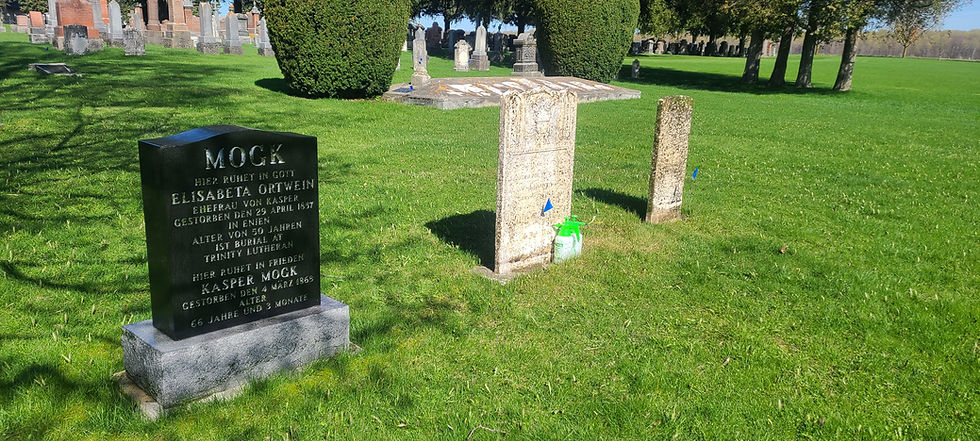
Long before the cemetery took its present shape, before rows were numbered and sections were named, three lives were laid to rest here whose stories reach back across an ocean and into the earliest years of this settlement. Their stones stand in Section A, Row one. Here you will find three stones, one a replacement, provided by a grandson, offering a newer, more easily read stone, representing a stone lost to time. The other two, artifacts, weathered and softened by time, but they mark something deeper than dates. They mark the moment when this ground shifted from a clearing to a community, when the land began to hold not only the living, but the memory of those who built the way forward.
When the Trinity restoration project began, this is where I knew I had to start: with the oldest interred. On a warm spring morning, just after 9:30 a.m., I wheeled my little wagon across the yard; brushes, D/2, water jugs, camera; toward the lichen‑covered stones that seemed to be waiting for someone to free their names again. I took my before‑photos, misted the first stone with cleaner, and let it settle into the grooves of the lettering. My goal that day was simple: these three stones, the first chapter of the cemetery’s story.

Kasper and Anna Elisabeta Ortwein Mogk, Section A, Row 1, Stone #2
The first belonged to Anna Elisabeta Ortwein Mogk, born April 7th, 1807, in Grebenau, a small market village in Hessen where the Ortwein family had lived for generations. Her childhood unfolded among timber‑framed houses and narrow streets where Lutheran hymns drifted from open windows. She was the daughter of Johann Heinrich Ortwein and Maria Christina Ruhl, raised in a world where land was scarce and futures often predetermined. But her life would soon stretch far beyond the boundaries of her village.
In March of 1827, at twenty years old, she married Johann Kasper “Casper” Mogk, born in Alsfeld in 1801. Their names appear again and again in the parish records of Hessen-Darmstadt; two families woven tightly into the fabric of the old German states. Together they crossed the Atlantic, leaving behind the familiar rhythms of home for the uncertainty of the Canadian bush.

The Mogks arrived in 1842 with two young sons, Heinrich and George, later welcoming three more children: Elizabeth (who married Conrad Wilker), Maria (who married Henry Schaefer), and their youngest, John. Early records show that upon arrival they leased land from the Canada Company, settling on Lots 21 and 22 of Concession 6, South Easthope. Their neighbours formed a small but growing German-speaking community: Henry Wilker to the east, Philip Oelig and Henry Schaefer just across the line in East Zorra. These farms would eventually be subdivided into what became the village of Tavistock.
For more than a decade the Mogks cleared, tended, and shaped the land. On September 23rd, 1853, Kasper purchased the remaining 84 acres for £68 and 5 shillings, finally securing ownership of the farm they had worked so long. The log house, the barns, the fields; they were no longer borrowed. They were theirs.
But joy is sometimes brief, as life moves us from one challenge to another. Elisabeth died on April 29th, 1857, at just fifty years old. The congregation did not yet have a formal cemetery; she was likely buried near the original log church, close to the place where she had worshipped, worked, and raised her family. Kasper followed in 1868, joining her in the churchyard among friends and neighbours who had shared the same hopes for this new land.

Elisabeth’s original stone did not survive intact and Kasper’s fragment rests within the memorial cairn erected in 1984. Elisabeth’s was replaced by a grandson, who ensured her name would not fade. The new stone, inscribed in German, carries the same words as the originals:
MOGK
Here rests in God Elisabeth Ortwein, wife of Kasper Died 29 April 1857, aged 50 years
1st Buried at Trinity Lutheran
Here rests in peace Kasper Mogk Died 4 March 1868, aged 66 years and 3 months
The Mogk homestead remained in the family for decades. In 1942, the log house was purchased by Harold “Doc” Wilker (grandson of Elisabeth Mogk Wilker), and his wife Ruby. Eventually the property changed hands, and in 2013 the buildings were removed to make way for “The Ponds” subdivision. But the land still remembers.

Census records confirm their presence. Church registers record their baptisms, marriages, and funerals. And here, in Section A, Row One, the cemetery holds what remains of their story. Cleaning their stone is not a necessity, the replacement is sturdy and clear, but it is an honour. Her name, simple and unadorned, was one of the first to be laid into this earth. The church chose to preserve it, ensuring that even as the original stone fell, the memory did not.
Before there was a churchyard, there were families who buried their loved ones close to home, trusting that one day a proper resting place would be made. Anna Elisabeth was one of them. And standing before her stone, brush in hand, you feel the truth of it: the past is never as far away as it seems.

Directly beside the Mogk stone lies the marker of Johannes Weicker, born in 1779, a man whose lifetime stretched from the final years of the Holy Roman Empire to the raw beginnings of rural Ontario. He was already in his seventies when he arrived here, carried across the ocean by the same hope that moved so many others: the promise of land, of work, and of a future for the generations who would follow him. His wife, Anna Elisabetha Bork Weicker, born in 1785, followed him into this new world with the steadiness of a woman who had already weathered much.
The Weickers' appear in the earliest census lists as farmers, neighbours, and founding members of the Lutheran community. Johannes lived only a short time in this new land; passing over in 1857, the same year as Anna Elisabeth Mogk. His burial, too, likely took place near the first church; the simple log structure where the congregation gathered to pray, sing, and steady themselves against the hardships of pioneer life. His stone, now one of the oldest in the Trinity burial ground, stands as a reminder that this place was shaped not only by the young and strong, but also by those who carried wisdom, memory, and faith across an ocean.
Anna lived until 1862, long enough to see the first church raised and the settlement take root. Their names appear throughout early records, listed among the families who cleared the bush, tended small fields, and gathered for worship wherever space allowed. They were part of the congregation before there was a building, part of the community before there was a village.
Her death in 1862 places her among the earliest women buried in this ground. Her stone, though softened by time, still carries the dignity of a life lived with endurance. She represents the countless women whose labour; often unrecorded, sustained families through illness, childbirth, hunger, and the relentless work of clearing land. Her presence here reminds us that the story of this place is not only one of axes and fields, but also of kitchens, cradles, and quiet resilience.

The Record of Deaths for the Church, places Johannes Weicker at #28 on the list. His records reads as follows…” On the 19th May, 1857, in the morning at 10:45 died Johannes Weicker, born August 2, 1776 in Leusel district of Ashfeld, Hessen Darmstadt, Germany. He married Anna Elizabeth Bork from Alsfeld, Hessen Darmstadt, Germany in 1805 and lived with her in a happy and Christian marriage. He came to Canada in 1830 and with the help of God, he succeeded in living seemingly successful life and unhappily in the year 1857, he was struck by a stroke, which affected his left side. On the 1st day of Easter, as well as his wife, he had enough strength to take along with her, the Holy Sacrament about 9:00 am. His death, however, followed but he was able to get home first. He is survived by his wife, 2 sons, and 5 daughters, married and 42 grandchildren and 7 great grandchildren. Six children have preceded them into eternity, 12 grandchildren and 5 great-grandchildren as well. Burial May 21, 1857 on the first day of ascension of our Lord. CFA Kaessmann.
Later in the Record of Death we locate his wife, Anna Elizabeth Bork Weicker as #70 and reads the following, “Died on June 9th in the morning at 6:00 o’clock, 2nd Pentecost day, the wife of deceased Johannes Weiker, Anna Elizabeth Bork, born February 17, 1785, in Augenrod in the place of Filia in the community of Billertshausen, Ashfeld, Hessen Darmstadt. She married in 1805 and her husband died on May 19, 1857. This marriage lasted for 52 years. They had 13 children. Of these at present, there are two sons Johannes and Heinrich and five daughters, while six children have previously died. Her entire survivors which totaled up to 97, namely 13 children, 62 Grandchildren and 22 great grandchildren. There are still 72 who are living .
She brought her age 77 years, 3 months, 22 days and live after her husband 5 years and 20 days in the same house. She apparently was ill for some time almost 3 years. However, she became critically ill only the day before the second day of Pentecost. (The pastor then wrote: I visited her and found her in great spirits and strong.) Reference to 42nd DH. I blessed her with the Trinity as a blessing to God and she then on the 11th of June was brought to the local cemetery and buried and friends from far and near came to see her and follow her to the gravesite for their own edification. Peace to her ashes.”
Whether these four; The Mogks and the Weickers, were buried here originally or reinterred when the cemetery was formally established remains uncertain. The earliest church stood on the Wilker clearing, and it is possible, even likely, that the first burials were made close to that original log structure. When the 1883 brick church rose on its present site, the congregation may have gathered the earliest stones and brought them here, ensuring that the founders of their faith community would not be forgotten. What is certain is that these stones, fragile as they are, carry the weight of beginnings. They hold the names of people who crossed oceans, felled trees, raised children, spread roots, and prayed in borrowed spaces long before permanence arrived.
Their presence here is not just historical, it is personal. These were neighbours, parents, grandparents, the ones who first lit lanterns in the darkness of the bush and trusted that a future could be built from almost nothing. Their stories are not written in long biographies or preserved in grand archives. They survive in the quiet details: a census line, a baptismal record, a weathered inscription softened by rain. And yet, these small traces are enough. They remind us that every community begins with a handful of lives lived with courage, endurance, and faith.
As we walk among their stones today, we are not simply reading names. We are acknowledging the first chapter of this place; the people who carried their traditions across the sea, who shaped the land with their hands, and who now rest in the soil they once worked. Their stories deserve to be remembered, tended, and spoken aloud. Without them, there would be no church, no cemetery, no community at all. Only forest, and the echo of axes in the distance.
As I begin the preservation work at Trinity, it feels right to start with this row; the first row, the oldest stones, the names that anchored everything that followed. Cleaning these markers is not just a task; it is an act of gratitude. It is a way of honouring the people who cleared the land, built the first church, and laid the foundations of a community that still gathers here nearly two centuries later. Their stones may be fragile, but their stories are not. And with care, patience, and respect, we can help ensure that their names continue to be spoken, remembered, and carried forward.
Next week we continue into the rows, moving into the 2nd row, cleaning off the stones, and recovering the past. This row holds the legacies of Kalbfleisch, Weitzel, Roth, Kaufmann, Wilker and another Weicker. Discover their contributions to the church and community, plus what they added to their farm and family.
Angie Moore


Comments