
St.James of Wilmot Chapter 3: Quiet Whispers from Row 2 (Stones 1-8)
Stepping out of Row 1 and moving forward into Row 2, the quiet sacred ground of St. James Anglican Cemetery opens up a fresh layer of Wilmot’s pioneer memory. Here, beneath the shifting shadows of the tall canopy, the stones tell a story of interconnected lives; families who crossed the Atlantic together, shared triumphs and tragedies in the bush, and bound their legacies to this soil. The first half of Row 2 brings us face-to-face with shared pioneer monuments, poignant infant loss, high-flying modern tributes, and the deep roots of our agricultural history.
Row 2 Stone 1: Thomas Stockwell (1799–1840), Thomas Hutcheson (1785-1835), and Robert Puddicombe (1800-1841) - The Pioneer Cenotaph

Standing before Stone 1 is like holding a physical cross-section of Wilmot’s earliest British settlement. This remarkable multi-sided marker functions as a collective historic cenotaph, tying together three major immigrant families who arrived in Upper Canada during the 1830s.
Here rest three men from three distinct corners of England - Thomas Stockwell of Cambridgeshire, Thomas Hutcheson of Lincolnshire, and Robert Puddicombe of Devonshire, who all passed away within a six-year window between 1835 and 1841. In those early frontier days, long before stonecutters were readily accessible in the region, loved ones were often laid to rest under simple wooden markers. Years later, as family ties intermingled through marriage, this enduring joint monument was erected to ensure these three early trailblazers were permanently remembered side-by-side.
Inscription (South): Sacred / in memory of / Thomas STOCKWELL / native of / Cambridgeshire / England / who departed this life / May 1, A. D. 1840 / in the 41st year of his age
Inscription (East): Sacred / in memory of / Thomas HUTCHESON / native of / Lincolnshire / England / who departed this life / Oct. 11, A. D. 1835 / in 50th year of / his life
Inscription (North): Sacred / in memory of / Robert PUDDICOMBE / native of / Devonshire / England / who departed this life / April 25, A. D. 1841 / in the 41st year of / his life
Understanding the timing of this stone reveals a fascinating piece of early Wilmot history. The land for St. James Anglican Church and its burying ground was not formally deeded by the Canada Company until 1857. While circuit-riding missionaries like Dr. Benjamin Cronyn traveled the region holding services and offering prayers over early graves in the 1830s and 1840s, a formal, consecrated cemetery did not yet exist when Thomas Hutcheson died in 1835.
This means these three men were almost certainly buried elsewhere initially; either in temporary homestead plots or under simple wooden markers. Years later, after St. James was firmly established, their families either reinterred their remains here or erected this multi-sided joint monument as a retroactive cenotaph, ensuring their names and overseas origins were preserved together for generations to come.
Thomas Stockwell (d. May 1, 1840, in his 41st year)

Hailing from the agricultural landscape of Cambridgeshire, England, Thomas Stockwell arrived in Upper Canada during the heavy British emigration wave of the 1830s. Born around 1799 to his parents, William Stockwell (or Stockdale) and Sarah Greason (also recorded as Griason), Thomas grew up alongside his younger sister, Elizabeth, who rests just a row away in Row 1 as the wife of pioneer Henry Puddicombe.
As the older brother, Thomas helped lead the family’s transatlantic crossing, bringing their East Anglian roots to the dense hardwood forests of Waterloo County. His early presence in Wilmot Township was instrumental in anchoring the Stockwell family line in the region, bridging ties between their native England and the emerging settlement along the Huron Road.
Tragically, Thomas’s chapter in Upper Canada was cut short when he passed away on May 1, 1840, at just forty years of age. Dying long before the formal churchyard at St. James was deeded, his early passing left his sister Elizabeth and the extended family to carry on the family name through the mid-Victorian era. His memory; intertwined with the Puddicombe, Hutcheson, and broader pioneer lines through shared faith and church leadership, remains permanently etched on the South face of Stone 1, standing as an enduring testimonial to an older brother who helped pave the way for his family in the Canadian bush.
Thomas Hutcheson (d. Oct 11, 1835, in his 50th year)

As the earliest death recorded on this multi-sided monument, Thomas Hutcheson passed away on October 11, 1835, in his fiftieth year; long before civil death registration, township infrastructure, or established churchyards existed in Waterloo County. Leaving behind his home in Lincolnshire, England, Thomas had braved the Atlantic crossing with his family to carve out a new future along the frontier of Wilmot Township.
Thomas was the husband of Sarah Hutchisson (1765–1856), the venerable pioneer matriarch whose resting place we met in Row 1. His sudden passing during the family’s first grueling years of clearing the dense hardwood bush was a devastating blow. It left Sarah, already in her late sixties, to navigate more than two decades of pioneer widowhood on the Upper Canadian frontier.
His marker on the East face of Stone 1 also holds the key to one of Row 1's most famous genealogical puzzles: the surname spelling variation. While Thomas’s section of this cenotaph clearly records the family name as HUTCHESON, Sarah’s stone in Row 1, erected twenty-one years later by a subsequent generation, was permanently carved as HUTCHISSON. Dying nearly a quarter-century before St. James cemetery was formally deeded, Thomas’s early sacrifice on the frontier is preserved here beside his Devonshire and Cambridgeshire neighbors, anchoring the Hutcheson family legacy to the very soil they helped tame.
Robert Puddicombe (d. April 25, 1841, in his 41st year)

Representing the Devonshire branch of the monument, Robert Puddicombe was a vital link in the early migration story of one of Wilmot’s core pioneer families. Born in Beaford, Devonshire, England, Robert was the brother of Henry Puddicombe (1803–1882), whose resting place lies nearby in Row 1 alongside his wife, Elizabeth (Stockwell) Puddicombe and William Puddicombe (1798–1877). Together, these Devonshire brothers made the daring decision to leave the rolling green hills of south-west England to claim land along the Huron settlement corridor in Upper Canada.
Making the journey across the Atlantic in the 1830s, the Puddicombe brothers faced the immense physical challenge of transforming dense hardwood forest into workable farmsteads. Tragically, Robert passed away on April 25, 1841, at just forty years of age, less than a year after his brother Henry's brother-in-law, Thomas Stockwell, passed away.
Dying in the prime of his life, Robert’s story was cut short before the family farmsteads had fully matured into the prosperous agricultural properties they would become later in the Victorian era. His inclusion on the North face of Stone 1, standing side-by-side with his family's Cambridgeshire and Lincolnshire neighbors, serves as a poignant reminder of the tight-knit bonds between the Puddicombes and Stockwells, ensuring that this Devonshire brother's early sacrifice on the frontier was never forgotten by the generations that followed.
Row 2 Stone 2: James Hawes (1869–1897)

Just past the pioneer cenotaph stands the quiet marker for James Hawes. Born on Canada’s second Dominion Day in July 1869, James represented the first generation of native-born Canadians coming of age in Waterloo County. His life was cut tragically short late in the summer of 1897 at just twenty-eight years old; a time when young men were the vital heartbeat of rural family farms. The single word carved at the base, Remembered, carries a simple, timeless weight across the generations.
Inscription: In memory of / James HAWES / born July 1, 1869 / died Sept. 5, 1897 / Remembered / HAWES
The son of Stephen and Rhoda Raby Hawes, James was raised in the heart of the local farming community. Coming of age in rural Wilmot Township meant shouldering the heavy physical demands of agricultural life at a time when strong young men were the vital heartbeat of family operations. As a young man, he married Maria Schrek (1867–1945), building a home and stepping into the promising future of late-Victorian Ontario.
Tragically, that future was cut short late in the summer of 1897. On September 5, 1897, at just twenty-eight years of age, James passed away, leaving Maria a young widow and shattering his family's world just as harvest season was getting under way. While Maria would live on for nearly another half-century, carrying his memory through the First and Second World Wars before her passing in 1945, James remained forever young in the soil of St. James.
While ongoing local genealogical research continues to clarify his exact branch among the regional Hawes families; some of whom remained in Southwestern Ontario while others joined the late-19th-century migration west to Manitoba, his physical presence here in Row 2 anchors his story firmly to Wilmot Township. Cleaning the moss from his stone brings back into focus a young husband, son, and native-born Canadian whose early loss echoes softly through Row 2.
Row 2 Stone 3: George Forsyth (1823–1898)

Beside the Hawes stone lies George Forsyth, a pioneer whose life spanned the vast transformation of Wilmot Township. Born in Ireland in 1823, George joined the wave of Irish emigration that helped settle Waterloo County, arriving as a young man to help tame the dense hardwood bush along the Huron corridor. Passing away in the early spring of 1898 at seventy-five years of age, he belonged to that resilient generation who saw Waterloo County evolve from virgin timber into some of the most productive farmland and bustling rural hamlets in the province.
Inscription: In memory of / George FORSYTH / died April 4, 1898 / aged 75 yrs. & 12 d's / FORSYTH
Upon his death in 1898, the official death register listed George’s occupation as postmaster; a title that placed him directly at the economic and social heartbeat of his rural community. In 19th-century Ontario, serving as postmaster went far beyond simply hand-canceling stamps; it was a position of immense public trust, requiring high literacy, meticulous ledger accounting, and posting a heavy financial bond.
Before rural home delivery existed, villagers relied on the local post office; often run out of a central general store or tavern; to connect with the outside world. George would have weighed outgoing mail on handheld balance scales, posted lists of unclaimed letters in the window for neighbors coming into town, and managed the Post Office Money Order system that allowed pioneer families to send funds back home to Ireland or Britain. Serving as equal parts postal administrator, news hub, and early village banker, George provided the vital daily link that kept isolated farmsteads tied to the broader world.
His clean marble stone stands today as a firm testament to a lifetime of honest toil, civic duty, and quiet devotion to his parish community.
Row 2 Stone 4: The Barber Family – Agnes Vance (1837-1912), Robert (-1892), Clara Mabel (1879-1880), & Mary A. (1872-1874)

Stone 4 tells the deeply emotional narrative of the Barber family; a story woven with both long community service and immense personal sorrow. Robert Barber, a respected pillar of the district, passed away in February 1892, leaving behind his wife Agnes, who survived him by two decades until 1912.
Yet the most heartbreaking facets of this monument belong to the North and West faces, which record the losses of their two baby daughters, Mary A. (d. 1874, aged 2) and Clara Mabel (d. 1880, aged 1). Carved into the stone are tender, poetic verses comparing the little girls to fragile buds called home before they could fully bloom. Cleaning the lichen from this four-sided marker brings a mother's deepest tears back into crisp, clear view under the leaves.
Inscription (South side): Agnes / wife of / Robert BARBER / 1837–1912
Inscription (East side): In memory of / Robt. BARBER / died Feb. 9, 1892 / aged 64 yrs / 3 mos. & 8 ds / Kind friends beware as you pass by / As you are now, so once was I / As I am now, so you must be / Prepare therefore to follow me / BARBER
Inscription (North side): In / memory of / Clara Mabel / dau. of / Robert & Agnes / BARBER / died Aug. 14, 1880 / aged 1 yr. 4 ds / Beneath this stone in sweet repose / is laid a mother's dearest pride / A tender flower that scarce had waked / to life and beauty ere it died
Inscription (West side): In / memory / of / Mary A / dau. of / Robert & Agnes / BARBER / died Sept. 7, 1874 / aged 2 yrs / The lovely bud so young, fair / called home by early doom / Just came to show how fair a flower / in Paradise would bloom
Robert Barber was not the first of his family to depart Ireland, but it is here that our story begins. Born in County Sligo, Ireland, in 1827, Robert came into a world marked by the quiet hardships of pre-Famine Ireland; a time when rising economic uncertainty pushed many families to look across the Atlantic for a future. Immigrating to Upper Canada in 1838 at just eleven years of age, young Robert arrived with his sister Elizabeth Barber Squires (whose resting place we visited in Row 1) and their parents, first making a home near the muddy streets of Toronto; still affectionately known by locals as "Little York."
By 1842, at fifteen years old, Robert set out for Wilmot Township to establish a permanent residence. Family lore tells us he made the entire journey on foot, spending his first night on the trail in Strasburg before completing the trek the following day. He took up residence on a tract of land that would later become known as the Levi Master farm. Settling the bush was a grueling endeavor, made all the more bitter by an early setback: the first $200 Robert painstakingly saved to pay toward the farm was stolen, a devastating loss for a young pioneer, with the culprit never caught.
Despite the theft, Robert persevered. In April 1854, he married Agnes Vance, daughter of Robert Vance and Mary Hogg, and sister to local pioneer Joseph Vance. Agnes was born in 1832, belonging to one of the foundational pioneer families of the area. Growing up alongside her brother Joseph, Agnes learned early on the quiet strength required to turn the wild brush of Wilmot Township into a thriving home. When she married Robert Barber in April 1854, she stepped into a life of shared toil, deep faith, and profound personal sacrifice.
Their marriage was blessed with seven children; four boys and three girls. Yet, like so many frontier households, their joy was shadowed by profound heartbreak. Angel wings awaited two of their little girls not long after their arrival; carved into the North and West faces of this very monument are the names of Mary A., who died on September 7, 1874, at aged 2, and Clara Mabel, who died on August 14, 1880, at aged 1.
In mid-19th-century rural Ontario, infant and child mortality was a constant, haunting shadow over even the most devoted pioneer households. Long before the discovery of antibiotics or routine vaccinations, vulnerable toddlers frequently succumbed to sudden, devastating childhood illnesses. Summer months brought "cholera infantum" and severe gastrointestinal infections from untreated well water, while harsh Canadian winters ushered in lethal bouts of croup, diphtheria, scarlet fever, and pneumonia. For Robert and Agnes Barber, laying two of their sweet little girls into the cold soil of St. James just months or years apart was a devastating price paid on the frontier; a profound grief shared by so many of their neighbors, yet lovingly memorialized here so their brief lives would never be forgotten.
After a long life of honest toil, Robert passed away in early February 1892 following a brief illness. His obituary, published in the New Hamburg Independent on February 12, 1892, honored him as one of the oldest and most respected residents in the district, noting that he had anchored his life in the same neighborhood for over half a century, leaving Agnes to steer the family and manage the homestead on her own for the next two decades.
As a pioneer widow, Agnes navigated over twenty years of quiet independence, watching the world around her rapidly transform. She saw horse-drawn buggies give way to early automobiles and watched her surviving children and grandchildren grow to take their own places in Waterloo and Perth counties. Throughout her long widowhood, her faith and deep roots in the community remained her steadying guide. When Agnes was finally called home in 1912, she was laid to rest beside her beloved Robert and their two infant daughters.
Reunited under the pines of St. James, her presence on the family marker stands as an enduring tribute to a matriarch whose resilience carried her household across two centuries of Canadian history.
Row 2 Stone 5: The Stanley Family – Rick, John F. and Jo
In striking contrast to the 19th-century white marble surrounding it, Stone 5 brings us into the modern era with a beautiful, poignant tribute to the Stanley family. The front features a striking etched image of a hang-glider catching the wind above the words Blue skies forever, honoring young Richard "Rick" Stanley, who passed away in August 1986 at just twenty-one years old.
Inscription (Front): / Blue skies forever / STANLEY / Richard (Rick) STANLEY / Sept. 7, 1964 – Aug. 14, 1986 / Beloved son of Ada & John / and brother of / Eileen, John & Rob / Superior Memorials, Kitchener
Inscription (Back): John F. STANLEY / 1926–1999 / John (Jo) STANLEY / 1962–2005
Rick was later rejoined here by his father, John F. Stanley (d. 1999), and his brother, John "Jo" Stanley (d. 2005). The modern granite monument serves as a powerful reminder that St. James is not merely a historic museum of the 1800s, but a living, breathing sanctuary where families continue to lay their beloved to rest across centuries.
Since these dates are not incredibly old and living direct family members may still exist, we will not get into the detail for this stone.
Row 2 Stone 6: John Crackel (1806-1889), Mary Spicer (1803-1859), Phemia McDonald (1833-1913)
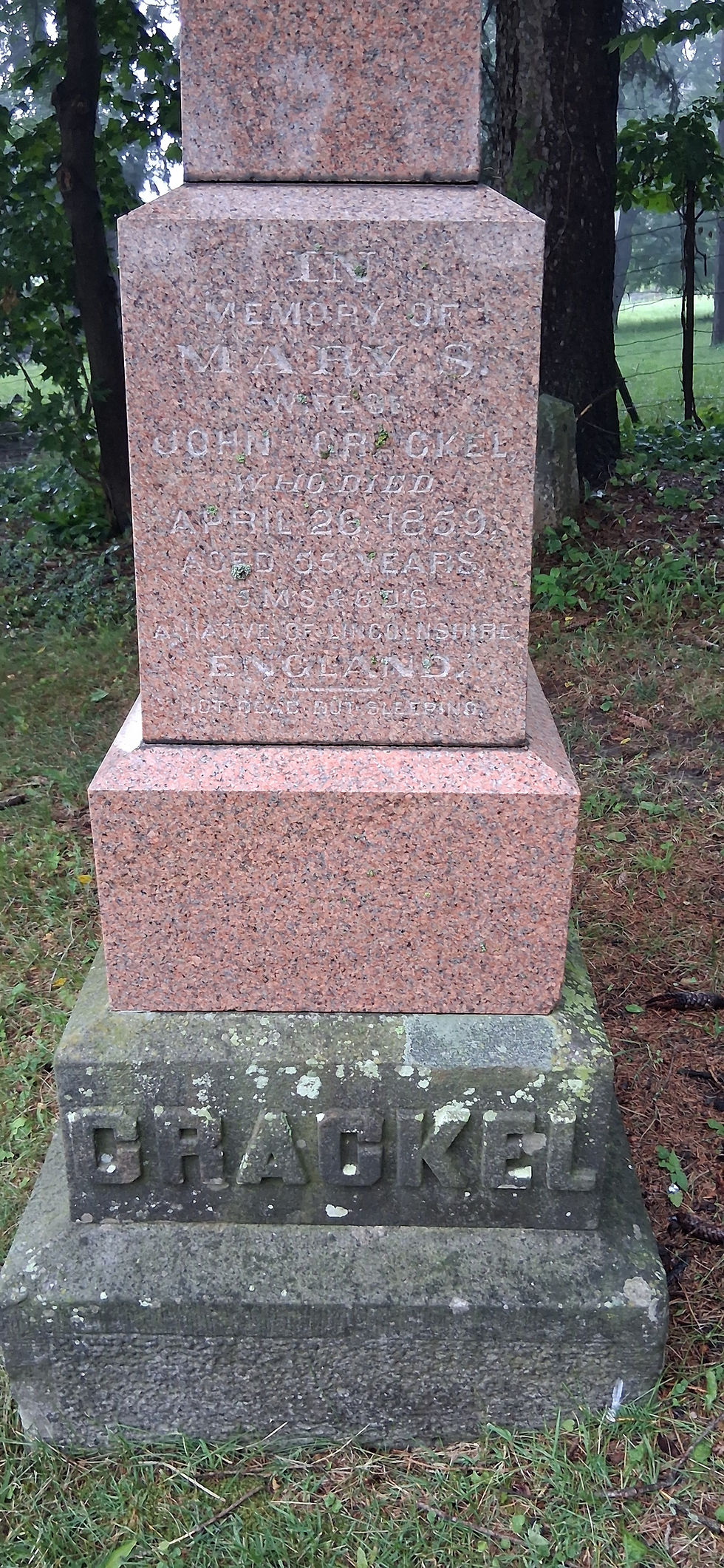
Stone 6 records the transatlantic journey of another foundational Lincolnshire family whose roots run deep through the soil of Wilmot Township. This three-sided monument stands as a powerful testament to pioneer endurance, English heritage, and the complex tapestry of 19th-century family life.
Inscription (South): In / memory of / John CRACKEL / who died / Aug. 8, 1889 / aged 83 years / 3 m's. & 6 d's / A native of Lincolnshire / England / Sleep on and take thy rest
Inscription (East): In / memory of / Mary S / wife of / John CRACKEL / who died / April 26, 1859 / aged 55 years / 5 m's. & 6 d's / A native of Lincolnshire / England / Not dead but sleeping / CRACKEL
Inscription (North): Phemia / wife of / John CRACKEL / 1833–1913
Patriarch John Crackel was born in Lincolnshire, England, in May 1806. As a young man in agricultural East Anglia, John braved the Atlantic crossing alongside his first wife, Mary Spicer (1803–1859), joining the early wave of British emigrants who undertook the grueling task of carving farmsteads out of Waterloo County's virgin timber.
Mary Spicer Crackel was among the early pioneer matriarchs laid to rest in the churchyard when she passed away in the spring thaw of April 1859, aged fifty-five. Her early passing left John with a heavy farm household to manage alone during a period when running a pioneer property required constant, collaborative labor. The tender verse beneath her name ‘Not dead but sleeping’ was etched into the marble just two years after the land for St. James Cemetery was formally deeded.

Following Mary’s death, John remarried, taking as his second wife Euphemia "Phemia" McDonald (1833–1913). Phemia brought a rich Scottish heritage to the Crackel household, representing a generation born on Canadian soil during the early settlement years. Nearly thirty years John’s junior, Phemia stepped into the demanding role of a farmer’s wife, anchoring the household through the mid-Victorian era as John entered his elder years.

John lived on as a highly respected community elder, passing away on August 8, 1889, at the advanced age of eighty-three. His thirty-year widowhood following Mary's death had been spent in partnership with Phemia, who survived him by another twenty-four years. Phemia lived through the turn of the century and the Edwardian era, passing away in 1913 on the eve of the First World War.
Together on this single, multi-faceted monument, Mary Spicer and Phemia McDonald rest side by side with the husband they both loved. The explicitly carved Lincolnshire origins on the East and South faces serve as an enduring, permanent link connecting Wilmot's farmland back to the fenlands of eastern England.
Row 2 Stone 7: William Smith (1834-1860), Anthony Smith (1805-1868) and Hannah Cummings Smith (1807-1894)

Stone 7 brings us to the resting place of Anthony and Hannah Smith, along with their grown son, William. The family suffered an early loss when William passed away in June 1860 at twenty-six years old, remembered by a touching verse written from the perspective of his surviving siblings.
Inscription (South): In / memory of / William / son of / Anthony & Hannah / SMITH / died June 19, 1860 / aged 26 years / 7 mos. 28 ds / Sleep brother dear, and take your rest / God called you home, he thought it best / Twas hard indeed to part with thee / but Christ's strong arm supported me
Inscription (East): In / memory of / Anthony SMITH / died / Jan. 1st 1868 / aged 62 years / 3 mos. 17 ds / Hannah / wife of / Anthony SMITH / died Jan. 2nd 1894 / aged 86 years / 2 mos. 5 ds / Our parents here lie underground / the dearest friends we ever found / But through the Lord's unbounded love / we hope to meet in realms above / SMITH
William was welcomed into the family as the first-born son, the oldest child in the Smith household. Surrounded by at least 4 siblings, Born in Durham England. William made the voyage along with his parents, two brothers and a sister, the final child Thomas would be born in Tavistock, Ontario after the arrival. Based on the dates and records, we calculate their immigration between 1850-1854.
Estimating at this time, William was between 16 to 20 when he arrived, and only surviving until his 26th birthday. Unsure of the cause of death, whether a farming accident or a illness the family was unable to control, his loss marked a dark day for the Smith family, perhaps preparing them for what was to come.
Eight years later, patriarch Anthony passed away on New Year’s Day 1868, leaving Hannah to navigate twenty-six years of widowhood before passing away on January 2, 1894; just one day after the twenty-sixth anniversary of her husband's death. The warm epitaph carved by their children calls them "the dearest friends we ever found," encapsulating the deep bond of early pioneer families who relied on faith and each other to survive the wilderness.
Row 2 Stone 8: The Forgotten Base (SR-2-8)

Completing the first half of Row 2 is Stone 8 or rather, an empty space where a monument once stood. Over decades of ground movement, frost heaving, and past maintenance, the marble tablet originally set into a previously discovered socket became dislodged, eventually coming to rest near Row 1. Recorded in the OGS transcripts from 1987.
Status: Concrete socket base only; marble tablet displaced to SR-1-1
Unfortunately the socket o longer exists, leaving an empty footprint in the row, this vacant space is a quiet call to arms for cemetery conservation. It reminds us why we continue to map, probe, and match loose tablets to their original foundations, ensuring that no story in Row 2 remains scattered or incomplete.
But who rests here? It is with the records we find a clue, a way to follow the stone and find out who it belongs to, written in the status is a location SR-1-1, leading us to the records and the protected stones that surround the church today. Originally unsure where these stones had come from, it has been discovered that over years of wear and tear, the displaced stones have found their way here, in addition to stones from possible homestead cemeteries. This is the first of these stones we have connected to the rows, undoubtedly, more will follow. We re-introduce the stone of Elizabeth Jury Smith
(Preserved at Church Perimeter): Elizabeth Jury Smith (1838–1874)

Born Elizabeth Jury in August 1838, she belonged to one of the early Jury families who settled in Southwestern Ontario. Daughter of Thomas and Elizabeth Jury. Her marriage to Anthony in 1861, was filled with dreams and promises for the future together. Into that future they welcomed six children, Charity 1861, John 1862, Anthony A 1864, Thomas 1869, Robert 1872 and Jacob 1874. The last child born the year she passed.
Inscription: [stone broken] In memory of / Elizabeth / beloved wife of / Anthony SMITH / who died / Jan. 7, 1874 / aged 35 years / 4 months & 9 days / Sleep on my dear in calm repose / though parted now awhile / In yonder realm we'll join to praise / and greet your happy smile
Anthony was the son of the previous stone holders, Anthony and Hannah Smith, making these children, their grandchildren and Elizabeth their daughter-in-law. One might imagine the entire family attending Sunday service, the grandchildren running up their grandparents and Elizabeth chatting with her sister as each family rolls up in their very best, ready to share the news of the week. Each one enjoying the beautiful, carefree summer days that everyone knew would not last forever.
Elizabeth passed away in the cold depths of winter on January 7, 1874, the cause tuberculosis, at just thirty-five years of age; a tragically early loss that left Anthony to manage their household and farm property alone during the prime of his life. Alas, he was not alone, family records indicate that during Elizabeth’s illness, her sister Charity Jury (1851-1929) looked after and cared for the family.
Preceding Elizabeth’s death, Charity and Anthony were married in February of 1876, moving from Ontario to Alberta they added four more children, Walter 1878, Frederick 1882, Emily May 1885 and Florence 1889.
The poignant verse carved across her broken stone; ‘Sleep on my dear in calm repose, though parted now awhile’, speaks to a husband’s unshakeable Christian belief in a future heavenly reunion. Though the physical marble fractured over decades of freeze-thaw cycles in Row 2, its careful preservation near the church walls ensures that Elizabeth Jury Smith's memory remains safe, honored, and readable for generations to come. I am hopeful to clean these stones in future projects and show them the respect that they deserve.
Reflecting on these first eight positions of Row 2, we see the true heartbeat of pioneer Wilmot Township laid bare beneath the soil. From the early settlement cenotaphs and young native-born Canadians like James Hawes to the long-distance treks of Sligo emigrants Robert Barber and Agnes Vance, this stretch of churchyard tells a story of incredible resilience. Here, young mothers like Elizabeth Jury Smith and tender infant daughters like Clara Mabel and Mary A. Barber rest alongside elder Lincolnshire pioneers like John Crackel, Mary Spicer, and Phemia McDonald.
Whether carved in pristine granite or etched into fractured white marble preserved against the church walls, every monument in this first section of Row 2 holds a piece of our shared heritage. As we move down the second half of this row, we continue our commitment to cleaning, documenting, and protecting these voices; ensuring that those who built this community are forever remembered under the canopy of St. James. Join us next week for the continuation of Row 2.


Comments