
The 11th Furrow – William Dunn (1809-1893) Awaking Downie Township, One Acre at a Time
Updated: Apr 8
There is a particular stillness in the autumn of 1842; a kind of hush that settles over the Huron Tract when the leaves begin to turn and the fields lie waiting for frost. It was in such a season that John J.E. Linton, the careful and methodical recorder of settler statements, made his way along the rough roads leading out of Stratford. His task was simple in theory but profound in practice: to gather the lived experiences of the men and women who had carved their homes from the bush, and to preserve their words for those who would follow.
Linton was not a farmer, nor a pioneer in the physical sense, but he possessed the quiet patience of a man who understood the value of listening. And so, he travelled from lot to lot, notebook in hand, sitting at rough-hewn tables or on split-log benches while settlers recounted the long, hard years that had brought them to this moment.
It was on the 22nd of September, 1842, in the Township of Downie, that he met with William Dunn, a man whose story, like so many others, began with hope, hardship, and the unyielding promise of land.

“I live near Rothbury in that county, but latterly I was in the employ of Mr. Joseph Hopper, merchant and miller, Squirrel Mills, Newcastle-on-Tyne; I was in this gentleman's employment when I left. My family only consisted of my wife, but I have four children since I came here. My father-in-law, John Gibb, (who also lived near Rothbury) with his son George, emigrated to Canada in 1834, and settled in the township, and they wrote home to me and his son-in-law, George Wood, giving a description of the country, and particularly of this place, and we resolved to follow them.”
As William spoke, one imagines Linton leaning forward slightly, pencil poised, capturing every detail. These were not grand tales of adventure, but the honest recollections of a man who had crossed an ocean with nothing but his wife and the belief that life could be better. The Gibbs and the Woods, names that still echo through the early records of Downie, had gone ahead, sending back letters filled with both warning and encouragement. It was enough to draw William across the sea.
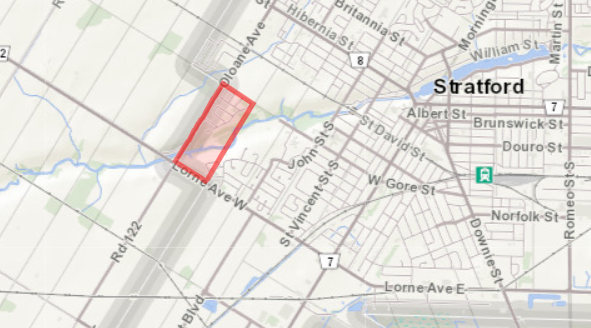
“When I arrived in the village of Stratford (which is about two miles away from my farm) I had not as cent, but I was owing George seventy-five dollars for advances he had made me, but this sum I have long since paid. Being a farm servant and labourer at home, and understanding a little of the milling business, I soon found profitable employment here (for I did not locate myself on land when I came) and at the grist and sawmill in Stratford. In the fall of 1837, I bought out the interest of the settler in Lot No. 5 in the concession of the township, consisting of 100 acres, but there was not a tree chopped on it.”
Although William provides the Lot number, he makes no mention of the concession. As I read through the statement, he makes mention of the Avon River running through his property and his location as 3 miles from Stratford. As the 5th lots run NE to SW, I can confidently estimate that Williams property was Lot 5 of Concession 2, the only Lot 5 with the Avon River running through it, and the Stratford core within the range.

Stratford in 1835 was hardly more than a clearing, just the mills, a few scattered buildings, and the river Avon winding its way through the bush. William arrived with debt, determination, and the skills of a miller, which were worth more in those days than any coin he lacked. His early years were spent working for others, saving what he could, until the moment came when he could claim a piece of land of his own.
“I paid $110 for the right to the lot, having the original price to the Canada company to be paid besides, at the rate of 1-1/2 dollars per acre, besides interest. I paid $60 in one payment to the Company, and some money since. I did not remove to live on the lot till spring of 1838. but in the fall in the winter of 1837-38, I chopped it on it, and that spring I put up a ‘shanty’ (a small log house) and cleared land for spring crops. The first crops I had were in the harvest of 1838. I now have a good log house with a log barn and other additions, and about thirty-five acres of cleared land, and well fenced. This land I have cleared all myself except for one acre, which I paid for.”
Linton would have known, as he wrote, that these details mattered. They were the measure of a settler’s progress: the number of acres cleared, the buildings erected, the debts paid down. William’s pride was quiet but unmistakable. A shanty first, then a proper log house, a barn, then fences, in all thirty-five acres cleared by his own hands. These were the milestones of a life built from the ground up.

“My land is exceedingly well watered, for the river Avon passes through my lot. This is the stream which goes through the above village, and on which the Stratford mills are built. This village is situated at the corner of the township, and is adjoining three townships."
The townships of Downie, South Easthope and Ellice, surrounded Stratford like a comforting hug. Pioneers settling in the area had a source of community, church and goods all within a carriage ride. Before the farms sustained them almost completely, Stratford and it's many growing shops helped provide the essentials and a few extras that made living in a transforming wilderness bearable.
"My crops this year are of fall and spring wheat, oats, barley, peas, and potatoes. My stock of cattle consist of one yoke of working oxen, one yoke of 2 year old steers, and two steers 1-year-old, four cows, two heifers in calf, three calves, seventeen sheep, and twenty hogs. I sold a yoke of working cattle lately. The wagon which I have cost me $75 and I have other necessary articles for a farm, as a fanning mill, plough, etc.”
The Avon was a lifeline; steady, reliable, and essential. William’s list of livestock and tools reads almost like a ledger of gratitude. Each animal represented security; each tool, a step toward independence. These were the things that allowed a man to sleep at night, knowing his family would be fed through the winter.
“I am not inclined to over-estimate my property, but I would not accept of $1,500 for my farm and stock; but I feel a comfortably placed, that this sum would not tempt me to sell. We have been blessed with good health, and considering that (saving our luggage, which held our clothing) when we arrived as before observed at this place, our means were small and I was in debt, my success as a settler has been progressively advancing. Many emigrants in the township can verify my statement in their own experience, for my property is not singular. An emigrants need to be watchful and industrious, and with sober habits there is the same (and perhaps a better) prospect than mine before him. Signed William Dunn.”
When William finished speaking, Linton would have closed his notebook with the same care he gave to every settler’s words. He understood that these accounts were more than reports; they were the living memory of a community still in its infancy.
So what became of William Dunn? Though this statement ends in 1842, the records of Downie Township continue his story. William and his wife Alice Gibb (1806-1889) raised their children on Lot 5, watching Stratford grow from a mill village into a thriving town. Seven children in all were raised on that farm, William Jr. (1837-1921), John (1839-1909), Robert (1842-1922), George (1844-1911), James, Thomas (1846-1926) and Mary (1848-1926).
The Dunn's appear in early assessment rolls, church registers, and the quiet burial grounds that hold so many of Downie’s first families. Their children however, spread their wings and made their way in all directions, finding their final resting places in Vancouver, San Bernardino, St. Thomas, and Toronto.


William and Alice rest in Avondale Cemetery, in Stratford, one of the earliest pioneer cemeteries of the township, among the Gibbs, the Woods, and the many neighbours whose lives were intertwined with his. His grave, like so many from that era, stands proudly, words as clear now as the day they were etched. Forever remembered in stone, now remembered on the backlit screen of a computer.
Today the Avon still runs through Lot 5, just as it did when he first cleared the bush and planted his first crop. The sun still touches the open fields and kisses the land that he and his sons cleared all those years ago. Leaving the wind to whisper the pioneers’ secrets through the leaves and between the trees that remain. Our gratitude and thanks to John J.E. Linton, a patient listener and careful recorder, he allowed William’s voice to carry forward, steady and unembellished, a testament to the quiet heroism of those who carved their lives from the wilderness. All in the place we call home, Perth County.


Comments