
The 5th Furrow - John Kelly (1811 -1892) The Resilience of Clearing
There is a certain humility in the way early settlers told their stories. They are never dramatic, never embellished, just the truth as they lived it. When John Kelly sat down on September 20th, 1842, to record the beginnings of his life in North Easthope, he opened with a line that reveals both his character and his caution: “Being desirous to give as concise and plain a manner as I possibly can, the following information which has been requested of me, I beg to offer the following.” Desiring so strongly to provide the information as accurately as possible and realizing the honour of being requested to provide it, he sat with John Linton and began.
He began tracing the long arc of his journey, starting in the rolling hills of Scotland. His fingers twisting a piece of grass as he spoke, “I emigrated from Scotland in 1834 to Canada, arriving in July of that year. I came from the parish of Stow, in the shire of Edinburgh, being a steward or overseer there for Mr. Hastie. It was near Dalkeith and Stow where I was, being ten miles from the former, and about eight from the latter place. I was then, and till about three years ago unmarried and I wrought for some months in this country before I settled on land.”
When he arrived in Canada, he was just twenty‑three. He had spent his youth working the fields of other men, never knowing the feeling of ownership. Canada offered something Scotland could not: the chance to own the soil beneath his feet. “I had then applied for and the Lot I live on, being No.15 in the third concession of this township, and a young man neighbour joined with me, and we got No.16 on the same concession between us, he also having another Lot No. 17, alongside of it.”
As was common at the time, the two men began as partners in hope, carving out adjoining futures in the bush. “I have therefore 150 acres. I may state that this young man, Alexander Hamilton, Jr. afterwards returned to Scotland”. Some settlers did not last in the new country, some came for a short time to prepare land for others, others could not handle the isolation and long winters. Some did not believe the stories told of the vast expanse of wilderness that lay before them, but many did carve out a productive and satisfying life.

John had a good idea what it was going to take, when he first stepped onto Lot 15, it was not a farm. It was a wilderness so thick that daylight barely touched the ground. “I commenced to improve on my land (it being then a perfect wilderness, travelled only by the Indian) late fall of 1834. The snow was on the trees then I recollect well, for, on beginning to chop down some trees to build my small ‘shanty’ with the snow at the stroke of the axe would be falling down upon me. I however got the Shanty Finished and moved into it.”
That first winter, alone in a rough shanty, marked the beginning of a life built entirely by his own hands. “This was the first beginning of what, as will be seen in the sequel, has turned out to be a state of prosperity. I had then about 250 dollars including what wages I earned in the country before I settled in the bush. I was then single, and depended solely, as I do still on my own exertions.”
He worked through the cold months, clearing enough land to plant his first crops between the stumps, because the stumps were too large and too deep-rooted to remove. “I chopped during the winter and when the spring came, I got my chopping logged up, and sowed four bushels of spring wheat, and other crops, and planted some potatoes. About new years day, 1835 I bought a cow for eighteen dollars, and a yoke of working oxen for sixty, and this same yoke I continue to work with for five years and then sold for eighty dollars.”
In a time were every dollar mattered, where every acre cleared was a victory and every man was giving all they had to carve their way, John recalls his finances. “I paid an installment in 1835 on the 150 acres, which was about seventy-five dollars, being at the rate of 2 half dollars per acre. I have now the land all paid for, except about twenty-two dollars and some interest.”

Fortunately for the settlers, this time of development brought many opportunities to earn not only experiences but wages as well. For many the opportunity to work on the new Huron Road offered much needed wages when John and many others needed them most. “In the summer and fall of 1835 the Canada Company got the main road to Goderich turnpiked, and I wrought on it for near four months and saved money by the job. I still kept what is familiarly called ‘bachelor’s hall,’ and milked my own cows.” The term “milked my own cows” refers to the fact that he had no wife at this time.
He would remain a bachelor for a few more years, but before this event, I was able to locate a reference to Mr. Kelly in an article about the North Easthope Memorial Cairn. “The granite for the Cairn was gratuitously given by Mr. McCallum, Mr. Laing and Mr. Kelly from their respective farms.” After much debate on the location, engineering and design the Cairn was erected and dedicated.
In 1936 a memorial cairn was constructed beside Hwy 7 “at the village of Shakespeare, Perth County, Ontario, (originally Bell's Corner) to commemorate all the pioneers who settled in North Easthope up to 1850 is all due to Miss Mary McLennan. On May 28, 1936 at 4:00 PM, it was unveiled” 100 years after the first settler entered the swamp and forest, a cairn was dedicated in memory of the North Easthope Pioneers, in the presence of nearly one thousand spectators.” It remains today with the names of many more pioneers listed. As seen in the pictures shown here.


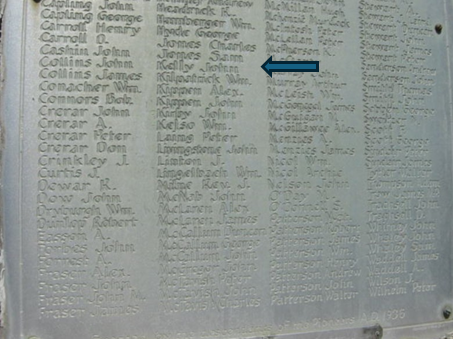
Cairns like these are located throughout Perth County paying tribute to the lives that forever changed the face of our county. But life continues to change and changed it did when John married, in 1839, to Joan Murray. Now 28 years of age, the responsibilities of family settled onto his shoulders. Welcoming their first child in 1841, a daughter, Isabella and then another daughter Elizabeth in 1842. His bachelor life was no longer and the luxuries of married life were beginning to be noticed.
He recollects, “The case is altered somewhat, for the cares of a married man, besides those attendant on an improving farm, are upon me, but my comforts are increased, and I am happier, and I manage matters so that generally I have my crops sowed and reaped, and in the barn as soon, and I may say, without any praise to myself, if not sooner than my neighbours, and they, to give them their due credit, are not idle, but industrious.”
By 1842, the land had begun to answer back. Johns hard work was paying off, “I have now near or about fifty acres of cleared land, and it is all laid out in fields of 6-1/4 acres; and availing myself of the running water or creek on my farm, I have it in all my field, except one, and that one is not destitute of water either.”
He spoke with pride, but never arrogance. “I must say that my land is good, but there is good land on my neighbours’ farms. In the above clearance is included above five acres of newly cleared land, which is sometimes also called ‘fallow’… on which I already sowed my fall wheat for next year.” Showing how preparedness and planning will payoff at harvest.

He knew the importance of crop rotation and diversified crops. His crops were varied and strong, providing the proof of the improvements the Canada Company was seeking. “My crops this year consist of fall and spring wheat, oats, barley, peas, and potatoes, besides about twenty acres in hay, and pasture thirteen acres. My crops are good. While on this subject I may say that I expect and average of thirty bushels per acre from my fall wheat, and the bushel weighs about sixty lbs.”
Even the frost could not dampen his optimism, taking the uncontrollable situation in stride and noting only a small difference, yet still profitable. “It would have been a little more I think, but there was a frost this season in May and beginning of June, which affected it a little. I have had in 1840 at the rate of thirty-five bushels of fall wheat to the acre, and in 1841 thirty-two bushels. This I ascertained from actual observation.”
Most farmers become in tune with their land and John was one of those men. He knew the land intimately, its rhythms, its limits, its potential. “The average crop however of fall wheat in this part of the country I may state as twenty-five bushels per acre… and this too on the land with the stumps remaining on it.” Even then, he was impressed with the possibilities his land offered.

Clearing those stumps was backbreaking work, often taking years. The first crops grew in their shadows, a testament to perseverance, but the potential was there and the love for the land was instant. John continued with the precision of a man who had learned by doing. “I cannot say from experience what the average would be under a like careful tillage when the stumps are out. The average crop per acre of spring wheat I considered to be about eighteen bushels, oats thirty-five to forty bushels, barley about thirty bushels, and potatoes about 300 bushels.”
Providing cautious and realistic estimates, he believed in farming within one’s means. “I consider it of greater advantage to a farmer to put an extent of crops in which he can manage with care”. Taking risks beyond ones abilities or gambling on luck, was not of interest to Mr. Kelly.
He had seen too many neighbours overextend themselves. He recounts as he stares off across his cleared acreage. “I have seen farmers… struggling hard to get in large crops… hurriedly, and perhaps slovenly put in… and then the harvest… brought its own difficulties…” resulting in low yields, improperly stored harvest, low quality product and worse.
Timing mattered, whether harvesting or planting it mattered. John knows it and so did the most successful farmers “The proper time for sowing fall wheat is from the 1st to the 15th September… Spring wheat should be put in from the 20th April to 15th May…”
He admired good farming wherever he saw it and did not fall short when paying a compliment. “As regards crops… my neighbour Robert Patterson, Jr… has an extraordinary crop of oats this year… sixty bushels or above that per acre… He is an industrious farmer and has his place in good order.”
John’s own farm was thriving and had come a long way from the days he spent chopping trees in the snow. “My stock of cattle at present consist of two horses and a colt, one yoke of working oxen, three cows, three yokes of steers… fourteen sheep, and some hogs.”
His home had grown from a shanty to something warm and lived in. The smells of bread baking and the sounds of children laughing echoed around this happy home. “I have a well-finished log-house, lathed and plastered in the inside… My garden is at the side of it, surrounded by a picket fence.”
Then there was his barn, an impressive ninety-six-foot-long structure, standing as proof of years of labour. “My barn is built of good logs… I have let out small jobs of chopping and clearing land at different times and paid these always from the produce of my farm. I have chopped and cleared about eighteen acres myself.”
It was then that he could finally look out over the land and see not wilderness, but home. “The situation my land and neighbouring farms are in I consider to be a very fine one… What a contrast there is between the appearance of the at the time when the snow was falling down upon me when I was chopping my shanty logs and what has been accomplished in a few years…”
His property, once a gamble, had become something precious and priceless. “As it may be expected I should state what the probable value of my property is now… it amounts to 2500 dollars. This sum I would by no means take for it though counted down in cash on the table before me.” Validating the connection he had made with this land he had dreamed one day of owning, the land that was his and the home of his children.
He spoke, too, of the families who had settled around him, the Pattersons and Hamiltons, each carving out their own stories in the bush. “I merely mention the above families… as instances of settlers who have succeeded as well, if not rather better than myself, and there are many others around me who have done as well.”
John sat back in his seat and thought for a moment, satisfied with the statement he had given, he leaned forward and added “the view I have before observed is a good one.” And finally, he signed his name: John Kelly.” Mr. Linton smiled, again satisfied with the accounts given, feeling the pride and accomplishments of the man seated in front of him. Acknowledging the effort and sacrifice of all the pioneers surrounding him.
By 1858, The Huron Road, Highway 7/8 became the lifeline of the region, only twenty-five years after the first settlers arrived in this area, the dense forest had given way to open fields and the beginnings of community. The face of the forest was changing, and the agricultural mecca was awakening. But change was a constant, not only on the land but within the community as well.

John Kelly lived a full life, passing away at the age of 81, surrounded by community and family. John had married Joan Murray (1812 - 1884) raised a family and was able to see his family rooted in the very soil he once cleared alone in the snow. Having two daughters Isabella (1841 - 1900), and Elizabeth (1842 - 1933), he welcomed his son John Kelly Jr. (1844 - 1929), only 2 years following this interview. John’s son also continued the tradition, working the land, raising a family, welcoming a son, and naming him John K. Kelly (1867 - 1907), as well.
Today, still together, quietly, reverently in St. Andrew’s Cemetery, North Easthope, not far from the land that shaped them. Not far from the land that John Kelly Sr. cleared, alone, during the darkest nights and the most isolating days. Their single marker stands as a quiet reminder of what perseverance can build and of how the earliest furrows cut into the wilderness became the foundation of Perth County as we know it.


Comments