
Chapter 14: The Threshold of the Midpoint of Section A, Row Five
Having decoded the images chiseled into the marble by the regional stone cutters, we return one last time to the damp grass of Section A. Moving directly behind the long line we recently completed, we step into Row Five. This row presents a noticeably shorter line; a brief, quiet row holding only eight monuments in place. The final row for this series.
Of the ten parallel rows that map out Section A, entering this fifth row brings us directly to the chronological and structural midway point of this section. The soil here holds a striking contrast of time, beginning with an extraordinary testament to old-world endurance before immediately confronting a devastating season of early mortality that shattered the concession lines during a single, tragic summer.
Heinrich Hornmann (1797–1888) & Elisabeth Hornmann (1802–1874)

The first monument anchoring position one of Row Five is a massive, deeply revered stone that bridges two distinct eras of history. This four-sided marker preserves a profound record of a shared lifetime that crossed the Atlantic, printed on two sides we find the text:
Side A: "Hier ruhet in Gott Heinrich Hornmann geb. in Niederofleiden Hessen Darmstadt gest. den 17 Dec. 1888 Alter 91 Jahre 5 Mon. 20 T."
Side B: "Hier ruhet in Gott Elisabeth Eheweib von Heinrich Hornmann gest. den 29 Apr. 1874 Alter 71 Jahre 5 mon."
Translated directly into English, this remarkable monument reads:
Side A: "Here rests in God, Heinrich Hornmann, born in Niederofleiden, Hesse-Darmstadt, died Dec. 17, 1888, Aged 91 Years, 5 Months, and 20 Days."
Side B: "Here rests in God, Elisabeth, wife of Heinrich Hornmann, died Apr. 29, 1874, Aged 71 Years, 5 Months."
Johann Heinrich Hornmann holds a breathtaking distinction in our journey so far: at ninety-one years old, he is the oldest patriarch we have encountered in the rows of Section A. Born in 1797 in the Hessian village of Vogelsbergkreis, Heinrich was a true child of the 18th century. He was a young man when Napoleon's restructuring swept through the German states, and he had already lived an entire lifetime in Europe before making the courageous choice to transplant his lineage to the raw, untamed forests of Perth County.

Heinrich left behind his parents, Johann Konrad Hornmann (1756–1832) and Elisabeth (Grau) Hornmann (1762–1838), in the very same village where he was born. Both of his parents, along with four of his siblings, lived, died, and were laid to rest in their German homeland, making Heinrich the sole member of his immediate family to brave the journey to Canada.

He did not make that journey alone, however. In 1853, Heinrich or Henry, as he would later be known, boarded the ship Elise alongside his wife, Elisabeth, and at least three of their children: Elizabeth (aged 24), Johannes (aged 19), and Anna Cathrina (aged 16). Upon arriving in Ontario, the family took up residence on Concession 8, Lot 39, putting every able body to work clearing land. By 1861, the 150-acre property was listed under their son John’s name, and together with his 60-year-old father, they transformed the bush into a thriving homestead. The agricultural census reveals a farm boasting 50 cultivated acres, 34 sowed with crops and 16 kept as pasture, with another 50 acres remaining in standing timber, bringing the property to an impressive cash assessment of $4,000.


A farm of this scale was notably above average for the area, where most families managed 100 acres or less. Working side-by-side, father and son tamed the land together while Mother, Elisabeth tended to the home, along side her daughter-in-law, john’s wife, Maria ‘Mary’ Schneider (1831-1914). Elisabeth, with her strong German upbringing, was the steady anchor of their pioneer household, acting as a true North Star guiding her growing flock in a foreign land.
Born late in 1802 to Henrich Becker (1774–1850) and Catharina Schneider (1772–1841), Elisabeth’s lineage also remained deeply rooted in Hessen, where her parents rest in their ancestral soil. Her side of the monument reveals that she passed away in the early spring of 1874, just weeks shy of her 71st birthday. Though no cause of death was recorded, her loss was deeply felt across the family homestead and as further research uncovered there was an invisible monster lurking and waiting to make this year, 1874, a memorable one.
Elisabeth’s passing left Heinrich to navigate fourteen long Ontario winters as a widower. Yet he remained surrounded by the legacy they built; census records from 1881 show Heinrich living comfortably with John, Mary and a bustling household of nine grandchildren.


Living until the closing weeks of 1888, the 91-year-old patriarch survived long enough to see the rough log shanties of his early settlement days completely replaced by brick homesteads, gravel concession roads, and the rumbling steam engines of the railway era. A true titan of the vanguard, he was finally laid to rest beside his faithful partner; forever remembered in stone.

Henry Weicker (1848–1874)
Stepping to position two, the language shifts abruptly from the traditional German script to a stark, elegant English inscription. The monument marks a sudden, devastating loss that cut down a young man in the very prime of his youth:

"In memory of Henry Wicker born Nov. 10, 1848 died May 26, 1874"
(Note: While the stone reflects a common phonetic carver's variant or weathered error as "Wicker," local archival and family records link this plot firmly to the prominent, foundational Weicker lineage).
Born November 10, 1848, to Johannes Weicker (1816-1890) and Catharina Zinkann (1821-1908). Grandson of Johannes Weicker (1776-1857) and Anna Elizabeth Bork (1785-1862), remembered on the stones in the fist row of Section A. Henry was a true first-generation son of South Easthope, raised to handle the grueling physical demands of clearing timber, maintaining drainage ditches, and managing livestock on the family farm. Married to Anna Staebler (1854-1943), he was only twenty-five years old when he passed away on May 26, 1874.

You will notice by the above death record, the recorder took some liberties with the spelling of Catharina’s name, Dina, may have been the name most knew her by. But the spelling of the last name appears incorrect, as her parents list their names as Zinnkann , an extra n. Not Zinkalm, however, when researching it is best to consider all variations.
Henry’s record also points to the season of his passing. Late May was a high-stakes, exhausting period for pioneer farmers, a frantic window where the spring planting had to be finalized and the heavy, continuous physical labor of the summer season was violently launching. To lose a strong, twenty-five-year-old partner at this exact moment was a catastrophic blow to a farming household. His passing in late May of 1874 marks the early edge of a terrifying wave of mortality that was about to sweep through the immediate neighborhood that summer.
Smallpox of 1873 leads to Typhoid in 1874
This increase in loss was not only felt in Row five but stretched across the oldest section of the graveyard. 1874 was soon to become a heartbreaking year for the parents and families of Trinity. Twelve deaths would find their way into the cemetery, and it began December 6th, 1873 with the death of Jacob Wagner Sr. The cause recorded as Smallpox, although not the first to contract this illness he did pass it to his family. The first death of 1874 was recorded January 6th with fourteen-year-old Anna Louisa Wagner. Her cause of death smallpox, quickly followed by her brother Jacob Wagner Jr, age 17, January 11th, of the same cause. The 3rd death, Catherine Mogk, a young mother lost to hemorrhage, unrelated to the epidemic. As the end of March arrived another loss, Georg Trachsel, another victim to smallpox showing in the record below the quick interment turn around, leave the exposure to the dead less than 1 day.

Catherine Gonder Keutsch was 38, a mother and with no information, no child born at the time of her death or further research we are left to assume. That is until we see the following entry. Gonder, N. also with no information but a small note ‘died of smallpox’. The relationship is assumed, perhaps a brother as they share the same last name at birth. The timing is critical coming in at entries 173 and 174, this places their deaths between the end of March and May 2nd, both occurring in April. Likely a result of smallpox, passed among the family members.

But then I discover a stone from another row, with the death year of 1874 as well, but a name not listed on the death records Eliza Jane Senkpiel, placing her death April 2nd, at the age of two, cause unknown. It is here that a shift begins to take place, as the weather begins to warm. The burial dates begin to distance themselves from the death dates, a signal that smallpox was passing, but something new was making its way into the homes and lives of the community. Elizabeth Hornmann was the first believed case, passing late in April, followed a month later by Henry Weicker, twenty five years of age, 5 weeks later Johannes Gerbig (16) and Heinrich Hansuld (73), passed on the same day, followed by 18-month-old Henry Krantz, July 26, then the next day Wilhelmine Stock (50) the next day July 27.

A true epidemic, questions were everywhere, where was this silent killer hiding, how could they stop this menace eliminating young and old. The threat came in the form of bacteria and the answer sanitary practices. The cause, Typhoid fever, and the losses would be devastating for so many. Typhoid fever began sweeping through the region, early that year, taking its toll on young adults and children with no sign of mercy. Rural communities lacking the appropriate water treatment and sanitation, sometimes found themselves drinking from bacteria filled wells or streams. Without understanding bacteria and the disease, outhouses nearby these ‘fresh water’ sources were contaminating drinking water by leaching their waste into these wells and streams. Making this one of the hardest years on record, for the community the church and Row Five.
Johannes Gerbig (1857–1874)

At position three, we return to the familiar German script to find a monument that stands in tight, heartbreaking chronological alignment with Henry Wilker just steps away. The stone reads:
"Hier ruhet Johannes Gerbig geboren den 20 Sept. 1857 gestorben den 2 Juli 1874"
In English, this sorrowful marker reads:
"Here rests Johannes Gerbig, born September 20, 1857, died July 2, 1874."
Johannes was a youth of only sixteen years old when he closed his eyes forever. His parents Johannes Gerbig (1815-1897) and Elizabeth Koch (1821-1911), immigrants from Germany, making this churchyard home, not only for their son, but themselves as they would also find a place among the rows, many years later. Johannes, born in the autumn of 1857, was right on the cusp of manhood; old enough to be a vital source of muscle on the farm, handling the heavy teams of horses and swinging a brush hook in the summer fields.

The terrifying archival reality of Row Five snaps into sharp focus when you look at the death dates: Henry Wilker died on May 26th, and young Johannes Gerbig died just five weeks later on July 2nd. To lose a twenty-five-year-old and a sixteen-year-old neighbor in such rapid succession during the warmest months of 1874 points directly to a localized summer crisis. Bacteria would grow at a rapid rate under the sweltering heat of July. In shallow hand dug farm wells and standing water pools, the water was quick to spoil, unleashing aggressive outbreaks of waterborne typhoid fever or dysentery that could overwhelm a young person's system within days. Johannes was laid into the soil just as the heavy hay harvest was beginning, leaving his family to face the fields with broken hearts and a devastating void.
Henry Hansuld (1801–1874)

Stepping to the fourth position, the timeline of this fateful summer remains tightly gripped by tragedy, but the focus shifts back to an elder of the community. The stone reads:
"Henry Hansuld gestorben July 2 1874 Alter 73 Jahren und 5 Monat"
Translated directly into English, this monument reads: "Henry Hansuld, died July 2, 1874, Aged 73 Years and 5 Months."
The reality of this stone reveals a profound community shock. Henry Hansuld died on July 2, 1874, the exact same day that sixteen-year-old Johannes Gerbig died just steps away in this very row. Within a single twenty-four-hour period, the churchyard gates had to be opened twice. The congregation was forced to lay both a promising youth and a seventy-three-year-old pioneer elder into the earth simultaneously during the sweltering July heat.

Born in 1801, the son of Johann Georg Hansuld and Maria Elisabetha Hedderich, he was baptized in Grebenau, Germany on February 5th, 1801. Here conflicting dates from the church record and other sources providing is actual birth date as February 3rd, 1801. Growing up in the Grebenau area, he married Anna Maria Rueffer in 1824 and together they had two known children. Conrad (1821-1906) and Casper (1824-1906). Maria passed away prior to 1827, leading to the second marriage with Elizabeth Krug in 1827. Further expanding the family with three additional known children, George (1834-1836), Margaret Kaumann (1836-1868), and Catharine Mohr (1841-1881).
Once the family was complete, they all packed up and immigrated to Perth County. Henry had survived the grueling decades of early bush clearance and settlement, guiding his family into an era of agricultural stability. His sudden passing, occurring alongside the deaths of young men like Gerbig and Henry Wilker, suggests that the waterborne epidemic was creeping along the concessions that summer, it spared neither the fragile strength of youth nor the seasoned resilience of old age.
Mary Elizabeth (Kalbfleisch) Weitzel (1819–1878)

At position five, we encounter a stone that has clearly seen better days. Unfortunately, when a stone becomes this degraded there is not much we can do. I can treat the stone, but scrubbing is an absolute no-no. Sad, as this stone dedicates this spot to a prominent matriarch whose resting place marks the beginning of a powerful family cluster within this community. Written in traditional German script, her monument reads:
"Mary Elizabeth eine geboren Kalbfleisch ehefrau von Adam Weitzel geboren den 1 Mai 1819 gestorben den 4 Mai 1878 Alter 59 Jahre u. 3 Tage"
In English, this beautiful marker reads: "Mary Elizabeth, née Kalbfleisch, wife of Adam Weitzel, born May 1, 1819, died May 4, 1878, Aged 59 Years and 3 Days."
Mary Elizabeth was born in Germany in the spring of 1819, a daughter of Johannes Kalbfleisch (1788-1872) and Anna Elisabetha Noll. Hailing from the foundational Kalbfleisch lineage. Mary found herself immigrating with her family in 1837. She made the courageous Atlantic crossing as a young woman, arriving in New York aboard the Earl Durham, August 17th. Marking their place of origin as Bieben with a destination of Upper Canada. The census of 1861, places them all firmly in South Easthope Township, in Perth County.
Mary would embrace her life in Upper Canada and would soon marry Adam Weitzel. Together they established a prosperous homestead in South Easthope. Her life was defined by the relentless, daily physical labor demanded of pioneer mothers; spinning wool, managing the dairy, and raising a large family to tend the crops. They grew their family to at least 6 known children, but unfortunately only enjoyed her family’s love for 59 years.

She passed away on May 4, 1878, just three days after her fifty-ninth birthday. Her cause of death, heart disease. The stone in this row, her presence here, anchors what local historians often recognize as the unofficial "Weitzel family plot" within Row Five, surrounded by the daughters who shared her blood.
Catharina (Weitzel) Heinbuch (1856–1880)
The sixth stone brings us to a deeply moving and visually fragile monument within the Weitzel family grouping. Heavily worn by a century of Ontario elements, the badly eroded German script reads:
"Catharina Eine geboren Weitzel Ehefrau von Just. Heinbuch geboren den 24 Marz 1856 gestorben den 10 Mai 1880 Alter 24 Jahre 1 Monat 17 tage"

Translated directly into English, it reads: "Catharina, née Weitzel, wife of Just. Heinbuch, born March 24, 1856, died May 10, 1880, Aged 24 Years, 1 Month, and 17 Days."

Catherine was a young bride of only twenty-four when she closed her eyes for the final time in the spring of 1880. Her marriage record from August 5, 1877, reveals she had been married for less than three short years. It is this document, alongside a handful of others, that allows us to piece together her story and uncover who she truly was.
The record lists her husband, Yost Heinbuch, albeit with a curious spelling, as a 27-year-old farmer from South Easthope, born to parents John and Elizabeth Heinbuch. Reading further, we find the bride listed as Catherine Weitzel, age 21, also of South Easthope, with an "S" indicating she was single at the time. The listing of her parents, Adam and Elizabeth, along with the names of the witnesses present, confirms beyond doubt that this is the Catherine we are seeking.
Together, Catherine and Yost would welcome two children: John Jost Heinbuch (1878–1957) and Adam Heinbuch (1880–1967). They surely held quiet dreams of building on this foundation and filling their home with love and laughter, until death’s sudden breath blew in her direction.
Her passing, coming just weeks after her birthday, points to a tragic and all-too-common reality for young pioneer women: either complications from childbirth or the rapid onset of "galloping consumption" (tuberculosis), which preyed heavily on young mothers in the damp spring months. Her youngest son, Adam, was born on May 4, 1880; leaving Catherine just six days to hold her newborn before her life came to an end.

Today, her headstone stands as a stark visual reminder of the vulnerability of soft, nineteenth-century white marble. The severe erosion on this marker is the result of decades of exposure to acidic rain, freeze-thaw cycles that pop the crystalline structure of the stone, and the growth of aggressive lichens. These lichens secrete organic acids that literally dissolve the chiseled details over time, slowly erasing the physical record of her short life. A life well worth remembering.
Elisabeth (Weitzel) Roth (1840–1876)

At position seven, we find a deeply meaningful duplicate marker that beautifully reconnects Row Five to the fragments we documented on the memorial cairn. The stone reads:
"Mother Elisabeth Weitzel Frau von John N. Roth gestorben Marz 13 1876 Alter 36 Jah. 6 Mon."
In English, this tender monument reads: "Mother, Elisabeth Weitzel, wife of John N. Roth, died March 13, 1876, Aged 36 Years and 6 Months."
This stone marks the original, intended resting place of the very same Elizabeth Weitzel Roth whose broken headstone fragment was rescued and placed at position sixteen on the memorial cairn wall. Finding her formal marker intact here in the fifth row confirms that this line was indeed the sacred ground of the Weitzel family. It brings her story full circle, placing her directly beside her mother, Mary Elizabeth, and her sister, Catharina Heinbuch. Though a piece of her memory was fractured and preserved on the cairn, her place in this row remains a permanent testament to the tight-knit bonds of pioneer sisterhood and motherhood.

Elizabeth Stahlschmidt Veit (1854–1876) & Friedrich J. W. Veit (1880–1881)
We reach the eighth and final anchor of Row Five at a monument that represents the deep, shared domestic grief of the parsonage itself. This double-inscription stone preserves the devastating losses suffered by the congregation's spiritual leader, Pastor F. Veit:
"Hier ruhet in Gott Friedrich Johannes Wilhelm Sohnlein des Pastor F. Veit und dessen Ehefrau Matha geboren 9 Juni 1880 gestorben am 1 Februar 1881 Elizabeth Veit Ehefrau des Pastor Fr. Veit geboren den 5 Maerz 1854 gestorben am 11 April 1876 Alter 22 Jahre 1 Monat und 6 Tage"
Translated directly into English, this sorrowful parsonage monument reads:
"Here rests in God, Friedrich Johannes Wilhelm, infant son of Pastor F. Veit and his wife Martha, born June 9, 1880, died February 1, 1881. Elizabeth Veit, wife of Pastor Fr. Veit, born March 5, 1854, died April 11, 1876, Aged 22 Years, 1 Month, and 6 Days."

This final monument reveals an incredible layer of personal sacrifice behind the ministry at Sebastopol. Pastor Veit was the man responsible for standing at the head of every grave in this row, offering words of eternal hope and scriptural comfort to families like the Wilkers, Gerbigs, and Weitzels as they buried their loved ones. Yet, this stone reveals that the pastor's own home was repeatedly shattered by the very same mortality.
In April 1876, he stood over the open grave of his twenty-two-year-old wife, Elizabeth, who died just a month after her birthday. Elisabeth Stahlschmidt was born March 5th, 1854 in New York, USA. The daughter of Rev. Daniel Stahlschmidt and Wilhelmina Pack, she was familiar with the life of a pastor’s wife, unfortunately she never had a chance to fulfill her duties. She had provided Pastor Veit with 3 known children, the most recent born only two days prior to her death, providing the common cause that affected so many young mothers.

In November of 1877, having remarried to Martha Halleen, daughter of Rev. Halleen of Stratford, tragedy returned to the parsonage in the dead of winter 1881, claiming his infant son Friedrich at just seven months old. This monument stands as a profound testament to a pastor who kept the faith of an entire community intact while carrying the heavy, quiet burden of his own empty cradle and broken family circle.

Stepping back from the eighth monument, we cast our eyes across the five completed rows of Section A. We have officially reached the structural midpoint of this sacred field. These rows have given us an unforgettable glimpse into the human cost of the township; from 18th-century titans like ninety-one-year-old Heinrich Hornmann, to the rapid summer epidemic that claimed neighbors Henry Wilker, Johannes Gerbig, and Henry Hansuld in the blink of an eye.
As we pack up our recording books and look out across the rest of Section A, a quiet, haunting reality settles over the grass. The eight stones we documented in Row Five stand tall and legible, but they only tell a fraction of the story. Between these neat, visible markers lie wide, open stretches of empty green turf. I can only image what secrets are held in those spaces, knowing that with out the records from this time, these stories are now lost forever.
Closing: Restoring the Sacred Ground
When this journey began on a crisp spring morning, my goal was simple yet profound: to bring light back to the names that built this community by providing what I consider to be the Holy Trinity - Research, Restoration, and Record. Armed with soft brushes, D/2 cleaner, water jugs, and my camera, I set out across the grounds of Trinity Evangelical Lutheran Church. Today, as the restoration work on our planned stones comes to an end and this blog series draws to a close, I am filled with deep, overwhelming gratitude for the opportunity to serve as a steward for these pioneer resting places. Every stone we cleaned was so much more than a physical monument; it was a doorway to the past, bringing us face-to-face with the founders, dreamers, and families who cleared the dense timber of South Easthope and East Zorra to build a life from the ground up.
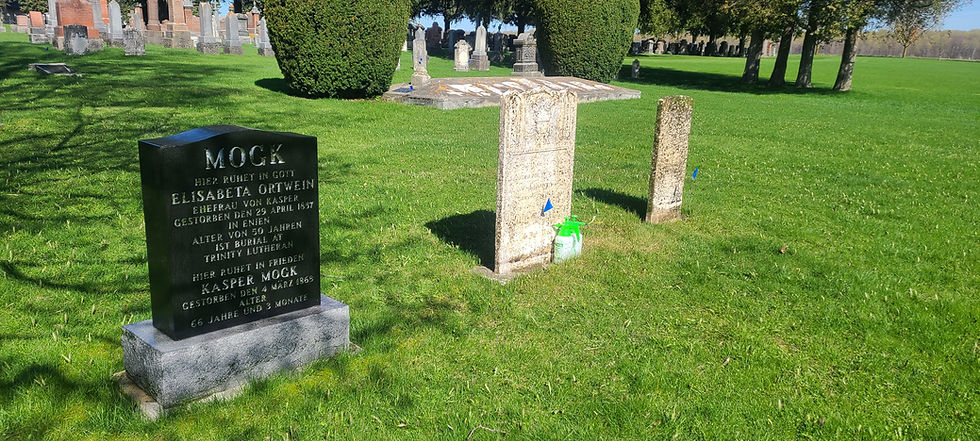
Reflecting on the work completed across the churchyard, memories of specific rows stand out so vividly. In Section A, standing before the markers of Kasper and Anna Elisabeta (Ortwein) Mogk alongside Johannes and Anna Elisabetha (Bork) Weicker, we touched the very beginning of this congregation. Their lives stretched from the historic German states across the Atlantic to the raw Canadian bush, laying down roots in 1857 before the current brick church ever stood. Moving down the line, cleaning the stones of Johann George Kalbfleisch, young Barbara Weitzel; lost to illness at just nineteen, Elisabetha (Nau) Roth, and the father-son pair of Heinrich and Nicolaus Kaufmann reminded us of both the endurance and the fragile heartbreak of pioneer survival. Nearby, the brief lives of Christina Wilker and John Weicker forever hold their place in the long memory of this settlement. Even the fragments bound within the concrete Memorial Cairn, from the tiny, sculpted lamb of little Magdalena to the double sorrows of the Jungblut, Wittig, and Seeger families, proved that when individual households were no longer there, the entire community stepped forward to ensure no name was erased by time.
This project was never a solitary effort; it was carried forward by a vibrant network of friends, volunteers, and supporters who share the belief that history deserves to be remembered and protected. My deepest gratitude goes to Joan, whose boundless passion for the church's heritage was instrumental in securing funding through the Ontario Genealogical Society, turning this vision into a reality. I am equally grateful for Annabelle, our energetic college volunteer, whose hard work, industrial spirit, and infectious enthusiasm turned long hours of scrubbing under the sun into moments of shared discovery. A special thanks to Rich and Sherrill, huge supporters and believers in this church, the grounds and the families that lie here, as they are apples from the trees.
How wonderful watching volunteers discover the simple, rewarding "addiction" of seeing an illegible name surface into the sunlight after decades in the shadows was easily one of the true highlights of this season. To all the community members, church patrons, online readers, and curious passersby who stopped to chat, share family stories, or offer encouragement, thank you for turning a restoration task into a true community gathering.
While the current cleaning phase for these rows is complete, the work of remembrance is never truly finished. The roots of these families extend far beyond the cemetery fence, and there is still so much to uncover. Looking ahead, plans are already underway to host guided historic cemetery walking tours on the Trinity grounds, allowing us to step through the rows together and speak these pioneers' names aloud as we recount their triumphs, tradecraft, and heartbreaks. At the same time, the research will continue as we cross-reference records, trace descendants, and work to solve the lingering mysteries of blank bases and unmatched names in the early German death ledgers. Nature never pauses, and neither will our commitment to returning and caring for these sacred markers as the seasons turn.
It has been a true privilege to load up my wagon, wear my Eternal Care Stone Services shirt, and spend these hours in the shade of the historic church. Every pass of the brush was an act of respect, and every revealed inscription was a gift back to our community. . I am hopeful to return again and uncover more stories of love and loss within these hollowed grounds, but for now I close this series. Thank you for joining me on this journey through The Holy Trinity – Research, Restore and Record. Rest gently, pioneers; your names are spoken once again.
Angie Moore, Eternal Care Stone Services


Comments