
Chapter 3: The Names that Hold the Second Row

Today we pick up where we left off, turning away from the first row and looking to the second. As we move closer to the church, the stones age progresses almost without our noticing; each row carrying us a little deeper into the community and the quiet beginnings of this place. The second row of Section A is not more important than the first, nor less than the third. Every name here belongs to someone who shaped this congregation, this community, and the land beneath our feet.
A small note for the record‑keepers (and the family historians who’ve learned to search twice): this church and burial ground began in South Easthope Township, Perth County; but over time it became closely tied to Tavistock next door, to the point that the congregation is commonly styled as Trinity Evangelical Lutheran Church, Sebastopol–Tavistock. In practice, that closeness means the same cemetery may be indexed under Tavistock and Oxford County Municipality in some databases, even while local historical resources still pin it to South Easthope. It isn’t so much a contradiction as a paper‑trail merger: the work and care of this churchyard flowing naturally toward the nearest town, while the ground itself never moved.
Headstones, unfortunately, do not always stay where they were first set. They can sink, tilt, slide, break, or be lifted away for safety; until all that remains is a blank space, or a stubborn base waiting in the grass like an unfinished sentence. Time, weather, good intentions, and simple necessity all leave their marks, and sometimes the only thing left to tell us a name is the old paperwork that calls it what it is: base only. Such is the case with the very first “stone” we encounter.

When we begin, it is with a small setback. In the very first position we find a single base; referred to in the OGS records as base only. I have tried to trace who belongs here, but for now it remains a mystery to be revisited, a story still hiding just out of reach. My focus on this day is to prepare six stones, six families; yet even this one silent base reminds me there are countless stories rippling outward through East Zorra and South Easthope, waiting for the right record, the right clue, the right moment to surface. I will return to this “base only”, later, hoping that the records reveal a name or that the memorial cairn holds this stone.
I turn away from this lonely base and look towards the stones. As I begin, I can not read the stones that stand before me. The lichen is thick and
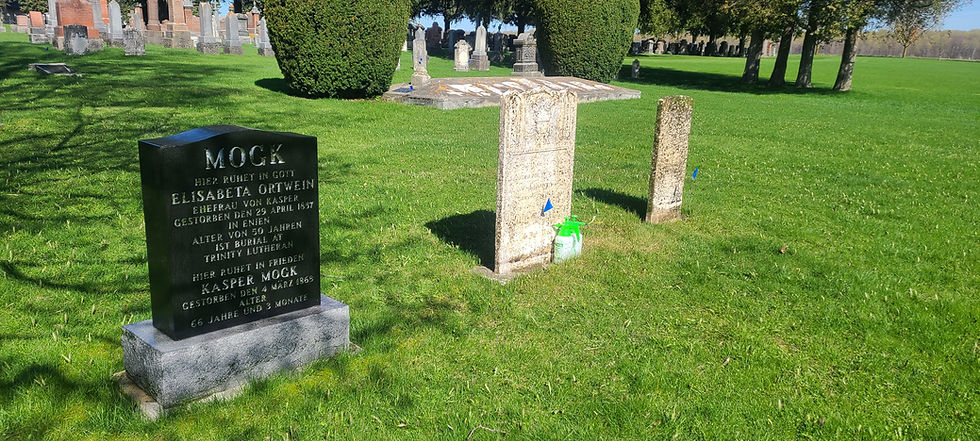
the moss has crept their roots into the stone, expecting to remain until the stone itself crumbles, giving way to an innocently appearing non-vascular, flowerless plant. Soft to the touch, but persistent enough to erode a monument or stone, if given the chance. As I walk up, face to face, it’s me against nature, but I am ready. With my trusty spray bottle filled with D/2, I take aim and begin to soak the stones of the second row. Immediately, I notice the change has begun the organic growth doesn’t stand a chance.
After a few days and some uncooperative weather, I return to the churchyard to a wonderful surprise…volunteers. Two of them, firstly, Joan, a woman whose excitement for this project is on parr with my own. Involved with the church operations, her care for this building, the grounds and the community is obvious. Joan was responsible for submitting the request for funding to the OGS (Ontario Genealogical Society). With some help from Eternal Care Stone Services, her and I prepared a package with testimonials, previous projects, photos of the stones desired to restore and the overall scope of the project. After the submission, all we could do was wait, no word was heard, no communication was given, until a random Tuesday months later. When an email replied, “Your funding is Approved!”
The second volunteer, Annabelle, an energetic college student, preparing for her future while dedicating time to the past. She is also here through a funded volunteer program, dedicating 280 hours to the various tasks required within the church and on the grounds, cleaning stones is included. All for the improvement of Trinity. She is a joy to work with, very industrious and dedicated, she will be an asset to this project and any that she joins.
We gather together and the demonstration begins with a brief tutorial, then we start to clean. It was with only one stone, like it was with me, that both volunteers realized the addiction of seeing the illegible become read for the first time in decades, bringing a name into the light and hearing a name that hasn’t been spoken for years. They quickly became aware of the time involved, as the hands on the church clock spun, the chimes, continually reminding us of the time we are dedicating to this task. We each set up in front of a stone, tonight we will clean three stones before the sun gets too low. We each begin to scrub gently, watching the grime lift way, with time, elbow grease, patience and lots of water, the first name is revealed…

Georg Kalbfleisch, his headstone reads, gradually his name appeared on this stone, a name spoken softly, like a familiar hymn that still lingers in the rafters long after the congregation has gone home. Now we know who we have discovered, but exactly who is this man?
Georg Kalbfleisch found his finally resting place far from his meager beginnings, born February 5th, 1819, in Wallersdorf, Vogelsbergkreis, Hessen Germany. Entering the family of Joachim Kalbfleisch and Anna Catharina Georg, raised within the German church traditions of home and village life. Georg was baptised only 5 days after birth on February 10th, 1819 in the nearby town of Grebenau.
His life in Wallersdorf was typical for a young boy in the 1820s and 30s; not because it was easy, but because it was ordinary in the way rural life has always been ordinary. Days were measured in chores, seasons, and the steady expectations of family and church. Wallersdorf sat tucked along the Jossa, a small village in the Vogelsberg countryside, where the land could be stubborn and the weather could bite. The soils were not reliably generous without careful tending, and the valley’s openness left it exposed to harsh winds. Those conditions shaped the way people worked and the way children grew up, learning early that food, heat, and security were earned one task at a time.
A boy like Georg would have been surrounded by the sights and sounds of a working village: animals close by, wood stacked for winter, tools that needed constant mending, and neighbours whose lives ran parallel to his own. Childhood here wasn’t a separate world; it was apprenticeship to adulthood. He would have carried water, watched younger siblings, helped in the garden and fields, and learned the practical habits that kept a household steady.
He grew, and soon the call of adventure and opportunity became too loud to ignore. Somewhere between Wallersdorf and this Ontario bush there was a crossing; wooden decks, salt air, and a horizon that kept moving away no matter how long you watched it. I have not yet found the single record that tells us exactly when Georg first set foot in North America, or whether he arrived first through the United States before making his way north. What I can say with confidence is that by May 5, 1840, he was here in Preston, Ontario, standing inside St. Peter’s Evangelical Lutheran Church and making a different kind of voyage, this one, into marriage. On that day, he became the husband of Anna Maria (Mary) Stitchin, the daughter of Jacob and Theresia Stitchin, and the new world stopped being a dream on the horizon and became a home with a family.
The Kalbfleisch family were among the German-speaking pioneers who came from the Alsfeld area of Hessen‑Darmstadt, carrying little more than faith, language, and the kind of endurance that doesn’t need to announce itself. Like so many others that settled in this area, they all had one thing in common, threaded through it all, was the familiar rhythm of church life. Sunday worship, the language of hymns, and the slow learning of prayers and bible stories that gave meaning to hardship. It is not hard to imagine Georg looking down, hearing the same bell that had called generations after him, never guessing that his own name would one day be read out loud, again. But today we do, we read his name to remember his journey across an ocean from where he began, to this small village of Sebastopol, we read his name from his stone his family placed with tear filled eyes, we read his name so many decades later and with that we breath new life into an old memory.
By the time Johann George’s life reached its final chapter, this settlement was no longer simply “the bush.” It was fences and furrows, neighbours close enough to hear an axe bite into oak, and children learning their letters, on a Tuesday in the same room where their parents prayed on Sunday. If you go looking for him in the paper trail the pioneers left behind, you won’t find a grand biography; but you will find him in the honest places: census lines, church registers, and cemetery transcription work that pins a name to a place. Trinity’s own history remembers the Kalbfleisch family among those early Alsfeld area settlers who helped form the congregation, long before brick and stained glass made permanence visible from the road.
Here is a snip-it of the 1861 census of South Easthope, George Kalbfleisch’s name appears here only months prior to his death on August 24, 1861. His occupation noted as a farmer, also listed here is his wife, Mary 43, and seven children. Henry 20, Katherine 16, George 13, Conrad 12, Mary Ann 7, Daniel 5, and Otto 3. You will also see his religion listed as Baptist.

One small detail in that census column deserves a gentle footnote: the 1861 enumerator records Georg and his household as Baptist. And yet, other milestones in his life point us back to Lutheran roots, most notably his marriage on May 5, 1840 at St. Peter’s Evangelical Lutheran Church in Preston. In pioneer communities, denominational labels could shift over time, and sometimes they were recorded loosely (or simply recorded as the closest match an enumerator recognized). Rather than forcing one label to erase the other, I hold both as part of the truth we can see: a family rooted in German church life, living within a landscape of faith where records don’t always agree, but the people; worshipping, marrying, burying, and raising children, were real all the same.

Here, in Trinity’s oldest ground; Section A, Row 2, Stone #2, his marker stands as a simple witness to a working life lived in the narrow space between hope and hardship. The dates are brief; the stone is quieter still. And yet, that is exactly why this work matters. Inscriptions soften. Lichen settles in like it belongs. Frost takes a little more each winter. Eternal Care Stone Services (ECSS) exists for the in-between moment; when a name is still there, but possibly not for long, because preservation and restoration are how we keep these stories from slipping back into the earth unnoticed. Our goal is to research, restore, and record, so that the next passerby doesn’t just see a weathered monument, they feel a connection to a familiar name, a neighbour, a life lived. Georg is one of these lives, now who is beside him?
Barbara Weitzel (1842–1862) Section A, Row 2, Stone 3

Beside him rests Barbara Weitzel (1842–1862), and even saying those years aloud feels like exhaling a sigh. I must warn you this story deals with the passing of a young woman, from an illness, that was untreatable at that time. According to the record that survives her, Barbara was born July 20, 1842, into the family of Adam Weitzel (1811-1886) and Mary Elizabeth “Eliza” (Kalbfleisch) Weitzel (1819-1878).
Barbara died April 28, 1862, only nineteen years old. The same record places both her birth and death in South Easthope Township, Perth County, and it places her here at Trinity Evangelical Lutheran Cemetery, in Section A, Row 2, Stone #3, a quiet coordinate that sounds almost clinical until you stand there and realize it is simply the modern way of pointing to a heartbreak that happened long ago.
The records of death for the church, contain a mention of Barbara and lists her as #68, on that registry. The Record of Death notes reads as follows, “Died on April 28 Barbara Weitzel, daughter of Adam Weitzel and his wife Maria Elizabeth nee Kalbfleisch. Born July 20. 1842 in South Easthope. She was already taken up into the arms of the congregation since her baptism 1857 on Palm Sunday on which day she was confirmed. At the end of August 1861, she began to become ill. Her illness, because of hemorrhage changed her condition to TB. She lay there for two and a half months, totally in bed and during this time she prepared herself for her death. On the 23rd of April she had the family gather around her and her pain in her last days was rather exceptional and she called our, ‘Dear Lord, have mercy on me.’ Her age was 19 years, 9 months and 8 days. She was buried on the 30th April at 2:00pm.” An incredibly sad chapter in the Weitzel family album.
This census from 1861, shows a complete view the family before Barbara passed. This would be the last census she is listed with her family. On this census we find her parents, Adam and Elizabeth. The next listed a sister Mary Elizabeth 22, Barbara 19, John 16, Henry 13, Anna Mary 10, Adam 8, twins, Catherine and Elizabeth 5, and Wilhelmina ‘Mena’ 2.

The census records provided below are from 1871 and do not list Barbara, as she had passed prior, if she was still alive for the next, she would have been 29 years old. This is not what needs attention here; there is another interesting point needed to be raised. The importance of verifying by using multiple sources. Although both censuses’ are for the same family, I quickly notice a discrepancy. The mother, Elizabeth, has omitted seven years, making her years younger than, Adam in 1861. However, by the 1871 census she has aged rapidly, placing her only a year behind him. Since I am unsure of which is accurate, I will leave both records here, available for more research.

A strong and determined family, never willing to shy away from hard work, the Weitzel name appears throughout the early records of South Easthope, families who worked modest plots, raised busy households, and gathered for worship long before the brick church rose in 1883. In Barbara’s time, the sights, smells and sounds that surrounded her consisted of bread rising in a warm kitchen, wash water hauled and heated, gardens coaxed from stubborn soil, and the long walk to church signaling the end of a week finally allowing that well deserved revival each Sunday.

Girls became women early here, not by ceremony but by necessity, and the future was assumed only one day at a time. When we read “1842–1862,” we’re not only reading a lifespan, but we’re also reading the fragile mathematics of pioneer living, where sickness could slip through a doorway like a draft and change everything before it could be sealed.
That is why Barbara’s headstone matters. It is small, it is weathered, and it does not tell us the whole story; but it gives us enough to stop, to imagine, and to remember. Time will keep doing what time does: softening carved lines, inviting lichen to settle in, letting frost worry the edges until a name becomes a whisper. Preservation and restoration are how we refuse that slow erasure. Our goal is simple and steadfast; saving all we can through research, restoration, and recording, so that the people of Trinity are not reduced to unreadable stone, but returned to the community as neighbours, still held in care.

The final stone we coaxed the introduction from was Elisabetha (Nau) Roth (1803–1862), a woman whose lifetime bridged two worlds and whose name feels like it was meant to be spoken in a church register, carefully, with ink that mattered. Unfortunately, the Record of Death did not have her name, all though her stone is clearly present. Piecing together what I can find from the fragments that survive, Elisabetha appears as the wife of Johanne Nikolaus 'Nicholaus' Roth (1806–1847). Part of that early German current that flowed into Oxford and Perth Counties and quietly changed the landscape one cleared acre at a time.
These families rarely left behind flowery stories; they left behind the honest kind; baptismal entries, family lists, the occasional note in a compiled genealogy, just enough to prove that a household existed, and that they worked hard, and like their neighbours, they belonged. In one such compiled family record, Elisabetha Nau married a young, Nicholaus Roth, a pairing that anchors her to the pioneer generation who worshipped long before the brick church rose in 1883. For more of her story, we will need to investigate.
As it so often happens in cemeteries like this, we are offered breadcrumbs, clues and direct descendants. We look to the next generation to step forward to speak for the one who came before. A memorial for Johann Heinrich Roth (1830–1909) identifies him as the son of Nicholaus Roth and Elisabetha Nau, tying Elisabetha to a living thread of family that continued in this place even after her own stone began its slow surrender to weather. Johann Heinrich is recorded as buried here at Trinity Evangelical Lutheran Cemetery, another quiet confirmation that the Roth story is not just a surname in the air, it is rooted in this ground. So what can we learn…
Johann Heinrich was born in Nieder-Ofleiden, Vogelsbergkreis, Hessen Germany. This confirms that Elisabetha and Nicholas, not only began their family but also were married in Germany. All those records therefore would remain in that location. We also know that they travelled to Canada as a family. There is also another child listed, Jacob (1842-1898), again born in Germany. This proves that the family did not begin their journey until after 1842. The last child listed to was Margaret (1845-1926), She was born in Ontario, in New Hamburg to be exact. Thus, establishing that the family arrived after 1842.
We can further confirm when we locate the Roth family appearing on the local land tax records, of 1843. With Nicholas Roth Sr. and Nicholas Roth Jr. taking up lots 9 and 10, respectively on the 3rd Concession. Other family members do not appear here as it is merely a tax collection record, but can confirm their location and existence.


I find this part the most connecting, seeing their names written, looking at the property the lived, worked and sometimes even died on. We can see the distance they walked to school and church, the lots they walked past and the spaces we will fill with neighbours as this project continues. To the left of the red square above, Elisabetha's son took residence, close to home, close to church and close the their final resting place.
Elisabetha’s headstone; like so many from these earliest rows, carries that dignity only old stone can hold, softened edges, lettering that asks you to slow down, and a silence that somehow feels like devotion. Here in Section A, Row 2, Stone #4, she rests among neighbours who also crossed oceans, raised families, and learned the rhythm of this place by working it. She lived through migration, through the hard mathematics of pioneer survival, and through the relentless work of building a home where the “road” was still more concept than certainty.
And now, more than a century later, I go to work as she becomes the recipient of the effort: the work of keeping names readable, histories available, and families connected to the truth of where they began. Preservation and restoration is key to holding on to what remains, so that a woman like Elisabetha Nau Roth is never reduced to “unknown,” when her story is still right here, written in stone.

And that is where I left my hands that day; wet, tired, and grateful. Three stones gave up their names, one base reminded me that not every story is ready on command, and the second row proved again what Trinity always seems to prove: this ground is not quiet because nothing happened here, but because so much did. For now, I carry Georg, Barbara, and Elisabetha with me, and I leave their neighbours to rest under the moss a little longer. I will return, wearing my Eternal Care Stone Services shirt and ready for another day of discovery.
The stones will continue to improve as the D/2 continues to work. With every rain, drew and drying cycle, more dirt will be released from the pours and gradually wash away. Gradually, returning the stone to the original beauty. Sure, the words might not be cut as deep, the lines not as defined, but it stands. A stone that remains is always better than a blank space, and with the records we can still manage to make out the words upon the face.
It’s simple work, the concept is quite basic, I clean headstones. Lucky for me it much easier to say and harder to do. But the days in the sun could be spent in less productive ways. Here I get to do the things I enjoy, I research, restore, and record. As I load up the car, I turn back towards the stones, noticing the obvious difference and appreciating the research that lay ahead. Yes, it’s been a long day, first eight and a half hours at the fulltime job, another 3-4 here, but as I put the car in drive, driving off into the sunset, literally, I know it’s the nights like this and a shining stone, that make it worth every minute.
Angie Moore


Comments