
Chapter 4: The Continued Tales of the 2nd Row
The weather is my friend and my enemy when it comes to this business. It’s the weather that feeds the growth; lichen and moss quietly taking over the stones the way the forest once tried to take back every clearing. Moisture stains, humidity swells, heat bakes, and all of it works away at the surface, slowly softening edges and blurring letters. But the hardest season on stone is still winter. Freezing and thawing is relentless: water finds the smallest pores and hairline cracks, then expands when it turns to ice, pushing from the inside out until a face begins to flake or a clean edge becomes sanded down by time. But it is also the weather that cleans and washes the dirt from the pours of these stones.
That is why I watch the forecast as closely as I watch the stone. D/2 is one of the gentlest tools I use for biological growth, but even it has its limits: the manufacturer notes it should be used in temperatures above freezing, and it works best when air and surface temperatures are around 45°F / 10°C or higher. In a Canadian climate, that detail matters. If temperatures dip below freezing too soon after we’ve rinsed and saturated a marker, any trapped moisture can become a risk. So, the timing becomes part of the care: choosing warmer windows, avoiding late‑day cleans when the temperature will drop overnight, and giving the stone the best chance to dry and settle before the frost returns.
Then, when the weather finally gives us permission, and only then, we return to Row 2, to the stones we couldn’t reach before the sun slipped behind the church. Ahead of us are, scrub brushes, shared markers and short lives, names that come in pairs and names that barely had time to become adults. Today we’ll meet the next families in line; for now, we only know them as Stone 5, 6, and 7. With a full jug of water, our brushes and determination, we uncover each person the same way we have all along: starting with what the stone will tell us, then turning to the records when the stone can’t say enough.
Today, I fill my pail and get to work, preparing on the new introduction we will make, the first of those a father and son.
Heinrich Kaufmann (1821–1863) & Nicolaus Kaufmann (1851–1875) Section A, Row 2, Stone 5

Two names share this one place in the row; Heinrich Kaufmann (1821–1863) and Nicolaus Kaufmann (1851–1875) and the stone itself reads like a family sentence without the punctuation. We can’t know every detail from weathered lettering alone, but the pairing and the years strongly suggest what your instincts already feel: father and son, laid down within a decade of one another, the older first and the younger following before adulthood could properly take hold. In a cemetery like Trinity, that kind of closeness is rarely coincidence. It is the quiet pattern of pioneer life; families arriving together, labouring side by side, and sometimes grieving in quick succession.
First, we will begin with Heinrich ‘Henry’ Kaufmann, the more senior of the two, born in Hartershausen, Germany, November 7, 1821, into a dedicated Lutheran home. Son of Johann Kaufmann and Anna Marg (Null). Henry grew up in the shadow of the Vogelsberg mountains in the Grand Duchy of Hesse. It was a landscape of ancient volcanic soil and dense forests; a place where faith and hard work were the only two constants. In a Lutheran home of that era, the Bible and the hymnal were the primary textbooks. Henry would have been raised with a world-view shaped by the seasons of the church calendar and the rigorous, quiet discipline of German village life. The issue was, there was no room to stretch out, to spread his wings or to make his own way, a new Country could offer that.
Reports estimate the year of his arrival as 1848, I do not have the manifest of the ship he boarded but we can see the footprint he left upon arrival. Like so many from the Hessen region, Henry was likely drawn to Canada by the promise of the Huron Tract; a massive wilderness being carved into concessions by the Canada Company. He didn't come alone; he brought that steadfast Lutheran upbringing with him, as well as his wife Anna Kunigunde (Wright or Reidt).
Together, they faced the staggering task of building a legacy from standing timber. They went on to have seven children; all born on Canadian soil. Mary (1849-), Nicolaus (1851-1875), John R. (1853-1943), Andrew (1855), twins Katherine (1858-1933) and Elizabeth (1858-1947), Adam (1860-1914), and Margaretha (1862-1942). Each child born was another hand to help clear the brush, another soul to fill a pew at the Sebastopol crossroads, and another reason to ensure the family name took root in this new, fertile, rocky earth.
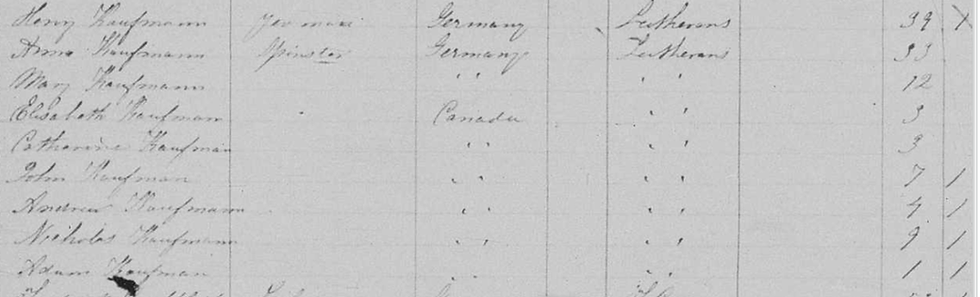
Sadly, I quickly realized is that Margaretha, the youngest child, born December 16, 1862, only knew her fathers touch for 35 days. Henry passed away January 21, 1863, at the age of 41 years, 2 months and 14 days. Leaving behind a postpartum widow, holding a newborn, with 4 children under 5. His family was now truly "of" this place, even if he began and then ended up a world away. It is the emotional facts that connect us, and these facts were collected from the Record of Deaths for the Trinity Evangelical Lutheran Church, Heinrich’s position on this list is #78.
This story for some reason moved me, was it the thought of a young family having their father taken from them, a young mother forced to face a foreign world they now called home alone, or the children that would grow up having no memories of the man who’s name they carry. Well, then I sunk deeper as I recalled that this stone had two names when we began, and the next was Henrys’ son Nicolaus.
Nicolaus Kaufmann, born November 21,1851, and departed June 4, 1875. Nicolaus is listed as #183 on the Record of Deaths at the Trinity Lutheran Church. This record is typically kept by the church, and the details are determined by the record keepers. I have seen some records extremely detailed, containing family trees and causes of death references. Others offer the bare minimum, the deaths on this page are like that, they are actually collected in a chart format, almost stripping away the personal touch and placing them in a scientific or mathematic space. This is most likely a new record keeper, reverend or pastor, here the personal details are quite minimal, except for next to Nicolaus’s name, there are two letters that say it all, those letters, TB.

In the mid-19th century, Tuberculosis or "Consumption" as it was often called, was the silent predator of the pioneer settlements. It earned the name the "White Plague" because of the pale, ghostly complexion of those it claimed. At a time when the "Germ Theory" of disease was only just beginning to be understood by the scientific community, the families in South Easthope would have looked upon TB with a mixture of terror and resignation.
For a young man like Nicolaus, 23 years old and in the prime of his working life, the diagnosis was a death sentence. There were no antibiotics, no sanatoriums, and very little understanding of how the bacteria spread through the air in the tight, wood-heated quarters of a farmhouse.
The tragedy of TB was its slow, relentless nature. For a farming family like the Kaufmanns, Nicolaus wasn't just a son; he was the future of the homestead. TB didn't take a life all at once; it stole it in pieces. It began with a persistent cough and a lingering fatigue that the family likely hoped was just the exhaustion of a hard harvest. But as the months went on, the "consumption" lived up to its name, consuming the muscles, the breath, and the vitality of a young man who should have been at his strongest.

The effect on the Kaufmann household would have been profound. In a community built on shared labor, losing a 23-year-old son meant more than just an empty chair at the table; it meant the loss of a pair of hands that were vital to the survival of the farm.
Moreover, because TB is highly contagious, the grief was often shadowed by fear. As they sat by Nicolaus’s bedside, Anna and his siblings would have been acutely aware that the very air they shared could bring the same fate to the next child. The "scientific" ledger at Trinity might have stripped away the personal touch, but those two letters, describing the Illness - TB, tell us that the spring of 1875 was a season of watching a son fade away while the world outside was in full bloom.

When we look at Stone 5, in Row 2, we see Nicolaus following his father, Heinrich, to this row just twelve years later. Henry died in the heart of winter, but Nicolaus died in June, the time of year when a young man should have been out in the sun, working the very soil that would, far too soon, be opened to receive him.
Here in Section A, their shared marker becomes more than a label; it becomes a visible link between generations. But the stone doesn’t argue about boundaries; it just stands, steadily, asking to be read while it still can be. Time will keep softening the lettering, season after season, unless someone intervenes, keeping family threads like Heinrich’s and Nicolaus’s from fraying into silence. That’s why we are here, for the Kaufmanns’ and the names that are still hidden below the lichen.
Christina Wilker (1850–1863) Section A, Row 2, Stone 6

Christina Wilker (1850–1863), is one of those names and her name lands differently than the others in this row. At just thirteen years of age, we recognize this is not a lifetime, it is a season that barely had time to turn. The record that survives her tells us she was born March 4th, 1850, and died on May 14, 1863, her age carved in numbers that feel too small to be real.
Her stone is simple, yet beautiful in a way that I’m sure when selected spoke to her mother in a way only grief could. There are few details adorning the front and the records provide an echo of what was already known. But, the lack of details do not reduce the importance of a life, in fact, sometimes the shortest sentence has the biggest impact. The loss of Christina feels huge to me, as I’m sure if felt to her family and community.
From a family’s memory and in the way this place tells its own story, Christina was a Wilker in the truest “founding family” sense: the daughter of Jacob and Anna Kunigunde (Rausch) Wilker. The Wilker name appears early and often because the Wilkers were not simply present; they were positioned at the heart of the beginnings. The first church stood on the Wilker clearing, a humble log structure that served as both school and sanctuary, raised from the same bush the settlers were still trying to tame. So, when we speak Christina’s name, we aren’t only naming a child; we are naming a household that would have known the sound of hymns in a rough-hewn room, the scheduled walk to worship, and the particular fellowship that forms when neighbours are few and everyone is needed.

Here in Section A, Row 2, Stone 6, Christina rests among the earliest rows; close to the families who shaped the first decades of this congregation, and close enough to remind us that the story of a settlement is not only told through pioneers and patriarchs. It is also told through children; through the small shoes that stopped appearing at the doorway, the empty place at the table, the grief that had to be carried quietly because there were still chores to do and younger siblings to tend. In a time when illness could move through a household without warning, a child’s death was heartbreakingly common; but never ordinary. Her stone stands as proof that she was here, that she belonged to this place, and that she is still worth the pause it takes to read her name.
John Weicker (1847–1865) Section A, Row 2, Stone 7

The final stone in this row belongs to John Weicker (1847–1865), and his dates sit on the page like a door that barely had time to open. The record that survives him tells us he was born January 12, 1847, in South Easthope Township, Perth County, and died March 8, 1865, still only eighteen. He is buried here at Trinity Evangelical Lutheran Cemetery, in Section A, Row 2, stone 7; a simple coordinate that leads you straight to a life that ended before it had the chance to stretch into its own story.
The Record of Deaths, only provides a sentence for such a short life. No cause of death is listed the only mention is his parents and that he was 18 years, 2 months and 21 days old. With very little, this is where the cemetery begins to do what good cemeteries always do; link one stone to another until a whole family stands up in your mind. A memorial for Catharina Zinkann Weicker (1821–1908) lists John among her children, naming his parents as Johannes “John” Weicker (1816–1890) and Catharina Zinkann, proof that John’s brief life belonged to a much larger household story than his single marker can hold.
Even more quietly, the records fold John back into the very first row of this series. A memorial for Johannes Weicker (1816–1890) identifies him as the son of Johannes Weicker (1776–1857) and Anna Elizabeth Bork (1785–1862); the same pioneer pair whose weathered stones anchored Row 1. That makes John, in the plain language of family, their grandson: one of the next branches meant to carry their story forward, cut short before it could fully grow.
By 1865, this was no longer the raw first decade of settlement, but it was still a world that asked much and promised little. Young men stepped early into adult work; clearing, planting, hauling, building, because there were always fences to mend and fields to bring under control. And yet, the Weicker name had already become familiar here, threaded through the earliest church life and the practical records that communities leave behind when they’re busy surviving. John’s stone stands for the private grief behind the public work: the kind of loss that doesn’t make a headline but changes a household forever.
If the second row is a chapter, then John is its closing line; proof that this ground holds not only the elders who carried memory across an ocean, but also the sons and daughters who were meant to carry it forward. Standing at the end of Row 2, you can feel how quickly a community had to learn both celebration and burial, sometimes in the same season. The stones are close together, the years even closer, and the silence between them feels earned.

Whether these individuals were buried here originally or reinterred when the cemetery was formally established remains uncertain. What is certain is that these stones, fragile as they are, carry the weight of beginnings. They hold the names of people who crossed oceans, felled trees, raised children, spread roots, and prayed in borrowed spaces long before permanence arrived.
As we walk among the stones of the second row, we are not simply reading names. We are acknowledging the second chapter of this place; the families who followed the first settlers, who strengthened the congregation, who carried traditions forward, and who now rest in the soil they once worked. Cleaning these stones is not merely a task; it is an act of remembrance. An act of gratitude. A way of ensuring that their names continue to be spoken, tended, and carried forward into the future.
And as this row closes; with John at its end, the work in my hands starts to feel like more than cleaning. It becomes a kind of listening: to names that have been quiet for too long, to families stitched into this soil, to a community that once gathered with lantern light and stubborn hope. Each pass of the brush is small, almost ordinary, but the result never is. A legible name changes how you stand in a cemetery, it turns an “old stone” into a neighbour, and dates into a life.
In Chapter 5: The Stones That Do Not Stand, we step away from the markers that still rise on their own and turn toward the ones that couldn’t; stones broken, fallen, sunk, or gathered into safekeeping, where the story becomes not only who is remembered, but how a community fights to remember at all.
And with the light fading and our hands already aching in that satisfying way, we left the remaining stones for another visit. The next stone and beyond would have their turn; names still waiting under moss and lichen, stories still tucked into the each row, until we could return and coax the next introductions into the open, until another day.


Comments