
Chapter 5: Shadows on the Hill - Row 3 (Stones 1 - 7)
Climbing the gentle rise into Row 3, the landscape of St. James Anglican Churchyard shifts into a quieter, deeply poignant territory. Positioned on the elevated slope beneath the high pine canopy, this first half of Row 3 is defined by profound generational sorrow; young lives cut short in their prime, young mothers called home early, and the quiet endurance of elderly pioneers who crossed ocean and forest only to bury their children here. From heartbreaking Victorian youth losses to Devonshire roots and enduring family lines, these first seven stones in Row 3 ask us to pause, reflect, and listen to the quiet echoes on the hill.
As we begin this row, we find three identical stones, all belonging to the Crackel family. We had discussed the Crackel family previous as we spoke of John Crackel, his first wife, Marie Spicer (1803-1859) and his second wife Phemia Schlegal (1833-1913) all sharing a place in the second row beneath stone 6. The stones that follow are two of their sons and a daughter-in-law.
Row 3, Stone 1: Frederick Crackel (1875–1891)

Inscription: Frederick / CRACKEL / died / Dec. 6, 1891 / aged 15 yrs / 11 mos 15 dys

Standing at the top of the rise, Stone 1 opens Row 3 with a devastating Victorian tragedy. Frederick Crackel was born on December 20, 1875, the son of John Crackel and Phemia Schlegal/McDonald. Tracing his origins initially presented a confusing puzzle: while some modern trees and indexers list his mother’s surname as McDonald, his official civil birth registration clearly records her name as Schlegal. While interchanging first and middle names is common in late-19th-century research, swapping entirely different surnames usually signals a deeper mystery. The intrigue drew me in, but turning to a compiled Crackel family tree only deepened the confusion, the chart listed line after line of descendants, yet Frederick was omitted entirely. Was he truly a son of this family, or had the records led us down a false path?
As is so often the case in cemetery research, the primary documents and the stone itself worked together to solve the mystery. Tracing Frederick through the archives reveals a classic, poignant story of rural youth.

We find him first in the 1881 census as a five-year-old boy growing up in Wilmot Township, surrounded by the familiar rhythms of his family’s farm. By the spring of 1891, at fifteen years of age, Frederick was beginning to step into adulthood. On the 1891 census, he appears with a curious designation: he is listed not in his parents' home, but as a "lodger" on a neighboring property. Far from implying he wasn't a direct descendant, this was simply standard census terminology for young teenage boys taking on their first jobs as hired hands, earning their keep, board, and independence while learning the trade on local farms.
This brief period of working away from home makes his omission from compiled family trees all the more understandable, yet all the more heartbreaking. Family flowcharts frequently trace only the adult lines that survived, married, and migrated into Michigan and beyond, leaving young Frederick off the printed page entirely.

Yet the discovery of Frederick’s death ledger in Wayne County, Michigan, reveals the tragic final chapter of his short life and explains his absence from the township. On December 6, 1891, just two weeks shy of his sixteenth birthday, "Fred Crackell" passed away at Harper Hospital in Detroit. Originally established in 1863 to care for wounded Civil War soldiers, Harper Hospital had expanded by the 1880s into a premier regional medical center renowned for its advanced surgical theaters and emergency care. The ledger entry records his occupation as working in the lumber trade, a common draw for energetic young men moving along the rail lines into Michigan’s booming timber industry.

Most significantly, the county record provides the exact cause of his sudden hospitalization and death: Diphtheria.

In the late 19th century, diphtheria; often termed the "strangling angel", was a fearsome, highly contagious bacterial infection that caused severe airway blockage, high fever, and rapid systemic collapse. Before antitoxins became widely available later in the 1890s, a severe case carried a devastatingly high mortality rate. His admission to a major urban hospital like Harper underscores the desperate effort by doctors to keep his airway open and save his life.
Knowing that Frederick died of such a virulent illness adds a deeply moving layer to his story. Despite the fear of contagion and the complex logistics of international transport in mid-winter, his grieving family ensured their young son was safely prepared, brought back across the border by train, and returned home to Wilmot. Erecting a clean, marble tablet that matches the surrounding family plots at the head of Row 3, they placed him to rest beneath the quiet pines of St. James. Standing as a silent sentinel under the sanctuary trees, Frederick’s stone captures a poignant moment in pioneer history; reminding us how heart breaking and uncertain this life was. That records are not perfect, that links can be lost and memories are never perfect.
Yet the soil and the stone at St. James hold the truth, the unbroken record and family connection. Frederick’s sudden passing left an irreplaceable void in the Crackel household. Some might think it hurt so badly, they chose never to speak of it again, perhaps this is how he fell from the record.
Row 3, Stone 2: Donald Crackel (1861–1888)
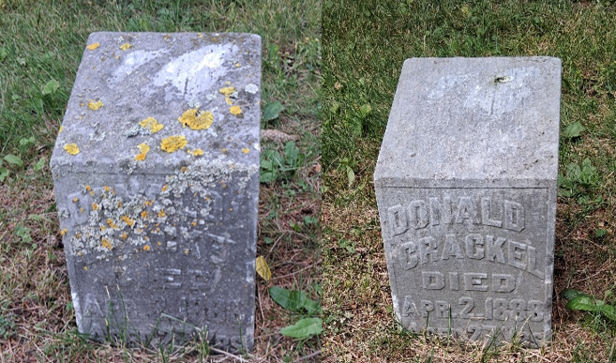
Inscription: Donald / CRACKEL / died / Apr. 2, 1888 / aged 27 yrs / 1 mo. 6 days
Just steps away from Frederick stands the monument for Donald Crackel, born February 27, 1861. As an older brother to young Frederick, Donald grew up learning the rhythms of farm work in Wilmot Township. The 1881 census shows him as a twenty-year-old coming of age on the family homestead, full of ambition. Yet, Donald’s path soon took a dramatic turn away from rural Ontario, leading to a life story that the stone alone does not reveal.

Joining the wave of energetic young men from Waterloo and Perth counties who crossed the border into Michigan's booming urban centers, Donald relocated to Detroit. It was there that he built a life with his young love, Ellen M. Tait. On November 1, 1884, Donald and Ellen were married in Detroit by Pastor Z. Grenell, with the civil register recording both as Canadian-born residents living in the city. Rather than tilling soil, Donald found work as a "car driver"; an operator on Detroit's bustling horse-drawn streetcars and transit lines.

The promise of their new life took firm root the following spring when they welcomed a son, John Crackel, born in Detroit on June 13, 1885. But their American dream was tragically short-lived. On October 2, 1886, Ellen passed away at just twenty-six years of age. Left with a sixteen-month-old infant, Donald made the heartbreaking decision to bring his young bride back across the border, laying her to rest in the Crackel family plot at St. James.
Carrying the quiet weight of grief while raising his small son, Donald’s own strength gave way less than two years later. On April 2, 1888, during the cold spring thaw, Donald passed away at just twenty-seven years of age. Whether taken by acute respiratory illness or worn down by heartbreak, he was laid to rest beside Ellen, leaving little John in the loving care of his grandparents, John Sr. and Phemia. In the span of just three years, the elder Crackels were forced to bury a young daughter-in-law and two sons, leaving behind a legacy of profound grief carved into Wilmot soil. Ellen’s stone is to follow.
Row 3, Stone 3: Ellen M. Tait Crackel (1860–1886)
Inscription: Ellen TAIT / wife of / Donald CRACKEL / died / Oct. 2, 1886 / aged 26 yrs

Stone 3 holds the key to the deep sorrow surrounding Donald Crackel. Here lies his young wife, Ellen M. Tait, who passed away on October 2, 1886, at just twenty-six years of age.
Passing away a mere eighteen months before her husband, Ellen’s early death represents a classic late-19th-century tragedy. In an era before modern antibiotics and surgical intervention, young mothers faced perilous health risks; ranging from delayed post-partum complications following the birth of her son John to aggressive seasonal infections like consumption or typhoid fever.
While her exact cause of death remains unrecorded, the emotional weight of her loss echoes across the row. Donald was left to mourn his young bride through two bleak winter seasons before rejoining her beneath the sod. Clearing the heavy lichen and weathering from Ellen’s marker brings back into focus a young mother and bride whose journey was cut heartbreakingly short, restoring her place beside her husband in the quiet sanctuary of Row 3.
Row 3, Stone 4: Sarah (Woodhead) Cameron (1841–1866)

Inscription: Sacred / to / the memory of / Sarah / beloved wife of / Charles CAMERON / and only dau'r of / Charles & Mary WOODHEAD / who departed this life / Sept. 13, 1866 / AE 24 yrs 11 mo's & 18 d's / [verse]
Stone 4 carries a deeply emotional tribute that bridges two prominent pioneer families. Sarah Woodhead, the cherished "only daughter" of Charles and Mary Woodhead, was just twenty-four years old when she passed away on September 13, 1866, just days short of her twenty-fifth birthday.
Born September 26th, 1841. Sarah joined the family and was christened January 9th, 1842, in Holmfirth, England. Her father Charles was recorded as being a Woollen Mule Spinner, a true artisan on the industrial factory floor, bridging the gap between raw natural fleece and refined textile manufacturing.

Operating the massive, moving carriage of the spinning mule, the spinner walked miles a day back and forth, using a keen eye and incredible manual dexterity to draw, twist, and wind hundreds of strands of fragile wool yarn simultaneously without snapping the threads. Because wool fibers were unpredictable and varied in length, this was high-skill work that required years of apprenticeship to master, making spinners the respected, well-paid "aristocrats" of the mill. Managing a small crew of young assistants who swept up oil-soaked wool dust and helped tie broken ends, the spinner worked 10-to-12-hour days in a clattering environment filled with airborne fiber and exposed iron gears. It was demanding, hazardous, and intensely specialized labor; a trade where a worker's practiced touch directly determined the quality of the cloth bound for local markets and distant shores.
Records indicate that Sarah and her family resided there until at least 1851, as the family still appears on the England and Wales census from that year. Between this time and 1865 the family immigrated to Canada, where Sarah would meet Charles Cameron. They were married July 26th, 1865.

Sadly, they would celebrate their one-year anniversary, but no more. Sarah would pass away on September 13th, 1866. Perhaps complications from childbirth, possibly an infection or virus, the cause is unknown.
What we are certain of is that she left behind her grieving husband, Charles Cameron, and her heartbroken parents. The explicit inclusion of her status as an only daughter on the marble face speaks volumes about the immense love and agonizing grief felt by her family as they carved her memory into stone during the late summer of 1866. Charles and Mary listed no other children, and we can only assume Sarah was their entire world.
Row 3, Stone 5: James (1799-1888) & Elizabeth H. Crook Mallett (1805-1865)

James MALLETT/ died Feb. 14, 1888/ aged/ 89 yrs. 11 mos/ his wife/ Elizabeth H/ died/ Nov. 13, 1864/ aged/ 59 y'rs 8 mo's/ Natives of Devonshire/ England/ MALLETT/
Standing in strong contrast to the surrounding young losses, Stone 5 honors two elder pioneers who lived through the vast transformation of Wilmot Township. James Mallett and his wife, Elizabeth H. Crook, are proudly carved as “Natives of Devonshire, England,” linking them directly to the same West Country migration wave that brought so many early families across the Atlantic to Waterloo and Perth counties.

James Frederick Mallett was born on March 15, 1799, on a farm named Birchill in the parish of Langtree, Devonshire. He was the fifth son born to Humphrey and Catherine (Balson) Mallett. A short distance away in Pilton, near Barnstaple, where Elizabeth H. Crook was born in 1805. Finding Elizabeth’s exact lineage takes a bit of digging, as her marriage record lists William Chapple taking the oath alongside her rather than a father named Crook, a clear indication that Chapple was acting as her legal guardian following her father’s passing. That along with the notation in the marriage record shown here.

James and Elizabeth were married in Pilton in 1824, surrounded by family and friends. They began their married life in Devonshire, where the christening records of their first children reveal James’s trades before they left England. On their firstborn son Frederick’s (1826–?) record, James’s occupation is listed as Schoolmaster, pointing to a strong education and a respected standing in the community. By the time their next children arrived, James Frederick (1828–1909) and Eliza Ann (1830–1920), his occupation on the parish register had shifted to joiner, a skilled bench carpenter specializing in precise woodwork.

By 1834, James, Elizabeth, and their young family had crossed the Atlantic and settled in Wilmot Township, joining the early wave of homesteaders entering the bush to clear the land. Their household grew into a busy one as the country awakened around them, with primary census and parish records documenting at least eight children in total, three sons and five daughters.
Elizabeth passed away on November 13, 1864, at fifty-nine years of age, while the American Civil War was drawing toward its final winter across the border. James, pictured here at the age of 70, survived his wife by nearly a quarter of a century. He lived to the remarkable age of eighty-nine years and eleven months before passing away on Valentine's Day in 1888. Spanning almost the entire 19th century, James’s long life bridged the gap between Old World England and the modernizing rural communities of pioneer Ontario.
Row 3, Stone 6: Annie Maria Walker Veitch (1862-1955)
Inscription: VEITCH / Annie Maria VEITCH / 1862–1955 / Annie M. WALKER / wife of George VEITCH

Stone 6 brings us right into the mid-20th century while anchoring the domestic line of the Veitch family. It commemorates Annie Maria Walker, wife of George Veitch. Born during the American Civil War era, Annie lived through both World Wars and saw the world transform completely before passing away in 1955 at ninety-three years of age. This granite monument stands as a quiet testament to longevity, female endurance, and the steady continuation of family roots across nearly a century of Wilmot history.
Annie’s story begins in the early 1860s, with census and vital records slightly conflicting on her birth year between 1861 and 1863, as she grew up in the bustling household of Thomas Walker and Maria (Illingworth) Walker, the middle child among at least eight siblings.
On June 9, 1886, Annie was married in St. James Anglican Church to George Malcolm Veitch (1858–1930) of nearby Haysville. At the time of their wedding, twenty-nine-year-old George was working as a merchant, while twenty-three-year-old Annie prepared to start a new chapter.
Motherhood came quickly for Annie. The following year saw the arrival of their firstborn son, George Walker, 1887, followed by Vera Walker in 1888, and Ina Walker in 1889. By the 1890s, while residing in North York, the family continued to grow with the arrival of twin daughters, Jessie and Marie, born on November 11, 1894, and later their youngest son, Ross.
In a fascinating genealogical twist, every single child in this family was given the middle name "Walker", a unique detail that initially looks like a series of maiden names on later records, but was actually a deliberate, loving effort to honor Annie’s ancestral line across every generation.
Life would test Annie’s strength through severe family loss. Her twenty-year-old daughter Vera passed away in 1907, and by the time George Malcolm Veitch passed away on June 8, 1930, at seventy-two years of age, Annie was left to face the next quarter-century independently. George's obituary noted four surviving children scattered across Ontario and the states: Marie (Mrs. Stephenson) in Detroit, Jessie (Mrs. Young) in Toronto, Ina in Cleveland, and Ross in Preston. Ross would later pass in 1943, and Ina in 1947, leaving Annie to carry the weight of outliving several of her own adult children.
When Annie finally passed away in 1955 at ninety-two years of age, she was returned to the quiet sanctuary of St. James. Laid to rest under the pines beside her young daughter Vera, mother and daughter were reunited at last beneath the Wilmot soil.
Row 3, Stone 7: Vera Walker Veitch (1888–1909)
VEITCH/ Vera W/ dau. of/ Geo. & Annie/ VEITCH/ died Mar. 12, 1909/ Aged 20 yrs/ 3 mos. 5 dys/ Gone but not forgotten/
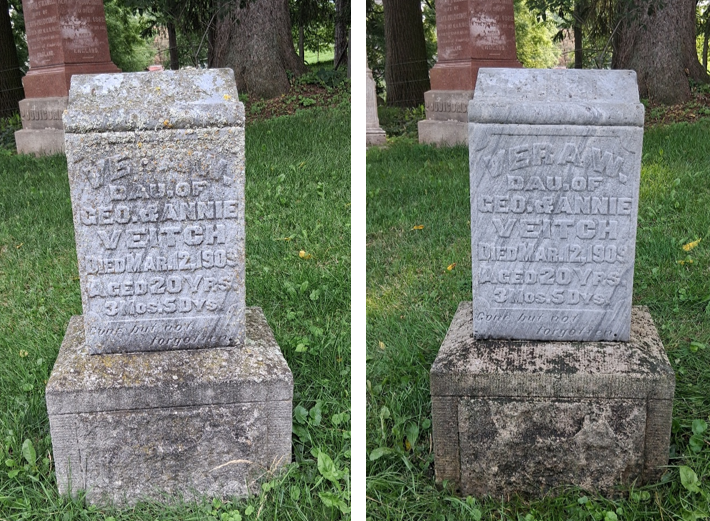
Closing out this section of Row 3 is the touching marker for Vera Walker Veitch, the second-born child and eldest daughter of George and Annie Veitch. Passing away on March 12, 1909, at just twenty years of age, Vera’s loss occurred right as the Edwardian era was drawing toward its close, shattering the quiet routine of a family that had built such strong roots in Wilmot Township.
Never married and without children of her own, Vera’s life was cut short right on the threshold of young womanhood. While her official cause of death goes unrecorded in local registers, the timing points to the common hazards of the era; most likely a sudden, aggressive viral infection like influenza, or a swift bacterial illness such as diphtheria or pneumonia that so frequently swept through rural communities before modern medicine could intervene.
A preserved funeral card saved by the family captures the stark, immediate sorrow of her passing down to the very minute. It records that Vera died at 5:00 a.m. on a Friday morning, carefully calculating her brief life down to the exact metric carved onto her monument: 20 years, 3 months, and 5 days. The card notes that her service was held at the home of her father on the following Monday, before the procession made its way to St. James.
Her heart-stricken parents carved the timeless promise "Gone but not forgotten" across the face of her stone. Resting elevated on the slope, Vera’s monument completes a poignant stretch of Row 3 where so many vibrant young lives were surrendered to the soil, a quiet spot under the pines where she waited forty-six long years for her mother to finally come lie beside her.
Pausing here at Stone 7, the first half of Row 3 leaves a profound impression on anyone who walks these grounds. From the tragic losses of teenagers Frederick Crackel and Vera Veitch to the double grief of Donald and Ellen Crackel, this hill holds some of the churchyard's most tender human stories. Yet, rooted right beside them are the long, resilient lives of Devonshire natives James and Elizabeth Mallett, illustrating the stark range of pioneer life; where extreme fragility and incredible longevity rested side-by-side under the same trees.
Our journey through Row 3 is only half complete. In the next chapter, we will step past Vera’s monument to cover the remaining seven stones of Row 3, where we will uncover further family connections, restore forgotten inscriptions, and continue bringing Wilmot's pioneer voices back into the clear light of day.


Comments