
Chapter 5: The Stones That Do Not Stand
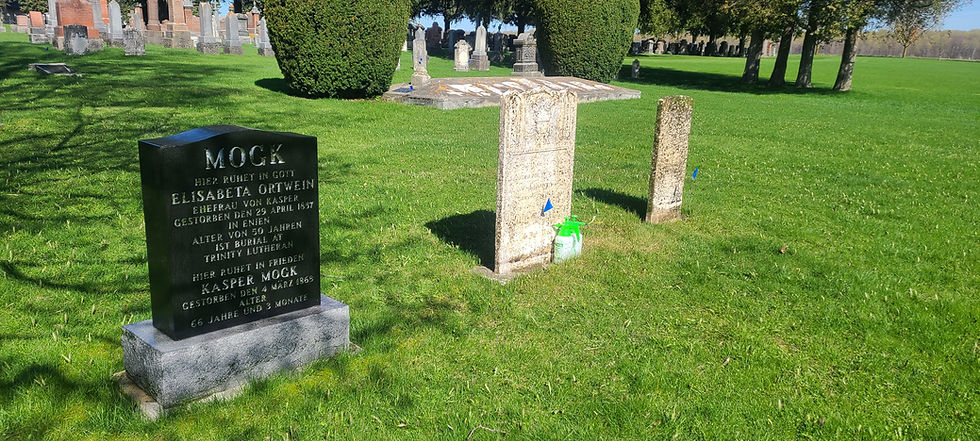
There is a certain kind of silence you only find in the spaces between stones. Not the hush of a Sunday morning, or the quiet after a service ends, but the pause that comes when you stand before an empty position in a row and realize that someone is still there; only their name is not. This chapter is the first in this series for those places: the unmarked graves, the fallen markers, the stones that have softened into the earth until they no longer stand above it.
Sometimes a marker is missing because time did what time always does. Frost heaved it. Roots shifted it. A mower caught an edge. A soft limestone face surrendered letter by letter until nothing readable remained. Sometimes the absence is older than that, because a wooden cross finally returned to the soil, or because a family intended to place a proper stone “when things settled,” and then life kept happening and the years ran away. And sometimes, with the very best intentions, a stone was never carved at all: a name held in the memory of a household, spoken at the table, and carried until the last person who remembered it also passed on.

At Trinity, that absence may reach back even further, back to the first church, when the congregation was still gathering in a rough-hewn space and the idea of “the cemetery” had not yet taken its present shape. It is entirely possible that some of the earliest burials happened close to that original structure or even in the backyards of their homesteads, in the practical way pioneers did things: near worship, near home, near the place where grief could be shared without a long walk. Later, when the brick church rose and the grounds settled into the rows we know today, families may have brought markers here, gathered fragments, or re‑set stones with care; trying, in their own generation, to keep the founders from being forgotten. We cannot always prove the exact path a stone took to get here, but we can honour the intention behind it.
In this chapter, we will look at what remains and what does not. We will pause at the empty spaces and treat them as part of the record, not an inconvenience. We will talk about stones that have fallen, stones gathered into safekeeping, and graves that were never given a lasting marker. Because preservation is not only about what we can lift and clean. It is also about noticing what is missing, listening for the stories that survive in ledgers, in family papers, and in the way a community still points and says, “Someone is here.” This is the heart of Eternal Care Stone Services’ work; to research, restore, and record. To give the absent, a mention, a place in the story, too.
So, when the stones cannot speak, we turn to the ink. Some of these names survive in the Trinity Evangelical Lutheran Congregation of South Easthope, County of Perth, Canada West in the Records of Death, where the entries begin in 1846. It is a plain, steady kind of record‑keeping of dates, ages, a minister’s name, sometimes a short description of illness. But in a chapter about what does not stand, those lines become their own kind of monument. The quiet proof that a life was seen, a loss was witnessed, and a child was carried to rest with prayers said aloud.
One gentle complication belongs in the open: confirming exactly where these earliest burials took place; on today’s cemetery grounds, at the original churchyard, or somewhere nearby. This is not always possible from a single line in a register. Occasionally, the records are wonderfully specific and tell us a different resting place altogether; for example, Elizzabeth Rothaermel is noted as buried at New Hamburg. For this chapter, I’m choosing to focus on the names we believe most strongly are interred here under Trinity’s care, even if their stones no longer stand; because sometimes the most honest map we have is a blend of ink, memory, and the ground that has been tended by the same congregation for generations.
Jacob Weber (c. 1841–1846)
One of the names we carry into this chapter is Jacob Weber, a little boy remembered not by a standing stone, but by a date and the ache behind it. Jacob died on April 9, 1846, only five years old. In the Records of Death, he is also lovingly accounted for in the church’s own handwriting: buried April 19, 1846, the service conducted by Pastor Pfeiffer, with the illness recorded as “stomach fever.”

Those old illness words can sound unfamiliar now, but they mattered to the families who heard them. “Stomach fever” shows up in nineteenth‑century records as a broad description for a dangerous fever with stomach and bowel symptoms; often what later generations would call enteric or typhoid fever, though record‑keepers weren’t working with today’s lab tests or precise language. What it tells us, simply, is that Jacob likely grew sick quickly and seriously, in a time before antibiotics, before IV fluids, before the small mercies we now expect as ordinary.
Adam Becker (1841–1846)
Not far from Jacob in the book of deaths is another small name: Adam Becker. He died on September 16, 1846; the son of Adam Becker, aged five years and seven days. The record notes that he was buried September 23, 1846, and that the burial was conducted by Pastor Pfeiffer. His cause is written down in the plain language of the time as “bad throat.” In a settlement that was still learning how to be a community, you can almost picture it: neighbours stepping in, the hush of a household, the walk to the resting place, and then the world insisting, immediately, on continuing.

“Bad throat” isn’t a diagnosis we’d see written that way now, but it points us toward the hard realities of childhood sickness in the 1840s. In old records, throat illnesses could mean severe tonsillitis or strep infections, croup, scarlet fever complications, or most frighteningly, diphtheria. This disease can form a thick membrane in the throat and make breathing impossible. We cannot name Adam’s illness with certainty from two words, but we can understand the kind of fear those words carried: a child struggling to swallow, to breathe, to rest, while a family did everything they could with the tools of that time.
Unbaptized son of Heinrich Schaefer & Katherine (Buettner) Schaefer (d. 1846)
The next entry in the Record of Deaths stops you for a different reason, because it holds a child with no given name to meet us. He is recorded only as the unbaptized son of Heinrich Schaefer and his wife Katherine, née Buettner. He died on September 23, 1846, exactly 3 years old. 3 years, 0 months, 0 days and he was buried the very next day, September 24, 1846, by Pastor Pfeiffer. Three years of age and no name to record, so we look to what we know. Even without a stone, even without a first name, the record proves someone carried him, someone stood with his parents, and someone made sure his short life was written down.

There is tenderness tucked into the way the entry is written. It names his parents, and it keeps his mother’s own identity intact (Buettner), as if the congregation understood that women, too, deserve to be traceable in the future, not only as someone’s wife, but as themselves. And the surname Schaefer is one we already know from Trinity’s earliest story: woven through the founding families, present in the first gatherings, part of the backbone of this settlement. So, this small, unnamed child belongs not only to one household, but to the wider beginning, one more reminder that the bush years were built on equal parts hope and heartbreak.
His illness is recorded as stomach cramps. In the language of the nineteenth century, that phrase could point to many of the illnesses that moved quickly through pioneer homes: severe colic, intestinal infection, dysentery, or what older documents sometimes called cholera morbus, a frightening combination of vomiting, diarrhea, and abdominal cramping. We cannot translate one short phrase into a single modern diagnosis with certainty, but we can understand what it meant in practice: pain that could not be explained away, a child becoming weak too fast, and parents with little to offer beyond comfort, prayers, and whatever remedies their neighbours knew.
Heinrich Stuebing (d. 1847)
The next name in the record turns from sickness to sudden accident: Heinrich Stuebing, son of Adam Stuebing and his wife Anna Maria Rausch. He was killed on February 26, 1847, struck down by something as ordinary and unstoppable as a falling tree, at the age of 40. The entry tells us he was buried the following day, February 27, 1847, by Pastor Pfeiffer. In an era before modern chemical embalming became standard practice, a rapid burial was both a practical necessity and a final act of care, especially in the dead of winter. Without means to preserve the body, the timeline of grief was dictated by nature itself. It was a burial so close to the loss that you can almost feel the winter air still clinging to coats and cuffs as neighbours gathered to do what a community must do when there is no time to be ready.

In these early years, trees were both enemy and livelihood. They were the wall that had to be pushed back before a field could breathe, the fuel that warmed a house, the beams that made a barn possible, the very material of “church” before brick and stained glass ever came. But felling timber was never gentle work. One wrong cut, one hidden lean, one gust, and the thing you were trying to tame could turn on you in an instant. Heinrich’s death reads like a single line in a ledger, yet it represents the daily risk that sat behind every cleared acre in South Easthope and East Zorra, work done not for sport or pride, but because families needed land, and land demanded trees to fall first.
The record also gives us what matters most after the shock, he left behind a wife and two children, Christiana and Maria. Those names, brief as they are, open a whole room of unseen life: a household suddenly changed, little hands still reaching for a father who would not come back from the bush, and a mother who had to keep going in a world that did not pause for grief. If Heinrich has no standing stone for us to find today, this line in the church book becomes part of his marker, too. The proof that he belonged here, that he was loved here, and that his absence had a name.
Johann Conrad Kalbfleisch (d. 1847)
The next name in the record carries a familiar weight in this place: Johann Conrad Kalbfleisch, the son of Johakam Kalbfleisch and Katherine, née Weitzel. He died on September 13, 1847, and he was buried on September 15 by Pastor Pfeiffer. What makes his entry feel especially tender is the timing; this death comes before any of the standing stones we can point to today. In other words, Johann Conrad belongs to the years when grief was still being recorded more reliably in ink than in limestone.

The record also ties him to living threads that appear again and again, in Trinity’s story: a brother, George Kalbfleisch, and a sister, Maria Rothar. Even in a single line, you can see how families braided together here, Kalbfleisch and Weitzel, then Rothar, names that reappear in pews, in baptisms, in marriages, and eventually on stones. It is the quiet geography of pioneer life: people settling near one another, worshipping together, and becoming kin over time until the cemetery reads like a map of relationships as much as a map of ground.
Whether Johann Conrad rests within today’s Trinity yard or nearer the earliest church clearing, the honest truth is that we cannot always prove it from the surviving evidence. But we can say this: he was buried within the care of this congregation, and his name has not been lost. In a chapter devoted to stones that do not stand, that matters. It means we can still research, still record, still speak him back into the story, even when the ground keeps its secrets.
Christian Heirock (d. 1847)
Just a few weeks after Johann Conrad, the record gives us another name that belongs to the bush years, when life was measured by seasons and labour and the steady turning of the church calendar. Christian Heirock died on October 5, 1847, aged 55 years, and he was buried on October 7, 1847, again by Pastor Pfeiffer. Even in its plainness, the entry carries a familiar rhythm now: a date, a burial, and the quiet certainty that the congregation gathered to do the last kind thing they could do.

Christian is named as the son of Nickolas Heirock and Maria, née Fuchs, and that maiden name matters, one more thread preserved in ink, waiting for a descendant to recognize it. The record tells us, too, what his death left behind: a wife, Margaretha, and eight children, five sons and three daughters. You can feel the weight of that number without ever seeing a farm ledger; mouths to feed, chores that don’t stop, and a household suddenly missing the person who had been at the centre of its everyday decisions. In a community built on cooperation, those are the moments when neighbours become lifelines.
Whether Christian’s resting place is marked by a stone that has since fallen, or whether it was never carved in the first place, the record keeps him from disappearing entirely. It gives us enough to picture a life, a son who became a husband, a father of many, a man who likely knew the feel of an axe handle and the long patience of clearing and planting. And now, in a chapter for the stones that do not stand, his name stands here. Held in the same place we are holding the others; between what the ground remembers and what we are determined not to forget.
We cannot point to a carved name in Section A and say, “Here he is,” because, especially in the 1840s, some burials happened before the cemetery took the orderly shape we see today. Memorials were often wood, fieldstone, or simply a place remembered by the family who stood there. A small cross can rot back into the earth. A hand‑gathered stone can sink until grass closes over it. A marker can fall, break, or be moved with care when the grounds changed. And sometimes, with the best intentions, a proper stone was meant to come later, after the next harvest, after the next season, until “later” became never.
So, for Jacob, for Adam, for Heinrich and Katherine’s little boy whose name was never written here, for Heinrich Stuebing, for Johann Conrad Kalbfleisch, and now for Christian Heirock; this page becomes part of the marker. We research what can be found, we record what is known, and we treat the absence itself as meaningful, because every unmarked grave still belongs to someone’s family story. This is why Eternal Care Stone Services exists: to keep names from vanishing twice; once from stone, and then again from memory.
And if this chapter feels heavier, it is only because absence asks more of us than stone does. A standing marker gives you a name to hold; an unmarked place asks you to hold the memory without it. Yet these empty positions are not empty at all, they are part of Trinity’s story, and part of the love that built this community in the first place. When we research, restore, and record, we are not only rescuing what can still be read, we are also acknowledging what has been lost, and making room for those who were buried with little more than grief and good intentions. In the next chapter, we come to the church’s answer to that loss: a place where fragments were gathered, names sheltered, and the earliest stones, too fragile to stand alone, were given support.
And here, for now, the ink pauses. Christian Heirock’s entry closes out this first run of deaths before the record shifts and time stretches forward into a new decade. The stories do not end, they simply wait. When we return in Chapter 6, we will open the book again with Leonard Neeb, the first death recorded in the 1850s, and follow the congregation as it grows, name by name, into a more settled, yet still fragile, world.


Comments