
Chapter 12: The Artists behind the Stone - The Monument Makers
As we work our way through the rows of Trinity Cemetery, brushing away decades of lichen and carefully lifting the veil of time from the old marble, our eyes are naturally drawn to the elegant German script and the deeply personal pioneer epitaphs. But if you pause and look closely at the very base of these historic stones, right where the marble meets the earth, you will often find a second story written in a quiet, unassuming script, the names of the men who actually carved these monuments: Gadsby & Sharman of Stratford, Scott of Galt, and local artisans from Tavistock. These are the signatures of the craftsmen; the monument makers who quite literally carved the history of each County into permanent record.

To trace these makers' marks is to understand that a cemetery is not just a place of quiet rest; it is an outdoor gallery of local craftsmanship and a reflection of a highly competitive nineteenth-century marketplace of grief. Choosing a headstone was one of the most significant financial investments a pioneer family would ever make. In the mid-to-late 1800s, families navigating the heartbreak of loss also had to navigate the practicalities of regional trade routes, the arrival of new railway lines, and the agonizing logistics of hauling hundreds of pounds of fragile, hand-carved stone over the deeply rutted mud roads of Southwestern Ontario.
The early markers standing in Trinity today tell a fascinating story of local commerce, artistry, and community service. By digging into historical directories, local archives, and leaning on a friend or two, we can pull back the curtain on the many stone yards and the men who held the chisels that shaped our local heritage.
Scott & Company

Before Stratford or Tavistock established their own stable, localized stone-cutting yards in the post-Confederation era, early South Easthope settlers had to look eastward toward older, established manufacturing centers to mark their dead. In those early days, James Scott’s Marble Works; operating as Scott & Company on Main Street in Galt (now Cambridge), was the premier destination for high-quality craftsmanship. The firm’s reputation was renowned across the province and you will find their stones everywhere.

Commissioning a stone from Scott & Company was not a simple transaction; it was a major logistical undertaking for a grieving family. When the Wilker family set out to mark the grave of thirty-three-year-old Christina in 1868, they would have had to travel by horse and wagon along the rough pathways of the old Huron Road or catch an early stagecoach to Galt just to order the piece.
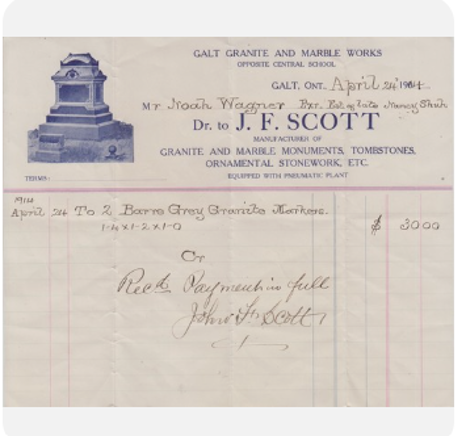
Here we see an actual invoice from Scott & Company, 1904, securing a Stone for a Nancy Shuh, of Kitchener or Berlin at the time. The estate executer, Noah Wagner, commissioned this stone for $30, the amount Paid in full. You can see at this time the business was operating as Galt Granite and Marble Works. Listing interesting details on the invoice, for example, the location “opposite central school”, his name listed as Dr. to J.F. Scott, and the mention that his plant is pneumatic. All very interesting.
After payment was made, the family faced the nerve-wracking task of transporting the heavy, fragile marble slab back across dozens of miles of deeply rutted dirt roads. Packed tightly in thick layers of straw to absorb the bumps and prevent the stone from cracking before it reached the Sebastopol churchyard, each successful delivery was a small miracle of pioneer determination.
Gadsby & Shaman - Stratford
By the late 1870s, families no longer had to look so far. Following the arrival of the Port Dover and Lake Huron Railway in 1875, Tavistock experienced a rapid economic boom, paving the way for localized stone yards to spring up on Woodstock Street directly on the border of Oxford and Perth counties. These hometown artisans operated on tighter margins than the massive city yards in Stratford, but they possessed a deep, personal connection to the close-knit rural community.

They frequently reached out to their neighbors through local circulars, placing confident advertisements that made a grieving family take notice.
The journey of our local monument makers began in earnest in the 1870s with James Gadsby and W. E. Sharman, the enterprising partners behind the Stratford Marble Works.
Originally operating on Downie near George Street, and later moving their yards to Market Street, Gadsby and Sharman were among the first prominent craftsmen to capture the regional market. As the Grand Trunk Railway turned Stratford into a bustling transportation hub, these partners gained a massive logistical advantage: they could import high-grade, pristine white marble directly from the famous quarries of Vermont.
They were highly regarded for their precision, employing incredibly skilled letter-cutters who could replicate the intricate German Fraktur script demanded by the congregations of Trinity and the surrounding pioneer churches. Because the English-speaking carvers in Stratford didn't always read German, families would bring exact paper transcripts directly from their family Bibles to ensure that a misplaced chisel stroke wouldn’t ruin an entire imported slab. Though their partnership eventually dissolved, James Gadsby’s passion for the craft endured, and he continued operating his independent yard on Downie Street well into the 1910s, leaving an indelible mark on our local landscape.
Their work on the markers of Henry Weicker, Anna Louisa Wagner and Heinrich Krantz highlights their dominance in the regional cemetery market during the mid-1870s.
Dierlamm & Sack - Stratford

By the turn of the twentieth century, a powerhouse creative partnership emerged at the corner of Wellington and St. Patrick Streets that would redefine local cemetery art: Dierlamm & Sack. This business was a beautiful marriage of fine art and grit. F. Sack was a master craftsman with thirty years of practical experience in granite and marble cutting, known for his ability to hand-carve highly detailed, original designs rather than relying on mechanical templates.
His partner, Peter Dierlamm, was a respected German-born portrait and landscape artist with a studio in Stratford’s Gordon Block. Dierlamm acted as the business manager, using his sharp artistic eye to ensure that every monument they produced was of unmatched quality in the province. Together, they imported rich granites directly from Scotland and Sweden alongside Vermont marble, promising families the very choicest memorials purchased direct from the quarries.


By 1904, the firm transitioned to Dierlamm & Mowat, continuing to offer competitive prices and artistic comfort to families wanting to mark the final resting places of their loved ones with beautiful, lasting tributes. Their monuments were artistic impressions of love and loss. The advertisement, located in the Stratford Herald, boast of the experience and expertise offered by the men. Along with the quality of the materials used.
As the decades marched on, the local stone-cutting landscape shifted from manual artistry to early industrial modernization.
Jones Monument Works

By 1909, the old Dierlamm & Mowat yard at 145 Wellington Street was taken over by R. J. G. Jones, eventually becoming the Jones Granite Co. on St. Patrick Street before relocating to 48 Huron Street in 1933 as Jones Monument Works. While the early pioneers of the craft relied entirely on hand mallets, iron chisels, and pure physical endurance, the mid-twentieth century brought rapid technological changes. Advertisements from the late 1940s proudly displayed their transition to the modern era, highlighting their state-of-the-art "Pangborn Carving and Lettering Machine" and noting that inscription work remained their absolute specialty.
Through pneumatics and sandblasting, the physical labor of monument carving changed, but the ultimate purpose remained exactly the same: carving a permanent, sacred testament of love, identity, and remembrance into the hardest stone.
Every time we clean a pioneer marker at Trinity and reveal a maker's mark at the ground line; whether it reads Gadsby & Sharman, Dierlamm & Mowat, or Jones, we are looking at a handshake across time. These subtle signatures remind us that preserving our local history is a deeply collaborative labor. It belongs to the families who grieved, the historians and genealogists who keep their stories alive, and the local craftsmen who held the chisel to make those memories immortal. The next time you stroll through Trinity Cemetery, look down at the very bottom of the stones; you might just spot the quiet signature of the artist who helped ensure our pioneers would never be forgotten.
The following is the Stratford Vernon directories of Monument makers over the years.


Comments